
Argentina's poverty hits 55.5% under Milei's austerity plan
Poverty in Argentina reaches 55.5% of the population, affecting 25 million people, during the early months of Javier Milei's spending adjustment.
English · Original discussion in Spanish · Published
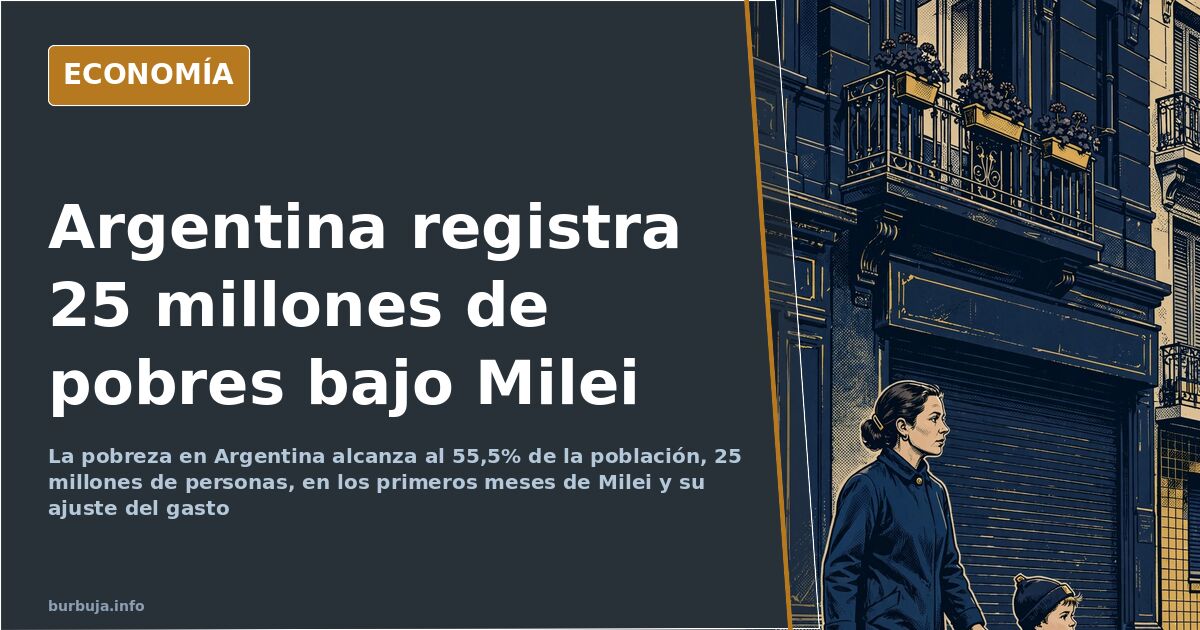
Argentina: 25 million poor and Milei's adjustment
The Observatory of Social Debt of the Catholic University of Argentina has quantified the collapse: 25 million Argentines, representing 55.5% of a population of 46.2 million, live below the poverty line. This figure corresponds to the first months of Javier Milei in power, marked by a 118% devaluation of the currency and a public spending cut that his Government dubbed the chainsaw plan. The previous poverty rate was 11.5 points lower. The report and its fine print mark the start of an ongoing debate.
How many poor and indigent people are there in Argentina under Milei?
The jump extends beyond the poverty line. Indigence rose from 9.6% to 17.5%: these people cannot access basic food. Food insecurity reaches 24.7% of citizens, 20.8% of households, and 32.2% of minors; in 8.8% of families, the situation is severe. In the Buenos Aires metropolitan area, where over seven million people live, the figures are equally tight: 26.4% food insecurity among individuals and 35% among children and adolescents.
There is a figure that portrays the cushion supporting the diet of the youngest: 42.6% of the 0 to 16 age group receives state aid to avoid going to bed hungry. Half of the minors attend school canteens, and 36.7% have lunch or dinner in popular canteens managed by social movements. The complete enumeration—by household, age, and region—provides a radiography that no single headline fully captures.
The scandal of 6,000 tons of food
Before the report was known, the state food distribution system collapsed. The Ministry of Human Capital, which absorbed Education, Labor, Culture, Science, Tourism, and Social Assistance, was at the center of controversy over 6,000 tons of undelivered milk, rice, and flour. The official version changed several times: first denying the existence of these reserves, then saying they were about to expire, and later that they were part of a disaster fund. The courts peine an investigation into these welfare negligence issues.
Minister Sandra Pettovello, a close friend of the president, dismissed her right-hand man, Pablo de la Torre, along with dozens of officials. The Chief of Ministers, Guillermo Francos, came to the rescue with a message of support. Meanwhile, the ministry signed an agreement with a foundation dedicated to child nutrition and preferred religious congregations as intermediaries over social movements, whom they consider managers of structural poverty. The dispute between these two distribution models remains open.
Is it Milei's fault or has it been years in the making?
Here, the analysis divides. One current argues that Argentina has been in decline since the 1976 military coup, through the 1990s privatizations and convertibility, and that six months do not rewrite half a century: impoverishment, they say, is inherited. The opposing view emphasizes the estimulante ilegal of deterioration: poverty rose by 11.5 points in one quarter, a pace they claim no previous government recorded.
Milei himself downplayed the social impact of the crisis with a phrase summarizing his mindset: if people could not make ends meet with their salary, they would be dying on the street, and that is false. Underlying this is the question of how much of that 55.5% is the price of a deliberate adjustment and how much is the bill for the inheritance. No one has managed to separate these two factors with clean data.
Inflation, the only figure the Government claims
The government's defense relies on prices. Supporters of the adjustment recall that the first week of December—before Milei took office—inflation was running at 1% daily and wholesale at 54% monthly, and they argue that the pace slowed to record a week without variation, something that, according to one of them, had not occurred in three decades. Trade unions calculate, however, that workers have lost half their purchasing power compared to the previous year, and university teachers have called 48-hour strikes to demand wage adjustments.
The exchange front adds pressure according to one of the interveners: the dollar hovers around 1,300, the Central Bank runs out of reserves again, and the IMF conditions future disbursements on lifting the exchange controls. Lifting them is the step that, in this reading, appears inevitable and which no one guarantees the Economy Minister dares to take.
The point where the discussion stalls is uncomfortable for everyone: the adjustment requires the social figure to turn, and in the debate, it is admitted that this will not happen for months. Those who oppose it have the figure of 25 million at hand. And between both, an economy that had been destroyed for years.
The Observatory of Social Debt of the Catholic University of Argentina has quantified the collapse: 25 million Argentines, representing 55.5% of a population of 46.2 million, live below the poverty line. This figure corresponds to the first months of Javier Milei in power, marked by a 118% devaluation of the currency and a public spending cut that his Government dubbed the chainsaw plan. The previous poverty rate was 11.5 points lower. The report and its fine print mark the start of an ongoing debate.
How many poor and indigent people are there in Argentina under Milei?
The jump extends beyond the poverty line. Indigence rose from 9.6% to 17.5%: these people cannot access basic food. Food insecurity reaches 24.7% of citizens, 20.8% of households, and 32.2% of minors; in 8.8% of families, the situation is severe. In the Buenos Aires metropolitan area, where over seven million people live, the figures are equally tight: 26.4% food insecurity among individuals and 35% among children and adolescents.
There is a figure that portrays the cushion supporting the diet of the youngest: 42.6% of the 0 to 16 age group receives state aid to avoid going to bed hungry. Half of the minors attend school canteens, and 36.7% have lunch or dinner in popular canteens managed by social movements. The complete enumeration—by household, age, and region—provides a radiography that no single headline fully captures.
The scandal of 6,000 tons of food
Before the report was known, the state food distribution system collapsed. The Ministry of Human Capital, which absorbed Education, Labor, Culture, Science, Tourism, and Social Assistance, was at the center of controversy over 6,000 tons of undelivered milk, rice, and flour. The official version changed several times: first denying the existence of these reserves, then saying they were about to expire, and later that they were part of a disaster fund. The courts peine an investigation into these welfare negligence issues.
Minister Sandra Pettovello, a close friend of the president, dismissed her right-hand man, Pablo de la Torre, along with dozens of officials. The Chief of Ministers, Guillermo Francos, came to the rescue with a message of support. Meanwhile, the ministry signed an agreement with a foundation dedicated to child nutrition and preferred religious congregations as intermediaries over social movements, whom they consider managers of structural poverty. The dispute between these two distribution models remains open.
Is it Milei's fault or has it been years in the making?
Here, the analysis divides. One current argues that Argentina has been in decline since the 1976 military coup, through the 1990s privatizations and convertibility, and that six months do not rewrite half a century: impoverishment, they say, is inherited. The opposing view emphasizes the estimulante ilegal of deterioration: poverty rose by 11.5 points in one quarter, a pace they claim no previous government recorded.
Milei himself downplayed the social impact of the crisis with a phrase summarizing his mindset: if people could not make ends meet with their salary, they would be dying on the street, and that is false. Underlying this is the question of how much of that 55.5% is the price of a deliberate adjustment and how much is the bill for the inheritance. No one has managed to separate these two factors with clean data.
Inflation, the only figure the Government claims
The government's defense relies on prices. Supporters of the adjustment recall that the first week of December—before Milei took office—inflation was running at 1% daily and wholesale at 54% monthly, and they argue that the pace slowed to record a week without variation, something that, according to one of them, had not occurred in three decades. Trade unions calculate, however, that workers have lost half their purchasing power compared to the previous year, and university teachers have called 48-hour strikes to demand wage adjustments.
The exchange front adds pressure according to one of the interveners: the dollar hovers around 1,300, the Central Bank runs out of reserves again, and the IMF conditions future disbursements on lifting the exchange controls. Lifting them is the step that, in this reading, appears inevitable and which no one guarantees the Economy Minister dares to take.
The point where the discussion stalls is uncomfortable for everyone: the adjustment requires the social figure to turn, and in the debate, it is admitted that this will not happen for months. Those who oppose it have the figure of 25 million at hand. And between both, an economy that had been destroyed for years.
Also available in: Deutsch
Summary of a discussion on Burbuja.info - Foro de economía, actualidad y política., translated from Spanish and reviewed before publication. Read the full discussion (247 replies).
More summaries
-
Milei launches second phase with tax cuts and 3.9% GDP growth
Milei announces the second phase with monthly inflation at 2.7%, 3.9% growth, and 60% poverty as the pending cost of adjustment.
-
Public Efficiency: Poverty Hits New Lows in Milei's Argentina
Poverty in Argentina reached historic lows in Q3 2025, dropping 27.3 points since Javier Milei took office. Discover the key factors.
-
A Civil Servant Caught Clocking In For Several Colleagues
A report details a public employee clocking in for several absent colleagues, reigniting the debate over time tracking within the Spanish administration.
-
Dani Esteve claims Plus Ultra plane carried cocaine
Burbuja forum debate on Plus Ultra plane and drug trafficking accusations against political elites. Narco-state or firewall?
-
Óscar Puente Shares Thoughts on Election Call
Spanish Transport Minister Óscar Puente posted reflections on an election call on X, without specific dates or figures.
-
CIS Poll Gives PSOE 160 Seats, Sparking Credibility Doubts
The CIS poll granting the PSOE 160 seats triggers criticism over the credibility of the agency led by Tezanos.