
Argentina's peso plunges as birth rate hits 1.04
The Argentine peso has lost 99.8% of its value since 2013, while the fertility rate drops to 1.04 children per woman, with no province reaching replacement level.
English · Original discussion in Spanish · Published
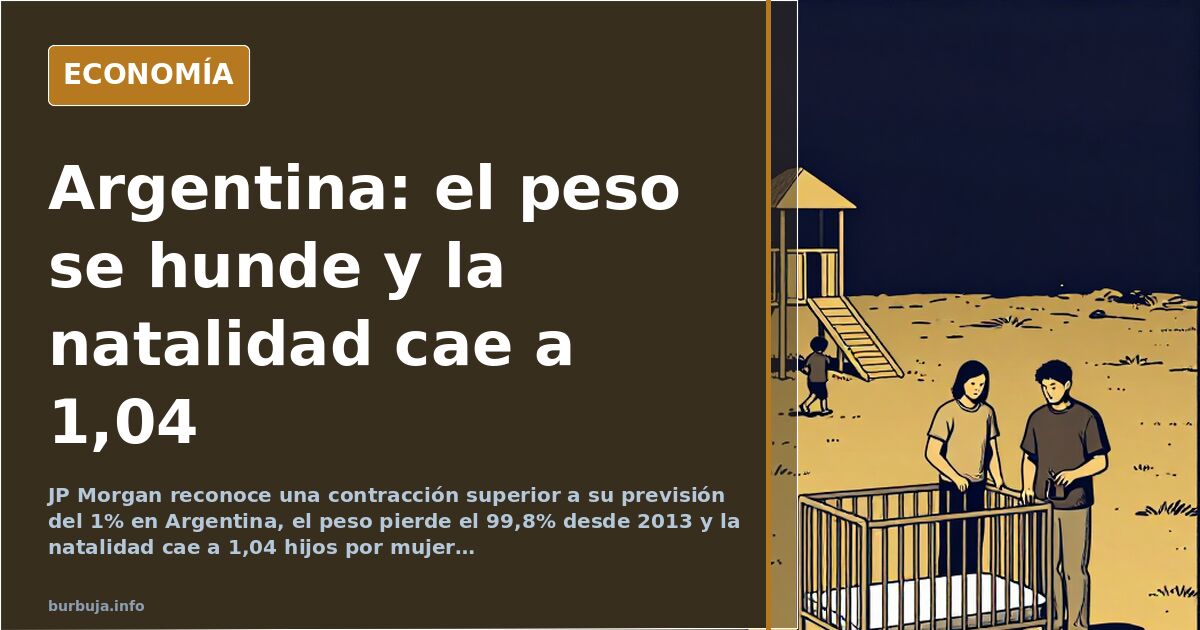
Argentina faces demographic collapse and currency crisis
A country that prints banknotes like flyers and has seen its currency lose nearly 99.8% of its value against the dollar since 2013 now faces a problem that cannot be fixed by austerity or fiscal surpluses: babies are no longer being born. According to domestic data, Argentina's total fertility rate stands at 1.04 children per woman, with Buenos Aires City at 0.79 and no province exceeding the replacement level. The highest figure belongs to Misiones (1.42), while Jujuy records the lowest (0.74). These are East Asian numbers, not South American.
The collapse of the peso and the demographic decline intersect in the same diagnosis: a country that has failed for decades to resolve its productive structure now discovers it cannot solve its generational renewal either. The debate over causes has become a small battlefield.
What the Argentine fertility data reveals
The global figure of 1.04 children per woman places Argentina below Spain and in the league of South Korea or Japan. The provincial map is relentless: no jurisdiction reaches the generational replacement threshold, set around 2.1. Buenos Aires City, the wealthiest district with greater access to contraception and higher education, marks 0.79. Jujuy, in the far north, sinks to 0.74. Misiones, with 1.42, is the relative exception.
Some argue this drop reflects the consolidation of a fertility pattern typical of urbanized and service-oriented societies, characterized by massive female labor market participation and housing inaccessible to young people. Opponents point out that this pattern already existed in Spain or Italy, where birth rates have stagnated without any policy achieving sustained reversal. The novelty in Argentina is the estimulante ilegal: the country moved from near-replacement rates to Asian figures in just a few decades.
From 99.8% peso loss to fiscal surplus
The peso's collapse against the dollar since 2013—losing almost 99.8% of its value—is the economic backdrop. Austerity policies have produced a fourth consecutive fiscal surplus, an unprecedented event in recent Argentine economic history. However, adjustment has come at a cost: it is argued that SME closures and subsidy withdrawals destroyed productive tissue dependent on internal consumption, increasing poverty by several million people.
The debate on whether the adjustment is sustainable intersects with financial dependency. Argentina has accumulated operations with the IMF, World Bank, and IDB, including a new $20 billion EFF program in 2025 and $12 billion in World Bank support packages. Some read these figures as a bailout, others as refinancing of previous debt: the Fund lending to the country to pay back the Fund itself. The discussion on whether this is new debt or accounting maneuvering remains open.
Why does birth rate fall faster than the economy?
The short answer is that fertility responds to concrete incentives, not speeches. Comparative data used in demographic analysis suggests that pro-natalist policies only work when they reduce the opportunity cost of having children: guaranteed childcare, affordable housing, paid maternity leave, and job stability. The GDR's 1972 package—wedding loans forgiven per child, one year of paid leave, nurseries—raised fertility to 1.9; four years after the Wall fell, the former GDR marked 0.77. The greenhouse turned off with the state that financed it.
The Hungarian case is similar: abortion liberalization in 1956 did not move the rate, nor did restriction in 1973 raise it. Prohibition does not manufacture children. The lesson for Argentina is uncomfortable: neither austerity nor social spending reverses a fertility decline if the real cost of raising children is not addressed.
The comparison with Spain hovering over the case
Comparison with Spain appears recurrently: a country that has also seen its birth rate fall, with a population dependent on the state and a political class failing to resolve structural problems. The debate on whether Spain is becoming Europe's Argentina is, for now, a hypothesis supported by macroeconomic and demographic parallels, not a closed prediction.
What is clear is that the Argentine case works as a mirror: a country that tried Peronism, liberalism, and austerity, and in all cases ended up with the same demographic bill. The rate of 1.04 children per woman does not distinguish between governments.
The unsettling data is not the peso's 99.8% loss or the fiscal surplus. It is that the Argentine province with the highest number of children per woman, Misiones, marks 1.42: below replacement. Not a single region guarantees its own generational continuity. And no exchange rate can fix that.
Also available in: Deutsch
Summary of a discussion on Burbuja.info - Foro de economía, actualidad y política., translated from Spanish and reviewed before publication. Read the full discussion (345 replies).
More summaries
-
Milei loses Buenos Aires election, threatening his government
Peronists win Buenos Aires with 47% against Milei's 34%, a 13-point gap, raising currency run risks before...
-
Milei atacks Spanish government at Vox event in Madrid
Argentine President Javier Milei criticized Spain's government and 'social justice' at a Vox rally, sparking debate over costs and ideology.
-
Spain recalls ambassador to Argentina after clash with Milei
Spain permanently withdraws its ambassador to Buenos Aires following a diplomatic row with Argentine President Javier Milei over Begoña Gómez, impacting 475,000 residents and billions in assets.
-
Bus Fight Video Sparks Debate on Violence vs. Provocation in Spain
A viral video of a bus assault raises questions about whether verbal provocation justifies physical violence. Spanish law does not support this defense.
-
Gaitán's Brief European Parliament Speech Sparks Bottle Cap Controversy
Spanish entrepreneur Ángel Gaitán spoke briefly at the European Parliament, using a bottle cap metaphor to criticize EU car regulations.
-
Madrid teachers earn up to €4,200 gross amid strike
A circulating calculation claims secondary teachers in Madrid can earn up to €4,200 gross with 18 years' seniority. The strike and...