
Argentina's Milei: Electronics down 50%, non-food sales plunge 60%
Press reports indicate electronics sales have fallen by 50% and supermarkets lost 20% of revenue in Javier Milei's second month.
English · Original discussion in Spanish · Published
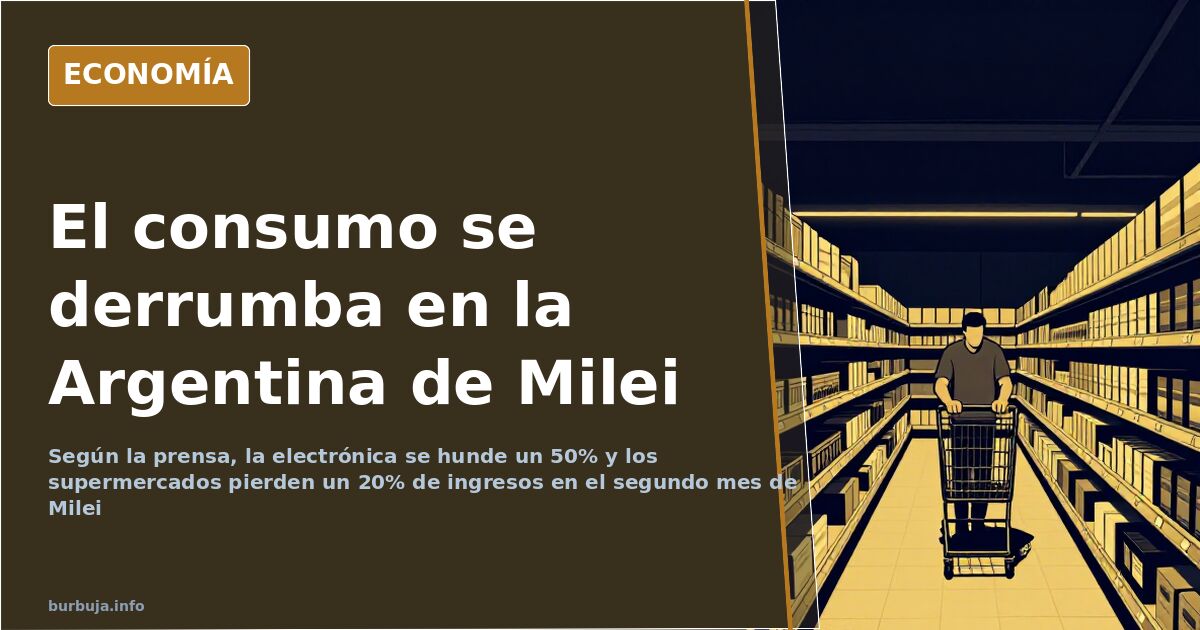
Electronics drop 50% and supermarkets lose 20% in Argentina
Suppliers sell to Argentina up to 40% more expensive than to other countries, according to figures released by Público. This overpricing is the fourth piece of a broader picture: in Argentina, sales of non-food goods face an expected 60% decline, electronics have already collapsed by 50%, and supermarkets have lost 20% of their revenue, with Javier Milei leading the government for two months.
The barrage of figures, published by Público and immediately replicated in the thread, peine a discussion that goes far beyond retail commerce: how much of this collapse is legacy, how much is deliberate shock, and how much is interested narrative. Because some argue that the second month of the mandate is being measured with two yardsticks—the one applied to Syriza in Greece and the one applied now—and that, in economics, this is never a minor detail.
The four-figure collapse: what falls and by how much
Four concrete data points emerge from the table. Non-food goods expect a 60% drop in sales. Electronics collapse by 50%. Supermarkets lose 20% of revenue. And foreign suppliers sell to the country up to 40% more expensively than to other markets.
Read together, the pattern is not homogeneous: discretionary consumption sinks much more than basic needs, and supplier overpricing adds another piece to the picture. The thread discusses whether a shock adjustment can be judged by its eighth week or if the damage is structural, and some argue this existed before and the situation remains unchanged.
What happens to food prices while sales plummet?
Some claim that certain segments of the basic basket are seeing price reductions, and that this is the data point that breaks the general collapse narrative. Several meat products would have lost up to 25% in price, according to calculations provided by a participant, pointing to a correction at the lower end of consumption.
Others read the 60% drop in non-food goods precisely as trinc: essential goods have risen so much that there is no disposable income left for anything else. The consumer eats and little more. Under that logic, the adjustment would first hit those buying electronics and furniture—middle and high incomes—while the basic basket begins to ease.
The gloomy version, also present in the thread, is the opposite: it is not that food prices are falling, but that no one has money for anything else. And the adjustment, according to those supporting the most pessimistic forecasts, will last at least two years of pain.
"It has been two months": the argument dominating the defense
Two months is the timeframe on which the refutation of the data repeatedly returns. The thesis: a shock adjustment cannot be evaluated by its eighth week, especially when starting from a decapitalized economy, with debt and inflation swept under the rug. That Milei does not perform miracles with inherited chaos is, for several participants, the only solid conclusion from the picture.
The comparison with Greece works as a dart in both directions. As one participant recalls, Tsipras was given no quarter when he had not ruined the country either: full adjustment was demanded from day one. Now, they argue, patience is requested. Either the adjustment is measured equally for everyone, or double standards are the norm, not the exception.
What admits less debate is who pays the bill: as pointed out in the thread, cuts are made against public spending, subsidies, and payments, and these have named recipients.
The IMF and Scioli: signals that do not fit the headline
Two subsequent news items qualify the chaotic photograph. First: the IMF head expresses confidence in Milei, calling him pragmatic despite setbacks; the thread also notes that the organization will lend money to the country. Second: Daniel Scioli, former Peronist presidential candidate, joins Milei's government.
A government in freefall does not hire a heavyweight from Peronism. Both pieces go in the opposite direction to the collapse headline, feeding those who argue that the catastrophic reading is editorial bias. On the other side weighs a hard-to-refute argument: a headline of confidence does not pay for the monthly grocery run.
From macroeconomics to work culture
The final section shifts to less quantifiable ground. Effort and productivity are compared: according to one participant, Chilean public spending is very low as a percentage compared to Spain's—whether under Piñera or Bachelet, it makes no difference—and the system performs unevenly; the same service took half an hour and was resolved poorly in Chile, and one minute well in the United States.
From there, it jumps to the cultural explanation defended by another participant: Protestant tradition versus Catholic, work culture versus other customs, Nordic countries that applied very socialist policies and manage better. The reasoning itself encounters its contradiction: if liberal policies are of Anglo-Saxon origin, applying them on different soil will yield different results. Milei does not execute a program in a vacuum, but in Argentina. The former president declared his heir, who dismantled the state without disassembling the elites who always used it, serves as a warning.
And the underlying data that is disorienting, as argued in the thread: the country produces food for twelve times its population. No 60% drop in non-food sales explains it. Nor does it fix it.
Also available in: Deutsch
Summary of a discussion on Burbuja.info - Foro de economía, actualidad y política., translated from Spanish and reviewed before publication. Read the full discussion (203 replies).
More summaries
-
Bride Abandons Groom at Altar to Travel to US
A 30-year-old woman leaves her fiancé at the altar to backpack to the US, sparking a debate on individual freedom and social expectations.
-
Argentina sues FIFA over alleged World Cup match-fixing favoring Spain
Argentine fans file a US lawsuit against FIFA, alleging the World Cup was rigged for Spain despite data showing clear Spanish dominance.
-
Huerta de Soto breaks down Milei's ten points from Davos in class
Analysis of Milei's Davos speech: from Adam Smith as a lukewarm social democrat to 58% of income seized by the state, with Argentina footing the bill
-
Madrid's North: Luxury Property Boom Coexists with Return of Shantytowns
In northern Madrid, rising property values in 'zulos' stand just 150 meters from a shantytown, highlighting the city's stark housing inequality.
-
Leire and the risk of an 'accident' in the fuel fraud scandal
Spain's UCO police unit warned Repsol and Cepsa of possible murders in the fuel fraud case. Parallels with Rita Barberá and Miguel Blesa revive doubts about Leire.
-
Central banks now hold more gold than US debt for the first time in 30 years
Gold has overtaken US Treasuries in central bank reserves for the first time in 30 years. China, Poland and Turkey are leading the buying.