
Argentina: Drones to ID Street Blockers for Welfare Checks
Proposal in Argentina to use cameras and drones to identify street blockers and check welfare eligibility sparks debate in Spain.
English · Original discussion in Spanish · Published
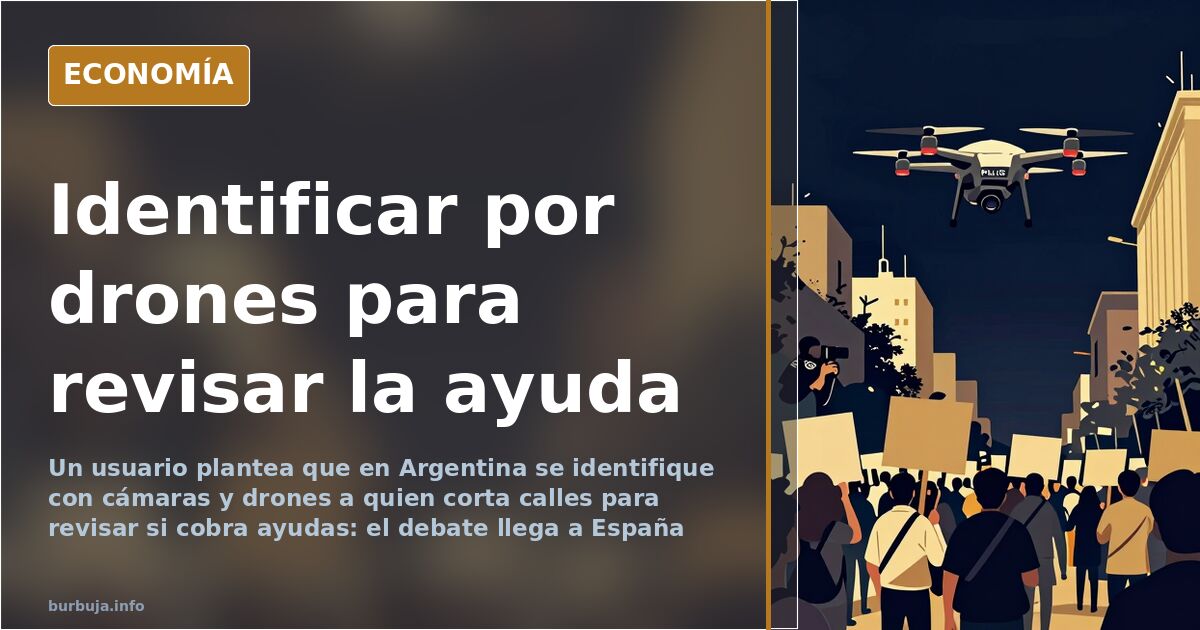
Argentina: Using Cameras and Drones to Identify Street Blockers for Welfare Reviews
A forum user proposes that Argentina should use television cameras and drones to identify those blocking streets, then cross-reference this with public aid recipients. The proposal, emerging amid new government measures, has peine the debate on where the right to protest ends and others' right to move begins. In Spain, the reaction was immediate: some argue that those who claim authoritarianism here applaud conditioning benefits on public behavior. The paradox is significant.
The Exact Proposal
The idea is simple to state but complex to execute: identification via cameras and drones of street blockaders, matching data with benefit registries, and potentially withdrawing aid. Supporters frame it as a public order measure, not ideological persecution. Protesters can still demonstrate; they cannot block main arteries for weeks.
The argument has legal and political dimensions. Legally, the right to protest does not cover arbitrary road closures without prior notice or agreed routes. Politically, social aid ceases to be a mobilization tool for intermediaries. This is the thesis of its defenders.
The Double Standard No One Wants to See
The discussion quickly moved to consistency. It is noted that in Spain, protests at Socialist Party headquarters involving traffic cuts were tolerated for weeks, while those now applauding Buenos Aires' strictness protested police measures then. The symmetry is tempting but likely flawed: a one-off gathering differs from prolonged daily blockades.
Still, the contrast stings. Some say freedom of protest ends where freedom of movement begins; others argue strict application leaves no room for dissent. Amidst this, a detail often forgotten: aid was already used as leverage by union intermediaries, according to recurring complaints the measure aims to address.
The Pandemic as a Mirror
The exchange turned to past events: health restrictions and pressure on the unvaccinated. It is argued that threats of job loss for refusing vaccination were accepted silently then, while less invasive measures cause outrage now. The comparison is crude but reminds us that ideological consistency is rare.
The core issue isn't the pandemic. It is whether the State can use beneficiary lists as tools for social discipline. Defenders argue managers did exactly that, and the novelty is reversing the sign.
What Spain Stakes in This Debate
The debate transcends Argentina. If receiving benefits requires verifiable civic behavior, why not apply it here? Some assume it will happen regardless of the government, because sustained road conflict costs are unsustainable for any administration.
The obvious objection is that mass identification via cameras and drones opens privacy issues current Spanish laws don't comfortably resolve. The Argentine approach is an experiment worth noting.
The Disorienting Detail
The measure is sold as defending freedom of movement. Critics see it as conditioning benefits on waiving rights. Both may be true, creating the problem: separating public order from social control is impossible when the instrument is identical. How long does it take a democracy to accept street surveillance to decide who gets paid?
A forum user proposes that Argentina should use television cameras and drones to identify those blocking streets, then cross-reference this with public aid recipients. The proposal, emerging amid new government measures, has peine the debate on where the right to protest ends and others' right to move begins. In Spain, the reaction was immediate: some argue that those who claim authoritarianism here applaud conditioning benefits on public behavior. The paradox is significant.
The Exact Proposal
The idea is simple to state but complex to execute: identification via cameras and drones of street blockaders, matching data with benefit registries, and potentially withdrawing aid. Supporters frame it as a public order measure, not ideological persecution. Protesters can still demonstrate; they cannot block main arteries for weeks.
The argument has legal and political dimensions. Legally, the right to protest does not cover arbitrary road closures without prior notice or agreed routes. Politically, social aid ceases to be a mobilization tool for intermediaries. This is the thesis of its defenders.
The Double Standard No One Wants to See
The discussion quickly moved to consistency. It is noted that in Spain, protests at Socialist Party headquarters involving traffic cuts were tolerated for weeks, while those now applauding Buenos Aires' strictness protested police measures then. The symmetry is tempting but likely flawed: a one-off gathering differs from prolonged daily blockades.
Still, the contrast stings. Some say freedom of protest ends where freedom of movement begins; others argue strict application leaves no room for dissent. Amidst this, a detail often forgotten: aid was already used as leverage by union intermediaries, according to recurring complaints the measure aims to address.
The Pandemic as a Mirror
The exchange turned to past events: health restrictions and pressure on the unvaccinated. It is argued that threats of job loss for refusing vaccination were accepted silently then, while less invasive measures cause outrage now. The comparison is crude but reminds us that ideological consistency is rare.
The core issue isn't the pandemic. It is whether the State can use beneficiary lists as tools for social discipline. Defenders argue managers did exactly that, and the novelty is reversing the sign.
What Spain Stakes in This Debate
The debate transcends Argentina. If receiving benefits requires verifiable civic behavior, why not apply it here? Some assume it will happen regardless of the government, because sustained road conflict costs are unsustainable for any administration.
The obvious objection is that mass identification via cameras and drones opens privacy issues current Spanish laws don't comfortably resolve. The Argentine approach is an experiment worth noting.
The Disorienting Detail
The measure is sold as defending freedom of movement. Critics see it as conditioning benefits on waiving rights. Both may be true, creating the problem: separating public order from social control is impossible when the instrument is identical. How long does it take a democracy to accept street surveillance to decide who gets paid?
Also available in: Deutsch
Summary of a discussion on Burbuja.info - Foro de economía, actualidad y política., translated from Spanish and reviewed before publication. Read the full discussion (128 replies).
More summaries
-
Foreigners make up 35% of Basque income guarantee recipients
A report for the Basque Parliament shows that in 2023, 65% of RGI recipients held Spanish nationality and 35% were foreign nationals.
-
Foreign tenants: over half in Spain, 70% in three regions
More than 5.2 million tenants in Spain were born abroad. In Madrid, Valencia and Murcia the share reaches 70%. Data and analysis of...
-
Spain housing funds sell 25,000 homes without price impact
Investment funds offload 25,000 Spanish properties for €5 billion amid a severe supply deficit and sustained high demand.
-
Bill Murray's Ice Cream Tax Lesson: Spain's Burden Hits 70%
Bill Murray uses an ice cream analogy to explain taxes. In Spain, fiscal pressure calculations reach 60-70%.
-
Argentina GDP grows 3.9%, reigniting economic debate
Argentina's economy grew 3.9% quarterly and 15.6% annualized, reopening debates on the social cost of austerity measures.
-
French report suggests devaluing euro by 30% against yuan
A French strategic report proposes depreciating the euro by 30% against the renminbi as an alternative to tariffs. Other analyses suggest a 9% adjustment.