
Foreigners make up 35% of Basque income guarantee recipients
A report for the Basque Parliament shows that in 2023, 65% of RGI recipients held Spanish nationality and 35% were foreign nationals.
English · Original discussion in Spanish · Published
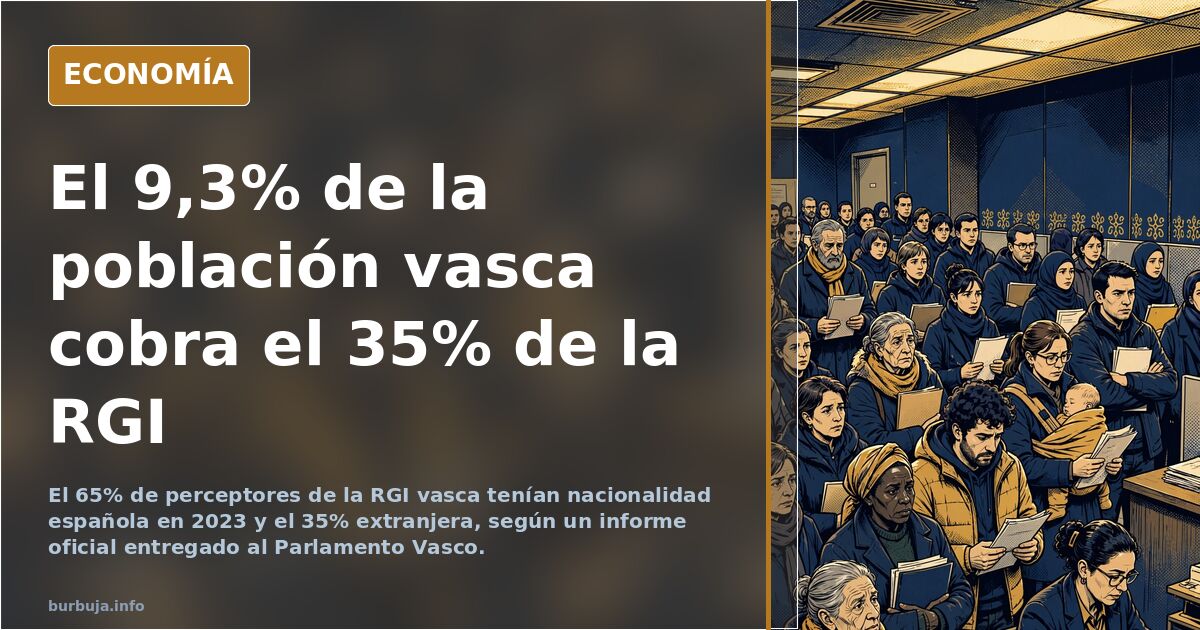
Foreigners make up 35% of Basque income guarantee recipients
An official report submitted to the Basque Parliament challenges Vox's claim that foreigners dominate social welfare benefits in Euskadi. The data indicates that in 2023, 65% of Income Guarantee (Renta de Garantía de Ingresos or RGI) recipients held Spanish nationality, while 35% were foreign nationals. Published by elDiario.es and written by Iker Rioja, the news has reignited a debate extending beyond mere figures: is a raw percentage enough to measure a group's actual impact on public spending?
The short answer is no. The long answer has dominated economic forums over recent days.
The striking statistic: 9.3% of population, 35% of aid
The official report states that foreigners represent 9.3% of the Basque population but receive 35% of the RGI. Mathematically, this means per capita incidence is nearly four times higher among foreigners than Spaniards. This is the relative disparity Vox had been highlighting, which the report confirms rather than refutes.
What the report debunks is the term "dominate." Dominating implies an absolute majority, and 35% is not a majority; the remaining 65% are Spanish citizens. Here lies the headline's trap: elDiario.es presents as a refutation what is actually a nuance.
Some argue that recipient percentages do not reflect spending percentages. For many retirees and low-income workers, the RGI acts as a supplement—receiving €100 or €200 monthly, not the full benefit. Conversely, foreign recipients without other income sources tend to collect the total amount. If true, the 35% of recipients might absorb significantly more than 35% of the budget. The report does not break down this variable.
The trap of relative percentages
The most cited analogy involves truck fleets. You have 100 trucks: 10 from Brand A and 90 from Brand B. If 40% of breakdowns involve Brand A and 60% involve Brand B, which brand is better? Obviously Brand A, since it represents only 10% of the fleet yet accounts for 40% of failures. Applied to the Basque case: foreigners are 9.3% of the population but generate 35% of claims. Brand A fails nearly four times more often.
The question remains whether that 9.3% figure is accurate. Several comments challenge the census data: there is no reliable registry of irregular immigrants, meaning the actual foreign population percentage could be much higher. If the denominator is underestimated, the per capita calculation is artificially inflated. This is a reasonable objection, though it could also work in reverse: if there are more foreigners than recorded, the recipient-to-population ratio would be lower.
Another unclear variable is nationality versus country of birth. Official data refers to "Spanish nationality," which includes those naturalized in recent years. Comments suggest a significant portion of that 65% are "Spaniards" with recently issued ID cards. Without a breakdown by country of birth, the picture remains incomplete.
Amount, not number of beneficiaries
The analysis repeatedly highlights that the report measures heads, not euros. A Spanish retiree receiving a €150 supplement counts the same as a foreigner receiving €1,200. If total amounts were measured, the distribution might look very different.
Calls for transparency are unanimous: publish data disaggregated by country of birth, average amount received, and type of aid. The RGI is not the only benefit; there are housing subsidies, school meal grants, and utility assistance. A 2016 report noted that two out of three beneficiaries of housing aid linked to the RGI were born abroad. That data is absent from the current report.
The report also provides data partially contradicting fraud theories: among those who left the system due to entering the labor market, 42% were foreigners and 58% were Spaniards. This suggests foreigners exit the RGI for work at a higher rate than they enter, indicating the benefit functions as a bridge, not a permanent trap, for at least part of the group.
What the report does not say
The report does not deny that foreigners have a much higher incidence in the RGI. It confirms it. What it debunks is the word "dominate," implying an absolute majority. This distinction is important, but not the one the headline suggests.
The underlying discussion is different: Is an income guarantee system sustainable when it concentrates 35% of payments in 9.3% of the population? The answer depends on whether one prioritizes distributive justice or fiscal sustainability, and whether one believes the 9.3% figure is real.
The official report does not resolve this question. It merely provides data that each side interprets differently. As is almost always the case.
An official report submitted to the Basque Parliament challenges Vox's claim that foreigners dominate social welfare benefits in Euskadi. The data indicates that in 2023, 65% of Income Guarantee (Renta de Garantía de Ingresos or RGI) recipients held Spanish nationality, while 35% were foreign nationals. Published by elDiario.es and written by Iker Rioja, the news has reignited a debate extending beyond mere figures: is a raw percentage enough to measure a group's actual impact on public spending?
The short answer is no. The long answer has dominated economic forums over recent days.
The striking statistic: 9.3% of population, 35% of aid
The official report states that foreigners represent 9.3% of the Basque population but receive 35% of the RGI. Mathematically, this means per capita incidence is nearly four times higher among foreigners than Spaniards. This is the relative disparity Vox had been highlighting, which the report confirms rather than refutes.
What the report debunks is the term "dominate." Dominating implies an absolute majority, and 35% is not a majority; the remaining 65% are Spanish citizens. Here lies the headline's trap: elDiario.es presents as a refutation what is actually a nuance.
Some argue that recipient percentages do not reflect spending percentages. For many retirees and low-income workers, the RGI acts as a supplement—receiving €100 or €200 monthly, not the full benefit. Conversely, foreign recipients without other income sources tend to collect the total amount. If true, the 35% of recipients might absorb significantly more than 35% of the budget. The report does not break down this variable.
The trap of relative percentages
The most cited analogy involves truck fleets. You have 100 trucks: 10 from Brand A and 90 from Brand B. If 40% of breakdowns involve Brand A and 60% involve Brand B, which brand is better? Obviously Brand A, since it represents only 10% of the fleet yet accounts for 40% of failures. Applied to the Basque case: foreigners are 9.3% of the population but generate 35% of claims. Brand A fails nearly four times more often.
The question remains whether that 9.3% figure is accurate. Several comments challenge the census data: there is no reliable registry of irregular immigrants, meaning the actual foreign population percentage could be much higher. If the denominator is underestimated, the per capita calculation is artificially inflated. This is a reasonable objection, though it could also work in reverse: if there are more foreigners than recorded, the recipient-to-population ratio would be lower.
Another unclear variable is nationality versus country of birth. Official data refers to "Spanish nationality," which includes those naturalized in recent years. Comments suggest a significant portion of that 65% are "Spaniards" with recently issued ID cards. Without a breakdown by country of birth, the picture remains incomplete.
Amount, not number of beneficiaries
The analysis repeatedly highlights that the report measures heads, not euros. A Spanish retiree receiving a €150 supplement counts the same as a foreigner receiving €1,200. If total amounts were measured, the distribution might look very different.
Calls for transparency are unanimous: publish data disaggregated by country of birth, average amount received, and type of aid. The RGI is not the only benefit; there are housing subsidies, school meal grants, and utility assistance. A 2016 report noted that two out of three beneficiaries of housing aid linked to the RGI were born abroad. That data is absent from the current report.
The report also provides data partially contradicting fraud theories: among those who left the system due to entering the labor market, 42% were foreigners and 58% were Spaniards. This suggests foreigners exit the RGI for work at a higher rate than they enter, indicating the benefit functions as a bridge, not a permanent trap, for at least part of the group.
What the report does not say
The report does not deny that foreigners have a much higher incidence in the RGI. It confirms it. What it debunks is the word "dominate," implying an absolute majority. This distinction is important, but not the one the headline suggests.
The underlying discussion is different: Is an income guarantee system sustainable when it concentrates 35% of payments in 9.3% of the population? The answer depends on whether one prioritizes distributive justice or fiscal sustainability, and whether one believes the 9.3% figure is real.
The official report does not resolve this question. It merely provides data that each side interprets differently. As is almost always the case.
Also available in: Deutsch
Summary of a discussion on Burbuja.info - Foro de economía, actualidad y política., translated from Spanish and reviewed before publication. Read the full discussion (166 replies).
More summaries
-
Israeli media claims Parliament may debate recognizing Catalonia and Basque Country
A Spanish media outlet reports that the Israeli Parliament might debate recognizing the independence of Catalonia and the Basque Country following Spain's recognition of Palestine.
-
The Basque educational crisis: record spending meets questionable results
The Basque Country spends more per student than any other region, yet educational outcomes lag behind. Compulsory Euskera and immigration are straining the system…
-
Omar Ndiaye's Fraud: From Spain to Canada Without Facing Prison
Omar Ndiaye collected over €1 million in benefits in Spain, disappeared, and is now detained in Canada on charges related to a €180,000 fraud. 41,000 recipients...
-
Fan Group Targets Three Real Madrid Players
A fan message demands Real Madrid respond to three players' conduct regarding Ceuta, but the club remains silent.
-
Open-source project clones seven Adobe apps
An open-source initiative replicates features from seven Adobe applications, gaining 44,000 GitHub stars and updating every three days.
-
Spain Audit Finds €2.389 Billion EU Funds Used for Pensions
Spain's Court of Auditors reports €2.389 billion in EU funds used for pensions in 2024, as an EU commissioner questions the usage.