
Apocalypto's Final Scene and the Battle for the Narrative of Conquest
The final scene of Apocalypto reignites the clash between two conquest narratives: salvation or apocalypse. The Laws of Burgos are back on the table.
English · Original discussion in Spanish · Published
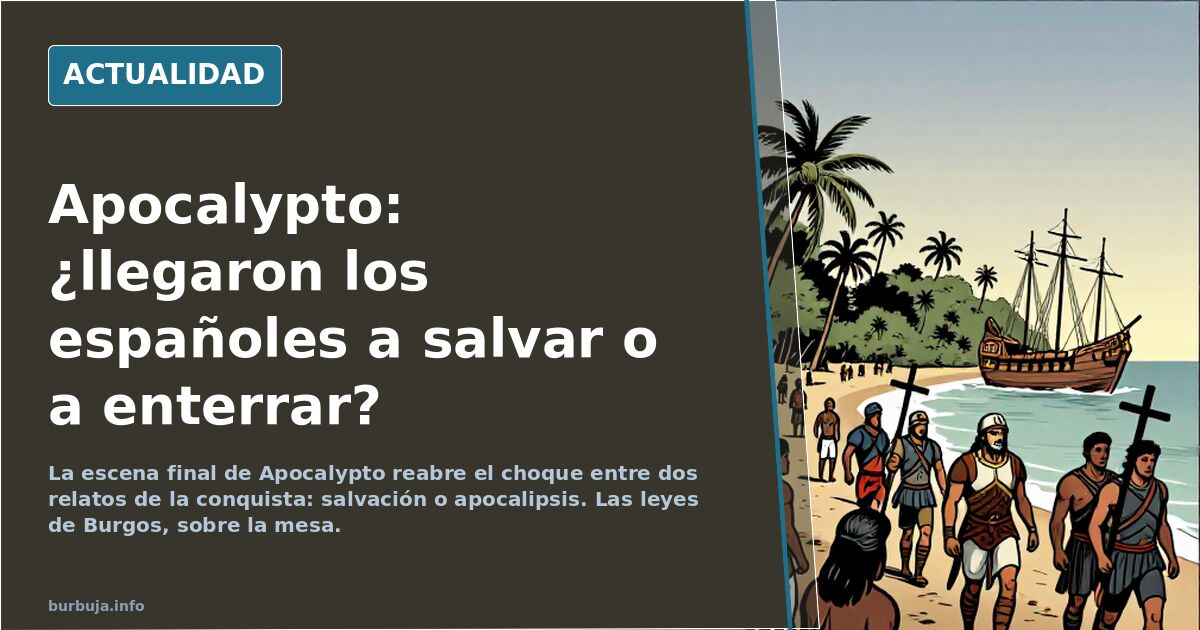
Apocalypto: The Final Scene That Reopens the Battle of the Black Legend
The final scene of Apocalypto shows ships, a cross, and a line of dressed men disembarking on a beach. This image, the film's last, continues to stir controversy even though the movie is nearly fifteen years old. The protagonist, fleeing a party intent on killing him, stops upon seeing them, uncertain of what they represent. Some interpret it as a message of salvation; others, as a warning of something worse to come. The debate remains open.
Apocalypto Isn't About Aztecs: The Error Almost Nobody Corrects
The film is set in the Maya Postclassic period, not the Mexica world, although many comments assume the opposite. The characters worship Kukulkán, a Maya deity – this is the internal evidence that settles the doubt. While this doesn't absolve Gibson of other historical inaccuracies, it clarifies the setting. The Mexica did not live on the coast but inland, in the Central Highlands. Cinematically, however, the final scene is described as awe-inspiring almost unanimously. The correction of the setting coexists with praise for the filmmaking.
What the Laws Say: From Burgos (1512) to the 1542 Expansion
Here, the discussion shifts from cinema to the legal realm. It is argued that slavery was prohibited by the Laws of Burgos of 1512, expanded in 1542, and that the inhabitants of the Indies were granted citizenship rights from the outset. Some go further, describing a labor system with wages, rest periods, and leave seasons, unmatched in the world at that time, even calling them the germ of human rights charters. The counterargument is predictable: the legal text is one thing, and its application on the ground is another. The disagreement is not about the existence of the laws but about their impact.
How Do You Conquer an Empire with 300 Men?
The arithmetic discussed by participants is on the table: about 300 men against over 200,000. The explanation gaining traction is not gunpowder but local geopolitics. The peoples subjugated by the Mexica allied with the newcomers, and without that support, the conquest would have been different. Added to this is a factor no one could have predicted: smallpox. Some joke that it arrived accidentally on purpose. Another, less heroic, nuance points in the opposite direction: that the legal framework protecting the indigenous people did not prevent the arrival from being a demographic disaster for many communities.
Salvation or Apocalypse: The Two Conflicting Narratives
One current interprets the scene as a relief: the end of ritual sacrifices and the arrival of order. Another completely inverts it, arguing that the true apocalypse begins precisely when those sails appear on the horizon. In between, there are those who refuse to pick a side, warning that history is not a game with good guys and bad guys. This third way, that of brutal conflict with victims and opportunists on all sides, generates fewer headlines and is the one that repeats most often.
The Drift: When History Becomes a Trench
Throughout the thread, the focus shifts from the script to identity. Theories about haplogroups, colonial hierarchies, and cross-accusations between both sides of the Atlantic emerge. This is the stage where historical analysis breaks down: figures are replaced by slogans, and a debate about a film devolves into settling scores. When this happens, Gibson's scene ceases to matter. Only the argument remains.
With these pieces, the question that started it all remains unanswered. The modern viewer looks at the beach through their own sarracena, not that of 1519. Gibson knew this, which is why he left the camera still and did not provide the answer.
The final scene of Apocalypto shows ships, a cross, and a line of dressed men disembarking on a beach. This image, the film's last, continues to stir controversy even though the movie is nearly fifteen years old. The protagonist, fleeing a party intent on killing him, stops upon seeing them, uncertain of what they represent. Some interpret it as a message of salvation; others, as a warning of something worse to come. The debate remains open.
Apocalypto Isn't About Aztecs: The Error Almost Nobody Corrects
The film is set in the Maya Postclassic period, not the Mexica world, although many comments assume the opposite. The characters worship Kukulkán, a Maya deity – this is the internal evidence that settles the doubt. While this doesn't absolve Gibson of other historical inaccuracies, it clarifies the setting. The Mexica did not live on the coast but inland, in the Central Highlands. Cinematically, however, the final scene is described as awe-inspiring almost unanimously. The correction of the setting coexists with praise for the filmmaking.
What the Laws Say: From Burgos (1512) to the 1542 Expansion
Here, the discussion shifts from cinema to the legal realm. It is argued that slavery was prohibited by the Laws of Burgos of 1512, expanded in 1542, and that the inhabitants of the Indies were granted citizenship rights from the outset. Some go further, describing a labor system with wages, rest periods, and leave seasons, unmatched in the world at that time, even calling them the germ of human rights charters. The counterargument is predictable: the legal text is one thing, and its application on the ground is another. The disagreement is not about the existence of the laws but about their impact.
How Do You Conquer an Empire with 300 Men?
The arithmetic discussed by participants is on the table: about 300 men against over 200,000. The explanation gaining traction is not gunpowder but local geopolitics. The peoples subjugated by the Mexica allied with the newcomers, and without that support, the conquest would have been different. Added to this is a factor no one could have predicted: smallpox. Some joke that it arrived accidentally on purpose. Another, less heroic, nuance points in the opposite direction: that the legal framework protecting the indigenous people did not prevent the arrival from being a demographic disaster for many communities.
Salvation or Apocalypse: The Two Conflicting Narratives
One current interprets the scene as a relief: the end of ritual sacrifices and the arrival of order. Another completely inverts it, arguing that the true apocalypse begins precisely when those sails appear on the horizon. In between, there are those who refuse to pick a side, warning that history is not a game with good guys and bad guys. This third way, that of brutal conflict with victims and opportunists on all sides, generates fewer headlines and is the one that repeats most often.
The Drift: When History Becomes a Trench
Throughout the thread, the focus shifts from the script to identity. Theories about haplogroups, colonial hierarchies, and cross-accusations between both sides of the Atlantic emerge. This is the stage where historical analysis breaks down: figures are replaced by slogans, and a debate about a film devolves into settling scores. When this happens, Gibson's scene ceases to matter. Only the argument remains.
With these pieces, the question that started it all remains unanswered. The modern viewer looks at the beach through their own sarracena, not that of 1519. Gibson knew this, which is why he left the camera still and did not provide the answer.
Summary of a discussion on Burbuja.info - Foro de economía, actualidad y política., translated from Spanish and reviewed before publication. Read the full discussion (593 replies).
More summaries
-
September 26, 2026 Demonstration in Madrid: Schedule, Route, Demands, and Traffic Disruptions
The II March for Dignity takes place in Madrid on September 26. Find out about the route, timings, and the demands driving this movement.
-
Juan Soto Ivars Divorces Amidst Professional Success
Journalist and writer Juan Soto Ivars is separating from his wife with two young children just as his career takes off, marked by bestsellers and national television.
-
Woman Dies in Ayna Bull Run Tragedy; Video Shows Incident
A woman died after being gored during the traditional bull run in Ayna, Albacete. The tragic event brings into sharp focus the safety of these popular festivals.
-
Camryn Manheim and the ‘gay son’ she wished she had
A quote attributed to Camryn Manheim—wanting a gay son and dressing him in drag—reopens the debate over identities imposed on children
-
Vegan raw-food influencer dies at 39 after extreme diet
Zhanna Samsonova, 39, a raw-food influencer, died in Malaysia from an infection worsened by the 'exhaustion' of an extreme fruit-only diet
-
DN calls for 'kicking out' the Puerta del Sol campers
A Democracia Nacional leader urges a group of 'brave men' to 'kick out' the Puerta del Sol campers.