
Anthropic CEO: AI to cure cancer, displace 20% of jobs
Dario Amodei predicts AI will cut junior roles by half and raise unemployment to 10-20%, even as the economy grows 10% annually.
English · Original discussion in Spanish · Published
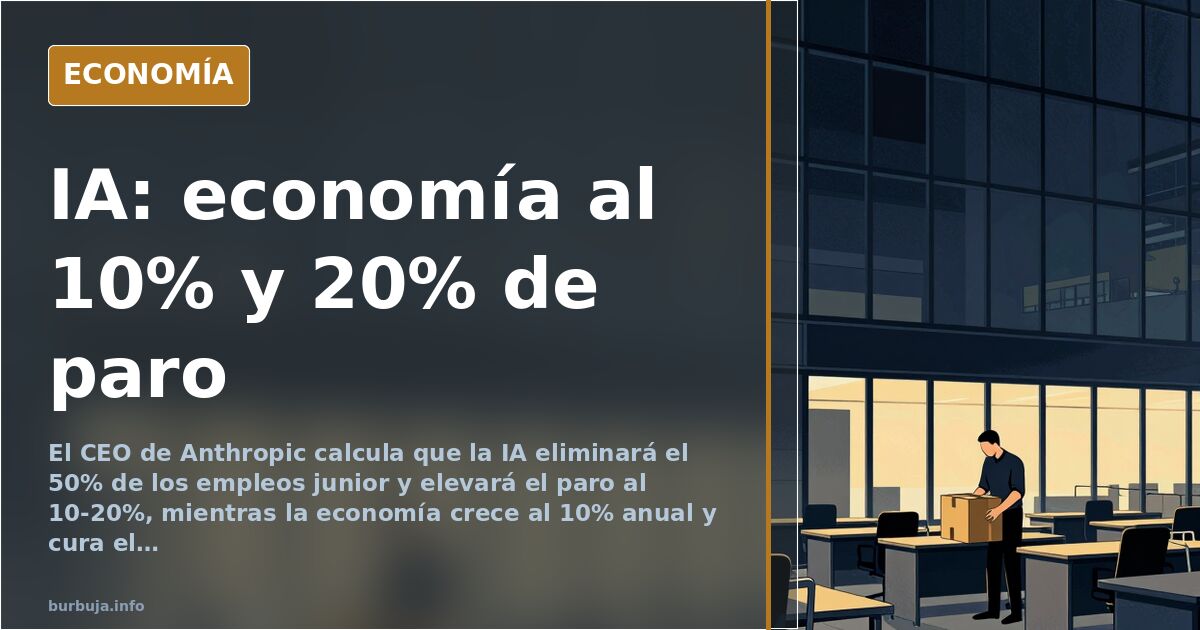
AI promises to cure cancer but leave 20% jobless
Can an economy grow at 10% annually, cure cancer, and simultaneously leave one in five workers unemployed? Anthropic CEO Dario Amodei believes so. In a May 28, 2025 Axios interview, he warned that AI could eliminate up to 50% of entry-level jobs in tech, finance, law, and consulting within five years. His calculation suggests this would drive unemployment to between 10% and 20%, disproportionately affecting young people.
What exactly does the Anthropic CEO say?
Amodei doesn’t just drop a number and walk away. He acknowledges that governments and businesses aren’t acting with the urgency required and proposes concrete measures: a symbolic tax on AI-generated revenue to redistribute gains and mitigate inequality. He also notes that many legislators and workers don’t fully grasp the magnitude of the impact, which he antiestéticars will lead to economic and social shock without proactive steps.
His vision isn’t technologically apocalyptic. Amodei imagines a future where AI solves problems like cancer and drives 10% annual economic growth. The catch is that this same scenario leaves 20% of people unemployed. Record growth and mass exclusion in the same sentence.
Data already pointing to a broken labor market
Amodei’s warning isn’t baseless. A SignalFire report cited by Business Insider on May 28, 2025, shows a 50% reduction in hiring recent graduates by major tech firms compared to pre-pandemic levels, partly due to AI adoption. The entry-level market is tightening before mass automation reaches mid-tier roles.
However, US macroeconomic data hasn’t yet reflected catastrophe. Unemployment held steady at 4.2% in April 2025, matching March figures and expectations. Job seekers rose by 82,000 to 7.165 million, while employment grew by 436,000 to reach 163.944 million. For now, the US labor market holds its ground.
The disconnect between narrative and office reality
Some argue the “AI eating jobs” story is largely propaganda from those selling AI. There’s logic here: executives developing these models benefit if the world believes transformation is unstoppable. Amodei calling for a tax on his own industry can be seen as legitimizing the discourse and preempting regulation.
Opposing views note early signs are visible. Consulting, advisory, and accounting sectors show the most strain: firms use AI tools for tasks once done by new grads. Industry insiders calculate that intangible value approaches zero, dragging down administrative jobs that sustained the middle class.
Sarracena’s paradox and unautomatable physical work
A common rebuttal focuses on physical tasks. No AI climbs scaffolding, installs doors, fixes pipes, or slices meat. Manual trades, care work, and maintenance resist displacement because the bottleneck is physical embodiment, not knowledge. Sarracena’s paradox—what’s hard for machines is easy for humans—remains true on construction sites and in elder care facilities.
Yet this barrier protects fewer people than it seems. Programming isn’t just coding, yet junior markets in tech consulting were already strained before AI arrived. Automation accelerates existing trends rather than creating new ones. Employers hire experience, but no one pays for the years needed to gain it.
Productivity gains never reaching paychecks
The underlying question is uncomfortable: if productivity has risen steadily for a century, why haven’t working hours decreased? The 40-hour week solidified decades ago and persists, even as output per hour multiplied. Productivity gains went to profits, lower prices for some goods, and new job categories—not significantly to wages.
This mismatch fuels distrust in official narratives. If AI delivers on its promise, debate won’t just be about job destruction, but who captures the surplus. Proposing an AI revenue tax is an attempt to answer that question before public outcry forces it.
Spain’s scenario: tighter entry markets, higher structural unemployment
Spain starts from a weaker position. With youth unemployment near 50%, the shrinking entry-level market observed in the US would hit fragile ground. Amodei speaks of his market, not Spain’s, but the mechanism is identical: if companies stop hiring juniors, the first rung of career ladders disappears.
Debates over redistributed time are emerging. Some advocate fighting for a 21–28 hour workweek if AI handles labor, ensuring benefits reach those who created them. Others recall past tech revolutions—from production line automation—began with unemployment and hardship before reaching new equilibria. The challenge is managing transition costs.
All this unfolds while US unemployment remains at 4.2% and big tech hires half as many graduates as pre-pandemic. The predicted collapse may take fifteen years instead of five, or arrive under a different guise. What doesn’t add up is rising productivity alongside unchanged working hours.
Also available in: Deutsch
Summary of a discussion on Burbuja.info - Foro de economía, actualidad y política., translated from Spanish and reviewed before publication. Read the full discussion (110 replies).
More summaries
-
The US-Israel alliance's military and intelligence power is monstrous
The US captures heads of state without casualties while Russia fails to advance 200 km in Ukraine. How Western intelligence and technology create an economic advantage.
-
US Citizens Fleeing Trump Move to Spain Amid Housing Tensions
Reportage details US citizens moving to Spain with digital nomad visas and high rents, raising questions about housing impact.
-
Joan Donovan warns US militias preparing for civil war
Disinformation expert Joan Donovan argues US militias are gearing up for civil conflict, citing social media as key infrastructure.
-
Galician regional government to fund driving licenses for legalized migrants
The Xunta will cover the cost of driver's licenses for migrants who have regularized their status: over €1,000 per person, and a growing debate about who should foot the bill.
-
Debate in Spain: pensions, Imserso trips and social media propaganda
Users debate whether pensions and Imserso trips decide the vote and whether the left dominates social media; no verified data on accounts or bots
-
Spaniards are dumb voters for the ****o-Masonic conspiracy
A viral message calls Spaniards 'dumb voting rats' and blames their problems on a 'Judeo-Masonic' conspiracy. There is no evidence whatsoever of that alleged control.