
Zaragoza feminist drum parade sparks debate
A feminist march in Zaragoza reignites controversy over drum parades, focusing on public subsidies and the recurring question of why drums dominate these protests.
English · Original discussion in Spanish · Published
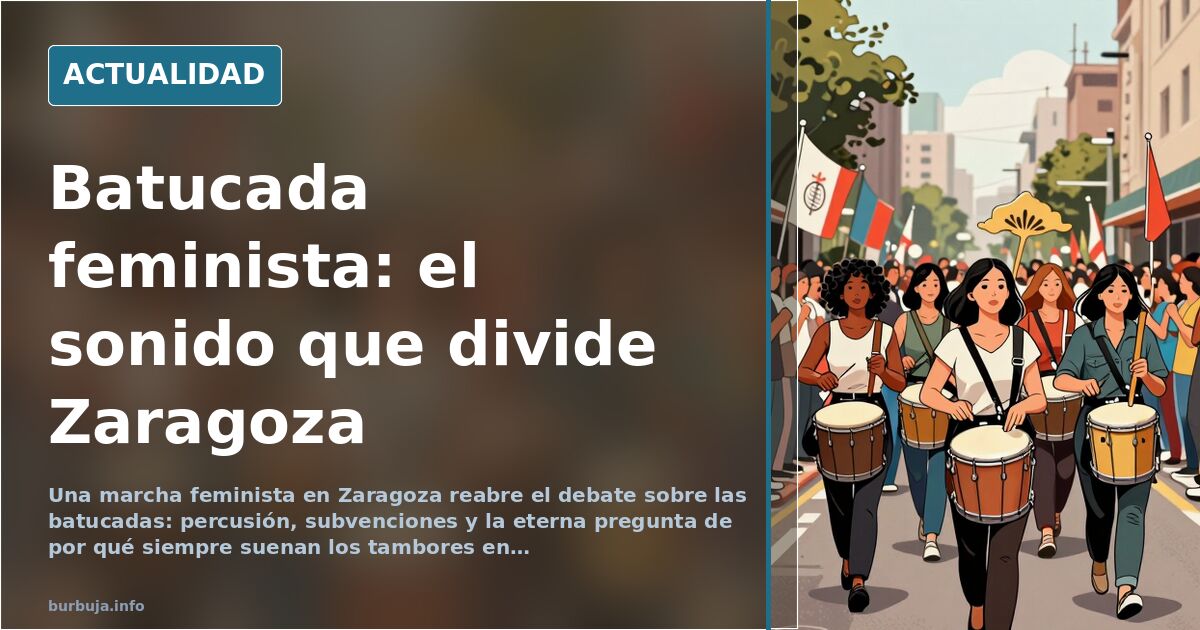
Zaragoza: The feminist drum parade that sparked a debate
A feminist march in Zaragoza. A video with drums. And, underlying it all, a question that resurfaces every time streets fill with percussion: Why always a batucada? The scene, captured on a street in the Aragonese capital, has shifted the conversation toward topics unrelated to the protest's original purpose. Rhythm as an identity marker, yes, but also as a trigger for a series of cross-accusations ranging from public budgets to women's role in contemporary society.
The starting point is almost always the same: a group of women, drums, choreography, and a common aesthetic. From there, everyone twists the narrative to fit their own agenda. Some see collective percussion as a metaphor for individual dissolution into the crowd; others interpret it as a deliberate, simple, and accessible aesthetic choice. And, naturally, some use it to settle ideological scores that go beyond the march itself.
Why do feminist marches usually antiestéticature drum parades?
The question is not trivial. The batucada, a set of Afro-Brazilian drums and percussion, has become the usual soundtrack for demonstrations of all kinds, especially feminist calls. According to the discussion, the reason lies in accessibility: advanced musical training is not required to keep a beat, allowing anyone to join. It is participatory music, not virtuoso performance.
This is the first friction point. For some, this simplicity is a democratic virtue: percussion is the simplest music, the only one accessible to those who haven't studied solfège. For others, that same simplicity signals a lack of artistic ambition, if not intellectual inferiority. As seen, the argument isn't really about music.
Underlying this is a fundamental issue: Is the batucada an aesthetic choice or a script imposition? Some argue that collective percussion fits perfectly in a type of gathering where there are no standout soloists, where everyone dresses alike but with differentiating details, and where shared physical effort creates a sense of collective achievement. The choreography, practice, and final exhaustion all point to a secular liturgy with its own rites.
The cost of rallies and the funding war
If there is one topic that reappears strongly, it is money. Who pays for this? The question, asked with sarcasm, hides a broader accusation: that feminist rallies survive on subsidies and associations that justify their existence through periodic events. The shadow of handouts looms over many comments, although no one provides a concrete figure for the cost of a march like Zaragoza's.
The matter quickly devolves into a general clash over public spending. Some accuse organizers of living off the state; others reply that critics of external aid often stay silent when they receive it themselves. The discussion becomes an exchange of accusations about who drains more from the budget, without anyone presenting a single invoice. It is the classic "you too" elevated to a public debate category.
Strikingly, the march itself takes a back seat. The video shows a group of women playing drums in a street, but the conversation shifts to areas such as the utility of feminist associations, the destination of subsidies, or the alleged lack of social security contributions by participants. Among them, they haven't contributed even one year, someone claims, without providing any data to support it.
From percussion to prejudice: rhythm as an excuse
There is an undercurrent running through the entire discussion worth noting: the association between repetitive rhythm and primitivism. It is rhythmic, tribal, primitive, it is stated, immediately linking it to a supposed pre-Paleolithic stage of society. Percussion music, the argument goes, merges the individual with the mass and stirs basic instincts. The implicit conclusion is that participating in a batucada means renouncing rational thought.
The argument lacks originality. It is the old accusation against all collective music, from war drums to stadium anthems. What is striking is its enthusiastic application to a specific feminist march. In this context, the batucada functions as an empty signifier: everyone hangs their own prejudice on it. For some, it shows a lack of creativity; for others, a lack of resources; for the pessimists, a supposed social regression.
The discussion also reveals a recurrent obsession: aesthetics. Those shirts and those pants, it is commented, as if attire were part of the problem. Participants' appearance becomes subject to scrutiny, revealing much about the conversation's overall tone. The wrapper is judged, not the content.
Context: A Zaragoza filled with marches
Beyond the specific case, there is an underlying complaint about the accumulation of rallies. How many demonstrations, marches, or protests do these people have?, it is asked with exasperation. The feeling of saturation is real for those living in a city of certain size: on any given Saturday, the center is cut off, streets fill with flags, and a leisurely walk becomes an exercise in patience.
One participant's description of this experience is almost literary: Palestinian, Republican, and Pride flags on balconies, commemorative murals commissioned by the city council, and demonstrations forcing detours. Living in a city of certain size must be ridiculous, he concludes. The exaggeration is evident, but it captures a diffuse discomfort that transcends the Zaragoza case.
The problem, if it is one, is not the march itself, but the sensation that urban life has become a permanent calendar of demands. Every weekend has its cause, route, and drum parade. And for someone who just wants to have coffee on a terrace, this can be exhausting. The complaint is not new, but it finds an easy target in these types of gatherings.
What the video doesn't show
The video that originated the discussion shows a group of women playing drums in a street. Little else. There are no attendance figures, no statements from organizers, no context regarding the rally's motive. The only truth is that it's a tiny crowd, someone asserts, though again without providing confirming data. The perception that feminist marches mobilize few people is recurrent but unsupported by evidence in the available material.
What is perceived is a generational and gender gap in interpreting the scene. For some, it demonstrates social vitality; for others, a collective waste of time. The batucada, with its hypnotic rhythm and ability to draw people in, amplifies this division. It is hard to remain indifferent to a drum.
And perhaps therein lies the key. The batucada is not just music: it is a declaration of intent. It occupies public space with sound, forces attention, and demands visibility.
A feminist march in Zaragoza. A video with drums. And, underlying it all, a question that resurfaces every time streets fill with percussion: Why always a batucada? The scene, captured on a street in the Aragonese capital, has shifted the conversation toward topics unrelated to the protest's original purpose. Rhythm as an identity marker, yes, but also as a trigger for a series of cross-accusations ranging from public budgets to women's role in contemporary society.
The starting point is almost always the same: a group of women, drums, choreography, and a common aesthetic. From there, everyone twists the narrative to fit their own agenda. Some see collective percussion as a metaphor for individual dissolution into the crowd; others interpret it as a deliberate, simple, and accessible aesthetic choice. And, naturally, some use it to settle ideological scores that go beyond the march itself.
Why do feminist marches usually antiestéticature drum parades?
The question is not trivial. The batucada, a set of Afro-Brazilian drums and percussion, has become the usual soundtrack for demonstrations of all kinds, especially feminist calls. According to the discussion, the reason lies in accessibility: advanced musical training is not required to keep a beat, allowing anyone to join. It is participatory music, not virtuoso performance.
This is the first friction point. For some, this simplicity is a democratic virtue: percussion is the simplest music, the only one accessible to those who haven't studied solfège. For others, that same simplicity signals a lack of artistic ambition, if not intellectual inferiority. As seen, the argument isn't really about music.
Underlying this is a fundamental issue: Is the batucada an aesthetic choice or a script imposition? Some argue that collective percussion fits perfectly in a type of gathering where there are no standout soloists, where everyone dresses alike but with differentiating details, and where shared physical effort creates a sense of collective achievement. The choreography, practice, and final exhaustion all point to a secular liturgy with its own rites.
The cost of rallies and the funding war
If there is one topic that reappears strongly, it is money. Who pays for this? The question, asked with sarcasm, hides a broader accusation: that feminist rallies survive on subsidies and associations that justify their existence through periodic events. The shadow of handouts looms over many comments, although no one provides a concrete figure for the cost of a march like Zaragoza's.
The matter quickly devolves into a general clash over public spending. Some accuse organizers of living off the state; others reply that critics of external aid often stay silent when they receive it themselves. The discussion becomes an exchange of accusations about who drains more from the budget, without anyone presenting a single invoice. It is the classic "you too" elevated to a public debate category.
Strikingly, the march itself takes a back seat. The video shows a group of women playing drums in a street, but the conversation shifts to areas such as the utility of feminist associations, the destination of subsidies, or the alleged lack of social security contributions by participants. Among them, they haven't contributed even one year, someone claims, without providing any data to support it.
From percussion to prejudice: rhythm as an excuse
There is an undercurrent running through the entire discussion worth noting: the association between repetitive rhythm and primitivism. It is rhythmic, tribal, primitive, it is stated, immediately linking it to a supposed pre-Paleolithic stage of society. Percussion music, the argument goes, merges the individual with the mass and stirs basic instincts. The implicit conclusion is that participating in a batucada means renouncing rational thought.
The argument lacks originality. It is the old accusation against all collective music, from war drums to stadium anthems. What is striking is its enthusiastic application to a specific feminist march. In this context, the batucada functions as an empty signifier: everyone hangs their own prejudice on it. For some, it shows a lack of creativity; for others, a lack of resources; for the pessimists, a supposed social regression.
The discussion also reveals a recurrent obsession: aesthetics. Those shirts and those pants, it is commented, as if attire were part of the problem. Participants' appearance becomes subject to scrutiny, revealing much about the conversation's overall tone. The wrapper is judged, not the content.
Context: A Zaragoza filled with marches
Beyond the specific case, there is an underlying complaint about the accumulation of rallies. How many demonstrations, marches, or protests do these people have?, it is asked with exasperation. The feeling of saturation is real for those living in a city of certain size: on any given Saturday, the center is cut off, streets fill with flags, and a leisurely walk becomes an exercise in patience.
One participant's description of this experience is almost literary: Palestinian, Republican, and Pride flags on balconies, commemorative murals commissioned by the city council, and demonstrations forcing detours. Living in a city of certain size must be ridiculous, he concludes. The exaggeration is evident, but it captures a diffuse discomfort that transcends the Zaragoza case.
The problem, if it is one, is not the march itself, but the sensation that urban life has become a permanent calendar of demands. Every weekend has its cause, route, and drum parade. And for someone who just wants to have coffee on a terrace, this can be exhausting. The complaint is not new, but it finds an easy target in these types of gatherings.
What the video doesn't show
The video that originated the discussion shows a group of women playing drums in a street. Little else. There are no attendance figures, no statements from organizers, no context regarding the rally's motive. The only truth is that it's a tiny crowd, someone asserts, though again without providing confirming data. The perception that feminist marches mobilize few people is recurrent but unsupported by evidence in the available material.
What is perceived is a generational and gender gap in interpreting the scene. For some, it demonstrates social vitality; for others, a collective waste of time. The batucada, with its hypnotic rhythm and ability to draw people in, amplifies this division. It is hard to remain indifferent to a drum.
And perhaps therein lies the key. The batucada is not just music: it is a declaration of intent. It occupies public space with sound, forces attention, and demands visibility.
Also available in: Deutsch
Summary of a discussion on Burbuja.info - Foro de economía, actualidad y política., translated from Spanish and reviewed before publication. Read the full discussion (116 replies).
More summaries
-
Zaragoza 8M: Drum parade sparks funding debate
Zaragoza kicks off International Women's Day with a drum parade, reigniting debate on public costs and the utility of the date.
-
Spain's Public Subsidy Search: DNI, CIF, and Millions in Aid
Spain's public grants portal allows searches by DNI or CIF, revealing beneficiaries and amounts. Mass queries crashed the site, sparking a transparency debate.
-
Venom singer Cronos dies days after Bruno Kramm's death
Cronos, singer of Venom, dies of unknown causes, days after the death of artist Bruno Kramm following a live performance in Granada
-
TikTok video on dating 'red flags' sparks online backlash
A viral TikTok where women list dating red flags divides the internet, triggering praise and angry replies from offended men.
-
UK Tourist's Peru Yoga Retreat Ends Under Cusco Bridge
Hannah Joanne Almond sought a spiritual retreat in Peru but ended up sleeping under a bridge in Cusco after a robbery triggered a mental health crisis.
-
Guardia Civil corporal in Tacoronte dies by suicide at home
A Guardia Civil corporal in Tacoronte, Spain, died by suicide in February 2025. Union AUGC demands mental health support for the force.