
Ankara Rejects US Condolences After Istanbul Attack
Turkey accuses Washington of complicity following an Istanbul bombing that killed six, rejecting US embassy condolences and citing knowledge of the attack's coordination.
English · Original discussion in Spanish · Published
Ankara Rejects US Condolences After Istanbul Attack
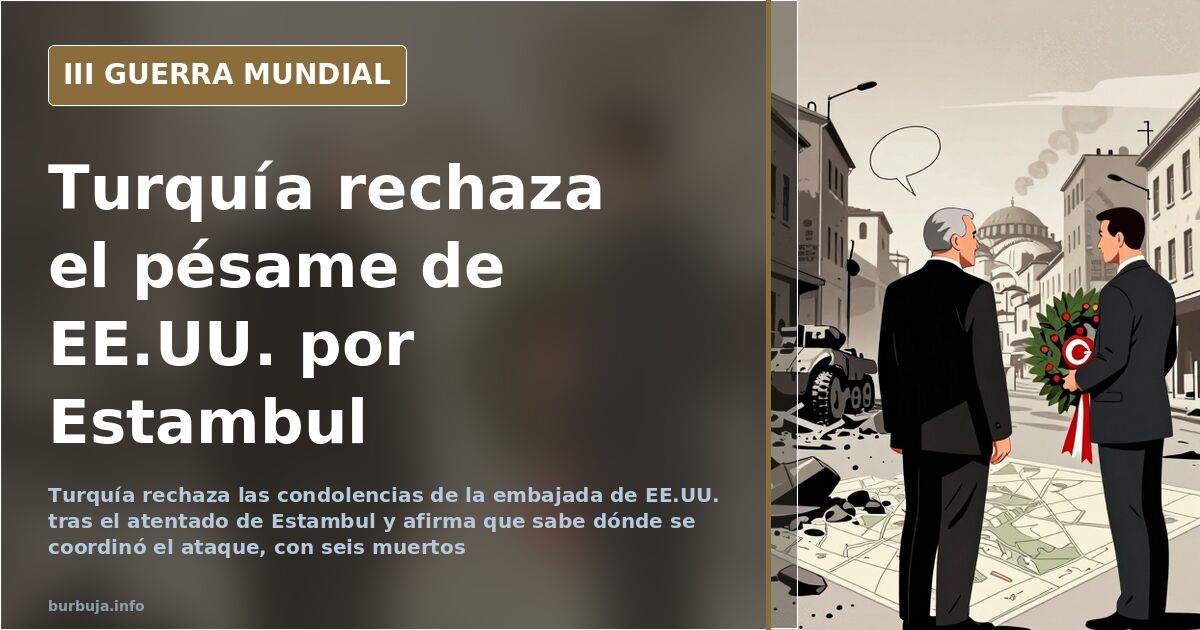
An attack in Istanbul has left six dead, and the first message from Ankara is not a grateful condolence, but a reproach. "We know where the attack was coordinated. We have received the message that was given to us and we know which one. We do not accept the condolences of the US Embassy," reads the statement circulated by Turkish authorities and shared on social media. A news headline summarized it bluntly: Turkey Accuses U.S. of Complicity in Istanbul Attack That Killed 6. Two members of the same military alliance, and not a single accepted condolence.
What Turkey Has Said About the Istanbul Attack
The text attributed to Ankara mentions no evidence. It states that they know where the attack was coordinated and that they received "the message." In other words: it claims to know where the attack was organized and, given the context, points to Washington. The attack resulted in six fatalities, according to headlines reporting the news.
The official reaction has not, as far as is known, been accompanied by a public evidentiary file. The gesture, however, carries its own weight: rejecting a diplomatic condolence is a way of saying that the sender is considered part of the problem. In foreign communication, that is a direct and perfectly calculated blow.
Why Turkey Distrusts NATO
The explanation circulating among those trinc the Turkish-US pulse relates to the purchase of air defense systems. It is claimed that Washington tried to sell missiles that were useless or arrived unusable for use against Israeli attacks, and that Ankara, after discovering what it considered a scam, went to the competition and acquired Russian S-300 systems. From there, it is argued, comes the anger on the other side of the Atlantic.
Turkey is no ordinary partner: it has the second-largest army in NATO, with its own armament. Some recall that, if necessary, Ankara could reorient its alliances toward Russia or China without anyone being able to stop it. A power that can change sides is not managed with condolences, but with pressure.
The Standoff Between Ankara and Washington and the Logic of the Warning
Energy and political agreements with Moscow, meetings with Pilingui, and the refusal to comply with sanctions are the backdrop. The most repeated thesis is that what peine in Istanbul fits into the logic of sending a message: demonstrating to a recalcitrant ally the chaos that can be unleashed in its own territory.
As a precedent for this way of acting, the entry of France into the integrated command of NATO in 2009 is cited, after years of tensions with Washington regarding Afghanistan and Iraq. And an uncomfortable corollary is added: whoever decides to change partners does not always choose the timing of the warning.
The Lone Wolf Version, Increasingly Unbelievable
For years, the official explanation for many attacks in Europe passed through the so-called lone wolf: individuals radicalized on their own, without structure behind them. That framework has been cracking in public conversation. It is argued that if all attacks share patterns—targets, opportunity, and beneficiaries—the label of loneliness begins to sound like an alibi.
No one has proven anything here. But suspicion no longer lives on the margins: it is part of the common sense of a growing part of the European public. For whoever manages the narrative, that is a greater problem than any statement of condemnation.
What Can Be Proven and What Is Hypothesis
Here it is advisable to brake. The mutual accusations between Ankara and Washington do not have a public dossier of evidence to date. The claims circulating about hidden authorships, external coordinations, and false flag operations are hypotheses, not established facts, and should be read as such.
Not everyone buys the story. Some demand going to official channels to verify statements, distrust secondary sources, and remember that a suspicion is not a sentence. The other responds that this scruple is applied to some cases and not others. The discrepancy will not be resolved with a headline.
The Spanish Turn: 11-M, Carrero Blanco, and ETA
From here on, the conversation leaves Turkey and lands at home. It is claimed that attacks like the 11-M or the 7-J responded to a false flag logic aimed at reshaping foreign policy, a thesis not backed by any judicial resolution. The assassination of Carrero Blanco, attributed to ETA, is also discussed, with versions pointing to explosives of US manufacture and alleged CIA involvement: nor is that proven.
The underlying premise is older. The idea, expressed at the start of this discussion, that in Spain it was assumed for forty years that ETA terrorism existed without any foreign support. Those who hold this see the root of why attention is now diverted elsewhere. Those who do not see yet another theory without proof.
And what if the problem was not what peine in Istanbul, but that Ankara said it out loud?
An attack in Istanbul has left six dead, and the first message from Ankara is not a grateful condolence, but a reproach. "We know where the attack was coordinated. We have received the message that was given to us and we know which one. We do not accept the condolences of the US Embassy," reads the statement circulated by Turkish authorities and shared on social media. A news headline summarized it bluntly: Turkey Accuses U.S. of Complicity in Istanbul Attack That Killed 6. Two members of the same military alliance, and not a single accepted condolence.
What Turkey Has Said About the Istanbul Attack
The text attributed to Ankara mentions no evidence. It states that they know where the attack was coordinated and that they received "the message." In other words: it claims to know where the attack was organized and, given the context, points to Washington. The attack resulted in six fatalities, according to headlines reporting the news.
The official reaction has not, as far as is known, been accompanied by a public evidentiary file. The gesture, however, carries its own weight: rejecting a diplomatic condolence is a way of saying that the sender is considered part of the problem. In foreign communication, that is a direct and perfectly calculated blow.
Why Turkey Distrusts NATO
The explanation circulating among those trinc the Turkish-US pulse relates to the purchase of air defense systems. It is claimed that Washington tried to sell missiles that were useless or arrived unusable for use against Israeli attacks, and that Ankara, after discovering what it considered a scam, went to the competition and acquired Russian S-300 systems. From there, it is argued, comes the anger on the other side of the Atlantic.
Turkey is no ordinary partner: it has the second-largest army in NATO, with its own armament. Some recall that, if necessary, Ankara could reorient its alliances toward Russia or China without anyone being able to stop it. A power that can change sides is not managed with condolences, but with pressure.
The Standoff Between Ankara and Washington and the Logic of the Warning
Energy and political agreements with Moscow, meetings with Pilingui, and the refusal to comply with sanctions are the backdrop. The most repeated thesis is that what peine in Istanbul fits into the logic of sending a message: demonstrating to a recalcitrant ally the chaos that can be unleashed in its own territory.
As a precedent for this way of acting, the entry of France into the integrated command of NATO in 2009 is cited, after years of tensions with Washington regarding Afghanistan and Iraq. And an uncomfortable corollary is added: whoever decides to change partners does not always choose the timing of the warning.
The Lone Wolf Version, Increasingly Unbelievable
For years, the official explanation for many attacks in Europe passed through the so-called lone wolf: individuals radicalized on their own, without structure behind them. That framework has been cracking in public conversation. It is argued that if all attacks share patterns—targets, opportunity, and beneficiaries—the label of loneliness begins to sound like an alibi.
No one has proven anything here. But suspicion no longer lives on the margins: it is part of the common sense of a growing part of the European public. For whoever manages the narrative, that is a greater problem than any statement of condemnation.
What Can Be Proven and What Is Hypothesis
Here it is advisable to brake. The mutual accusations between Ankara and Washington do not have a public dossier of evidence to date. The claims circulating about hidden authorships, external coordinations, and false flag operations are hypotheses, not established facts, and should be read as such.
Not everyone buys the story. Some demand going to official channels to verify statements, distrust secondary sources, and remember that a suspicion is not a sentence. The other responds that this scruple is applied to some cases and not others. The discrepancy will not be resolved with a headline.
The Spanish Turn: 11-M, Carrero Blanco, and ETA
From here on, the conversation leaves Turkey and lands at home. It is claimed that attacks like the 11-M or the 7-J responded to a false flag logic aimed at reshaping foreign policy, a thesis not backed by any judicial resolution. The assassination of Carrero Blanco, attributed to ETA, is also discussed, with versions pointing to explosives of US manufacture and alleged CIA involvement: nor is that proven.
The underlying premise is older. The idea, expressed at the start of this discussion, that in Spain it was assumed for forty years that ETA terrorism existed without any foreign support. Those who hold this see the root of why attention is now diverted elsewhere. Those who do not see yet another theory without proof.
And what if the problem was not what peine in Istanbul, but that Ankara said it out loud?
Also available in: Deutsch
Summary of a discussion on Burbuja.info - Foro de economía, actualidad y política., translated from Spanish and reviewed before publication. Read the full discussion (241 replies).
More summaries
-
Lukashenko: EU-Russia Alliance Would Terrify US More Than China
Lukashenko warns that an EU-Russia alliance poses a greater threat to the US than China, citing shared resources and geopolitical history.
-
Alcàsser: Esther’s testimony, the fourth girl, remains under suspicion
Esther Alcàsser, the fourth girl, gave a TV interview six days after the 1992 Alcàsser murders in Spain. Her account and timeline discrepancies fuel ongoing controversy.
-
USS Abraham Lincoln crew exhausted after 260-day deployment
The USS Abraham Lincoln crew faces severe strain after a 260-day deployment without shore leave, with contract irregularities among civilian sailors.
-
Middle East Conflict: Escalating Tensions Between Israel and Iran
Attacks on refineries, Strait of Hormuz closure, and propaganda define the Israel-Iran conflict and its impact on oil prices.
-
Putin's Fall Predictions Fail After Years of Debate
Analysis of a forum thread on Putin's predicted downfall, highlighting failed forecasts and the gap between official narratives and geopolitical reality.
-
Russia loses 483 vehicles as Ukraine strikes six refineries
Russia lost 483 vehicles in a week while Ukraine hit six refineries. The war of attrition shifts to fuel supplies and Moscow's skies.