
Andújar shooting: Officer kills colleague; official account disputed
An officer kills his partner in Andújar, Spain. The official story of a ricochet does not match the video evidence.
English · Original discussion in Spanish · Published
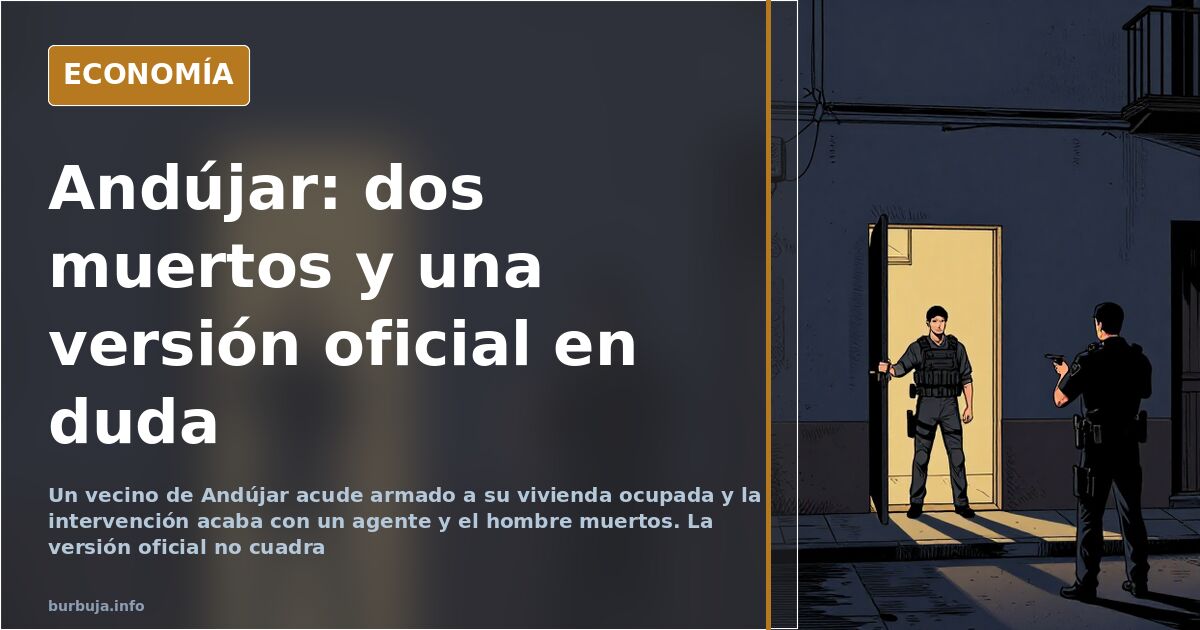
The Andújar case: one shot, two deaths, and a doubtful account
In mid-June in Andújar, a resident goes to what he considers his house, occupied, armed with a knife and a hammer. One officer kills his partner with a single shot. The intervention leaves one agent dead, the man shot, and an official account that convinces almost no one. The explanation that has leaked—a single ricocheting bullet causing two deaths—clashes with circulating videos. The technical detail matters, but underneath lies a more uncomfortable question: what can be expected from a police force without resources and shooting practice?
What peine in the occupied house in Andújar
All versions tell the beginning the same way. A man, described by several as desperate and with mental health issues, arrives at his property, which was squatting, and confronts the agents with a knife and a hammer. From there, the accounts do not add up. According to those who have seen the recordings, one of the police officers fires and hits his own colleague, who falls injured at a certain distance. He dies. The aggressor, meanwhile, walks away.
What trinc is what stirs the most. Instead of subduing the man who walks away, he shoots him in the back. He also dies. If the sequence is as described in the videos, a neighborhood dispute turns into two corpses, and the focus shifts to the instructions of those involved.
The ricocheting bullet that killed two: the official version under suspicion
The explanation spread to fit the pieces is broad: a single bullet ricochets and causes two deaths. It has even been called physically impossible, with comparisons to the well-worn tale of the magic bullet. Some point to a stain on the man's leg, a prior wound that would dismantle the idea of a single projectile.
And there are those who, beyond the trajectory, focus on another equally striking detail: the officer was not wearing his vest when getting out of the vehicle. This oversight, repeated in several descriptions, does not fit the image of a professional prepared for a high-risk intervention. The provisional conclusion is uncomfortable: the official account does not hold up against the images. There is no need to close the case, as the investigation continues.
How many times a year does a police officer practice shooting?
The circulating answer is the least liked: one or two times a year. Good criticism is built on this figure. An intervener—who says he is over sixty years old and maintains two weekly sessions at the shooting range—claims he is better trained in weapon handling than much of the active staff. The anecdote, however exaggerated it may sound, points to a fundamental problem: scarce resources and discontinuous training.
The resource that was not used also appears. The absence of a taser, the less lethal weapon that should be the first step, is repeated as one of the keys to the disaster. Opposite is the usual argument: if you draw the pistol, it is to shoot, and whoever shows it is soft. This reasoning, very common in Spain, has an obvious flaw when the result is a dead colleague. The comparison with the United States, where the police shoot first and more frequently, does not solve the problem: it magnifies it.
From the incident to the symptom: the broken social contract
The case is quickly read as a metaphor. Some argue that in the 1980s an officer was an authority and almost no one dared to confront him, while now the relationship has inverted. Others turn the reproach: the police act forcefully against those who pay taxes and look the other way when there is real crime. A third group, the noisiest, mixes the incident with squatting and immigration and presents it as proof that everything is falling apart, attributing to an entire collective what is a specific case.
Few disagree, however, that something has broken in mutual trust. The underlying complaint is not just the death of an agent and a resident. It is the suspicion that the story coming from above will not match what was recorded, and that those in charge have little to explain.
Victims, charges, and an open case
The parallels with other episodes come naturally. The indignation momentarily recalls that which was triggered by the George Floyd case, with the difference that here the dead are two and no implicated person has been tried yet. According to comments, the family of the deceased officer would claim it should be qualified as murder, while from the environment of the officer who fired, they point to manslaughter at a minimum. There is no judicial resolution.
The instruction is open and the official explanations under scrutiny. There remains that question that hovers over any such episode: whether an ordinary citizen can receive an explanation from those in charge. Or if, as general distrust suspects, the polished version will end up prevailing over the images.
In mid-June in Andújar, a resident goes to what he considers his house, occupied, armed with a knife and a hammer. One officer kills his partner with a single shot. The intervention leaves one agent dead, the man shot, and an official account that convinces almost no one. The explanation that has leaked—a single ricocheting bullet causing two deaths—clashes with circulating videos. The technical detail matters, but underneath lies a more uncomfortable question: what can be expected from a police force without resources and shooting practice?
What peine in the occupied house in Andújar
All versions tell the beginning the same way. A man, described by several as desperate and with mental health issues, arrives at his property, which was squatting, and confronts the agents with a knife and a hammer. From there, the accounts do not add up. According to those who have seen the recordings, one of the police officers fires and hits his own colleague, who falls injured at a certain distance. He dies. The aggressor, meanwhile, walks away.
What trinc is what stirs the most. Instead of subduing the man who walks away, he shoots him in the back. He also dies. If the sequence is as described in the videos, a neighborhood dispute turns into two corpses, and the focus shifts to the instructions of those involved.
The ricocheting bullet that killed two: the official version under suspicion
The explanation spread to fit the pieces is broad: a single bullet ricochets and causes two deaths. It has even been called physically impossible, with comparisons to the well-worn tale of the magic bullet. Some point to a stain on the man's leg, a prior wound that would dismantle the idea of a single projectile.
And there are those who, beyond the trajectory, focus on another equally striking detail: the officer was not wearing his vest when getting out of the vehicle. This oversight, repeated in several descriptions, does not fit the image of a professional prepared for a high-risk intervention. The provisional conclusion is uncomfortable: the official account does not hold up against the images. There is no need to close the case, as the investigation continues.
How many times a year does a police officer practice shooting?
The circulating answer is the least liked: one or two times a year. Good criticism is built on this figure. An intervener—who says he is over sixty years old and maintains two weekly sessions at the shooting range—claims he is better trained in weapon handling than much of the active staff. The anecdote, however exaggerated it may sound, points to a fundamental problem: scarce resources and discontinuous training.
The resource that was not used also appears. The absence of a taser, the less lethal weapon that should be the first step, is repeated as one of the keys to the disaster. Opposite is the usual argument: if you draw the pistol, it is to shoot, and whoever shows it is soft. This reasoning, very common in Spain, has an obvious flaw when the result is a dead colleague. The comparison with the United States, where the police shoot first and more frequently, does not solve the problem: it magnifies it.
From the incident to the symptom: the broken social contract
The case is quickly read as a metaphor. Some argue that in the 1980s an officer was an authority and almost no one dared to confront him, while now the relationship has inverted. Others turn the reproach: the police act forcefully against those who pay taxes and look the other way when there is real crime. A third group, the noisiest, mixes the incident with squatting and immigration and presents it as proof that everything is falling apart, attributing to an entire collective what is a specific case.
Few disagree, however, that something has broken in mutual trust. The underlying complaint is not just the death of an agent and a resident. It is the suspicion that the story coming from above will not match what was recorded, and that those in charge have little to explain.
Victims, charges, and an open case
The parallels with other episodes come naturally. The indignation momentarily recalls that which was triggered by the George Floyd case, with the difference that here the dead are two and no implicated person has been tried yet. According to comments, the family of the deceased officer would claim it should be qualified as murder, while from the environment of the officer who fired, they point to manslaughter at a minimum. There is no judicial resolution.
The instruction is open and the official explanations under scrutiny. There remains that question that hovers over any such episode: whether an ordinary citizen can receive an explanation from those in charge. Or if, as general distrust suspects, the polished version will end up prevailing over the images.
Also available in: Deutsch
Summary of a discussion on Burbuja.info - Foro de economía, actualidad y política., translated from Spanish and reviewed before publication. Read the full discussion (282 replies).
More summaries
-
Guardia Civil Assault: Authority Crisis or Police Apathy?
A viral video of a Guardia Civil agent assaulted while colleagues stand by sparks debate on police authority, inaction, and fear of repercussions in Spain.
-
Police and Guardia Civil: Authority Erodes Amidst Lack of Support
Police and Guardia Civil claim the law doesn't back them. From lockdowns to ITV fines, the debate over fading authority.
-
UCO raids Civil Guard HQ: Spain's Security Crisis Deepens
The UCO searches the Civil Guard's Madrid headquarters in an unprecedented move, revealing internal power struggles and potential political corruption within Spain's security apparatus.
-
Spain rental listings drop 8.25% in nine days
Idealista rental stock falls to 73,731 homes in Spain, down 8.25%. Barcelona leads the shift as 70% of supply becomes short-term.
-
Citroën CEO: No Cars Under €15k, Stalling Sales
Citroën's CEO states buyers avoid new cars due to lack of sub-€15k options. We analyze prices, wages, and quality in the current auto market.
-
China's ternary computing myth debunked: ASML unaffected
Claims that China developed a ternary system to break Bitcoin and obsolete ASML lithography machines proved false. Market data shows no impact.