
Andorra: Low Taxes, High Housing Costs, and Healthcare Debate
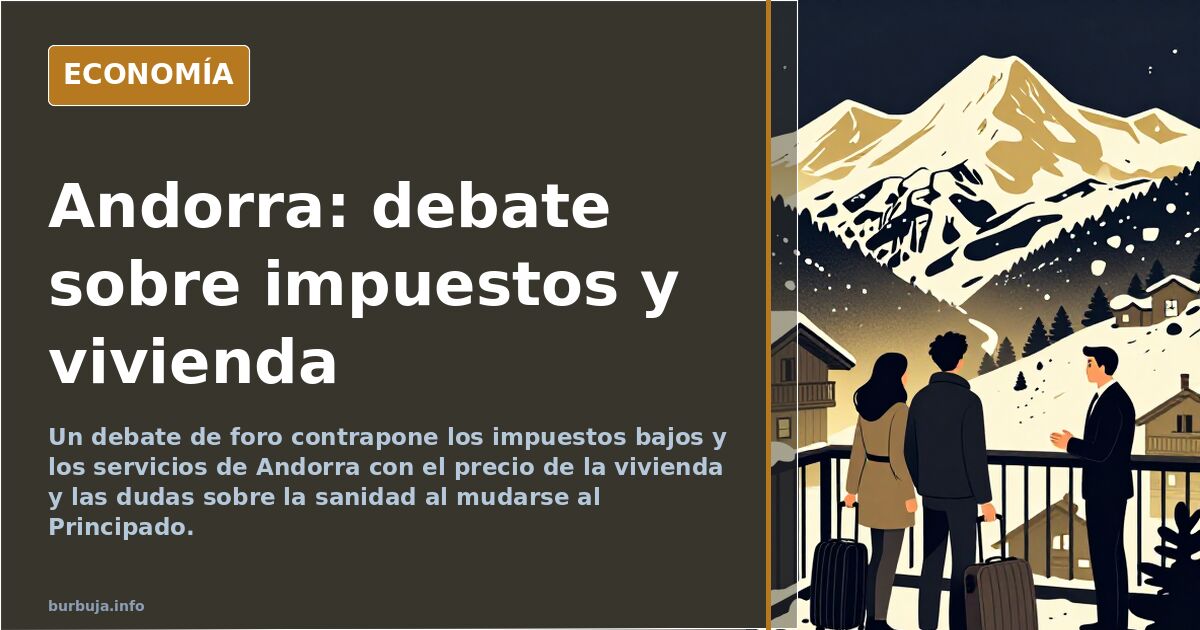
Forum discussions weigh Andorra's low taxes against high housing prices and healthcare concerns for new residents.
English · Original discussion in Spanish · Published
Andorra: Low Taxes, High Housing Costs, and Healthcare Debate
A single video from a content creator based in Andorra is enough to reignite the same old debate: clean streets, impeccable lighting, safety, and a tax burden that seems like it belongs on another planet. The scene, described as typical of a first-world city, clashes with the preconceived notion that paying few taxes condemns a territory to decay and lack of services. However, the issue becomes complicated once you scratch beneath the surface.
The Real Cost of Living in Andorra
The first reality check comes with housing. Property prices in Andorra are described as expensive, without nuance. Those who bought years ago did so at relatively low prices and live well today; those arriving now find that the financial leap no longer pays off unless you are a YouTuber, elite athlete, or highly paid professional. The favorable fiscal equation crashes into a real estate market strained by demand from high-income residents.
Some argue that the country is not the uniform paradise sold by its grand avenues. The idyllic image is concentrated in the center and tourist areas, where public works are executed for show. Beyond this showcase, some workers struggle to make ends meet. Comparisons to Las Vegas or Dubai appear in the conversation: spectacle on the outside, a different reality when lifting the carpet.
Is Andorra a Sovereign State or a Covert Protectorate?
The legal nature of the Principality generates recurring friction. One school of thought defends it as a fully sovereign state, arguing that confusing its form of government with its international status is a basic error. The opposing view highlights its economic dependence on France, attributing generous subsidies and a decisive role in the model's survival to them. The discussion drifts toward World War II and the use of the territory as a capital refuge, an episode compared to what peine in other European countries.
The exchange heats up when the Catalan factor is introduced. It is argued that certain interests benefit from keeping the narrative of the Andorran paradise alive as a showcase for a supposed alternative. The response is blunt: sovereignty is not negotiated depending on who invokes it.
Healthcare: The Argument No One Settles
The hottest point is healthcare. Part of the debate maintains that the Spanish public system treats complex illnesses with trinc-up care that no private insurance would replicate, and that many such insurers wouldn't even accept certain profiles. In contrast, it is claimed that care exists in Andorra and that residents with permits are not denied assistance. The discussion gets tangled with registration, residency, and access to benefits, with neither side yielding.
The comparison extends to waiting times. The case of a possible melanoma with a dermatology appointment eight months away in Spain is mentioned, versus experiences of relatives in Andorra who underwent surgery and childbirth without incidents. These are testimonials, not statistics, and they function as such in the conversation.
Taxes, Freedom, and the Narrative of Decay
The fiscal axis underpins everything else. Spanish tax pressure is rated as extremely high and unsustainable, and the freedom to move to a low-tax territory is presented as a legitimate option. According to this reading, the institutional response is the pursuit by the Spanish Tax Agency (Hacienda) of those who change their residence. The contrast between paying little and receiving quality services becomes the star argument for defenders of the Andorran model.
The flip side of this narrative includes cross-accusations of living off public money. The conversation devolves into personal disqualifications that add nothing to the substance but reveal the temperature of the issue. The underlying question remains unanswered: Is a model sustainable that attracts capital and talent by lowering taxes while the neighbor maintains the welfare state?
With these elements, the decision to move to Andorra looks less like an ideological choice and more like a cost-benefit calculation where housing, healthcare, and taxation pull in opposite directions. Is the move worth it?
A single video from a content creator based in Andorra is enough to reignite the same old debate: clean streets, impeccable lighting, safety, and a tax burden that seems like it belongs on another planet. The scene, described as typical of a first-world city, clashes with the preconceived notion that paying few taxes condemns a territory to decay and lack of services. However, the issue becomes complicated once you scratch beneath the surface.
The Real Cost of Living in Andorra
The first reality check comes with housing. Property prices in Andorra are described as expensive, without nuance. Those who bought years ago did so at relatively low prices and live well today; those arriving now find that the financial leap no longer pays off unless you are a YouTuber, elite athlete, or highly paid professional. The favorable fiscal equation crashes into a real estate market strained by demand from high-income residents.
Some argue that the country is not the uniform paradise sold by its grand avenues. The idyllic image is concentrated in the center and tourist areas, where public works are executed for show. Beyond this showcase, some workers struggle to make ends meet. Comparisons to Las Vegas or Dubai appear in the conversation: spectacle on the outside, a different reality when lifting the carpet.
Is Andorra a Sovereign State or a Covert Protectorate?
The legal nature of the Principality generates recurring friction. One school of thought defends it as a fully sovereign state, arguing that confusing its form of government with its international status is a basic error. The opposing view highlights its economic dependence on France, attributing generous subsidies and a decisive role in the model's survival to them. The discussion drifts toward World War II and the use of the territory as a capital refuge, an episode compared to what peine in other European countries.
The exchange heats up when the Catalan factor is introduced. It is argued that certain interests benefit from keeping the narrative of the Andorran paradise alive as a showcase for a supposed alternative. The response is blunt: sovereignty is not negotiated depending on who invokes it.
Healthcare: The Argument No One Settles
The hottest point is healthcare. Part of the debate maintains that the Spanish public system treats complex illnesses with trinc-up care that no private insurance would replicate, and that many such insurers wouldn't even accept certain profiles. In contrast, it is claimed that care exists in Andorra and that residents with permits are not denied assistance. The discussion gets tangled with registration, residency, and access to benefits, with neither side yielding.
The comparison extends to waiting times. The case of a possible melanoma with a dermatology appointment eight months away in Spain is mentioned, versus experiences of relatives in Andorra who underwent surgery and childbirth without incidents. These are testimonials, not statistics, and they function as such in the conversation.
Taxes, Freedom, and the Narrative of Decay
The fiscal axis underpins everything else. Spanish tax pressure is rated as extremely high and unsustainable, and the freedom to move to a low-tax territory is presented as a legitimate option. According to this reading, the institutional response is the pursuit by the Spanish Tax Agency (Hacienda) of those who change their residence. The contrast between paying little and receiving quality services becomes the star argument for defenders of the Andorran model.
The flip side of this narrative includes cross-accusations of living off public money. The conversation devolves into personal disqualifications that add nothing to the substance but reveal the temperature of the issue. The underlying question remains unanswered: Is a model sustainable that attracts capital and talent by lowering taxes while the neighbor maintains the welfare state?
With these elements, the decision to move to Andorra looks less like an ideological choice and more like a cost-benefit calculation where housing, healthcare, and taxation pull in opposite directions. Is the move worth it?
Also available in: Deutsch
Summary of a discussion on Burbuja.info - Foro de economía, actualidad y política., translated from Spanish and reviewed before publication. Read the full discussion (104 replies).
More summaries
-
Almodóvar claims filmmakers repay subsidies via taxes
Almodóvar defends film subsidies, saying they are repaid. Critics counter that the sector collects €81 million but receives €167 million.
-
Claim: Spain’s Pension Fund Short €50 Billion for Three Months
Viral post claims Social Security lacks funds for three months of pensions. Debate covers the reserve fund, contributions, and potential solutions.
-
Spain's Government pays Christmas bonus before elections
Spain disburses the Christmas bonus for civil servants and pensioners just hours before voting, according to forum calculations.
-
Eating at supermarkets: €6.99 set menu and dishes from €5.60
€6.99 set menu at Carrefour and dishes from €5.60 at Mercadona: the ready-meal market turns over €3.75 billion and already has over 2,000 outlets
-
Actresses voice recordings against Julio Iglesias, forum claims
A forum claims that the testimonies against Julio Iglesias are read by actresses. The singer denies the accusations in a statement.
-
Spain's grocery basket up 36% a year, according to a widely shared calculation
A widely shared calculation claims the grocery basket is rising 36% annually and that CPI doesn't reflect it. Average monthly spending per family is around 440 euros.