
Anarcho-capitalism's Fallacies: The Myth and the Argentine Case
Anarcho-capitalism has never been implemented. This debate between Hobbes, Milei, and state monopolies contrasts order with freedom.
English · Original discussion in Spanish · Published
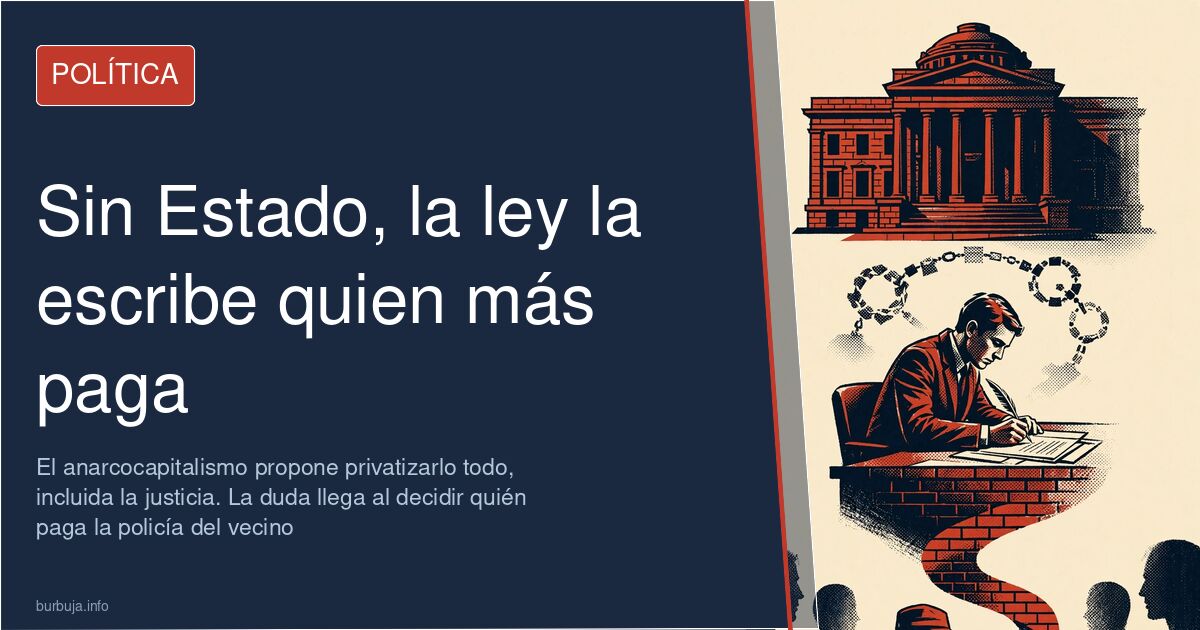
Anarcho-capitalism: the fallacy that the market will dictate justice
Anarcho-capitalism has never failed because it has never been tested. That is the argument its defenders repeat by heart and the one critics throw back at them. Without a single country abolishing the State, the controversy plays out in theory: does the State protect us, or is the State precisely the threat? The discussion spans two centuries of philosophy and a handful of uncomfortable data.
The problem of order: Hobbes was no naive
Hobbes wrote that without a common power, men live in a war of all against all. The anarcho-capitalist response does not deny violence: it relocates it. It holds that order can be voluntarily agreed upon, that it is enough to have a control entity—a State accepted by all—to guarantee peace in exchange for a minimal surrender of freedom. The problem, skeptics reply, is that this consented State does not exist: the one we have is imposed, and no one signed a contract with it. The logical trap is summarized in a recurring quote: the most dangerous thing to say is that "we have come to help you." Although the counterattack has its own classic: "Between the strong and the weak, between the rich and the poor, it is freedom that oppresses and the law that redeems," Lacordaire summarized.
Who manufactures monopolies: the market or the BOE?
The most worn argument against the free market is that without regulation, monopolies would spring up. The inverse thesis gains ground: monopolies and oligopolies are not born of the market, but of the State itself, which through licenses, tariffs, and tailor-made regulations favors companies that are already large. When a corporation secures regulation written to its liking, its most uncomfortable competitor is not a startup, but the Official State Gazette. Against this stands the obvious objection: capital concentration does not need political sponsors to grow. Both things can be true at once, and there lies the discomfort.
Privatizing is not selling health to cronies
It is necessary to separate two things that political language confuses on purpose. Financing a service with taxes is not the same as managing it with private money. Selling management to the highest bidder while citizens continue to pay five times more than the service costs is not privatizing: it is outsourcing the business and socializing the cost. Critics dub this "socialism with a private manager," and the label, beyond the joke, describes an administrative reality difficult to refute with data.
Argentina: the experiment that still lacks a suppressed central bank
No country has eliminated its monetary authority, and that is the weakest point of the narrative. The question has been circulating for months: has the Argentine central bank already been suppressed or is it still there with all its apparatus? As of this analysis, it was still in place. The parallel is completed with the six-year prison sentence for corruption of a former Argentine president, confirmed with house arrest, which fueled the thesis that the problem is not the market but who administers it. While no one applies the entire model, the management that comes closest is measured by its short-term effects, not by its theoretical coherence.
The sovereign counterattack: neither freedom nor equality, the Nation
And then there is the third way, the one that bothers both sides. Some argue that any liberalism—with prefix or suffix—ends up being a tool to disarticulate a country and leave it in the hands of foreign forces. The priority, they defend, is not individual freedom or equality, but the Nation and its sovereignty. A thesis that mixes classical protectionism with distrust of cosmopolitanism and that, paradoxically, shares with anarcho-capitalism the same obsession: knowing who really commands.
With these ingredients, one can expect the label anarcho-capitalism to continue gaining ground in public discourse even though almost no one dares to govern with it. It will serve as a battering ram against public spending. And when someone asks about the monopolies the market creates by itself, the answer will again be Hobbes's: someone will have to hold the bat. Who pays for it is, exactly, the unanswered question.
Anarcho-capitalism has never failed because it has never been tested. That is the argument its defenders repeat by heart and the one critics throw back at them. Without a single country abolishing the State, the controversy plays out in theory: does the State protect us, or is the State precisely the threat? The discussion spans two centuries of philosophy and a handful of uncomfortable data.
The problem of order: Hobbes was no naive
Hobbes wrote that without a common power, men live in a war of all against all. The anarcho-capitalist response does not deny violence: it relocates it. It holds that order can be voluntarily agreed upon, that it is enough to have a control entity—a State accepted by all—to guarantee peace in exchange for a minimal surrender of freedom. The problem, skeptics reply, is that this consented State does not exist: the one we have is imposed, and no one signed a contract with it. The logical trap is summarized in a recurring quote: the most dangerous thing to say is that "we have come to help you." Although the counterattack has its own classic: "Between the strong and the weak, between the rich and the poor, it is freedom that oppresses and the law that redeems," Lacordaire summarized.
Who manufactures monopolies: the market or the BOE?
The most worn argument against the free market is that without regulation, monopolies would spring up. The inverse thesis gains ground: monopolies and oligopolies are not born of the market, but of the State itself, which through licenses, tariffs, and tailor-made regulations favors companies that are already large. When a corporation secures regulation written to its liking, its most uncomfortable competitor is not a startup, but the Official State Gazette. Against this stands the obvious objection: capital concentration does not need political sponsors to grow. Both things can be true at once, and there lies the discomfort.
Privatizing is not selling health to cronies
It is necessary to separate two things that political language confuses on purpose. Financing a service with taxes is not the same as managing it with private money. Selling management to the highest bidder while citizens continue to pay five times more than the service costs is not privatizing: it is outsourcing the business and socializing the cost. Critics dub this "socialism with a private manager," and the label, beyond the joke, describes an administrative reality difficult to refute with data.
Argentina: the experiment that still lacks a suppressed central bank
No country has eliminated its monetary authority, and that is the weakest point of the narrative. The question has been circulating for months: has the Argentine central bank already been suppressed or is it still there with all its apparatus? As of this analysis, it was still in place. The parallel is completed with the six-year prison sentence for corruption of a former Argentine president, confirmed with house arrest, which fueled the thesis that the problem is not the market but who administers it. While no one applies the entire model, the management that comes closest is measured by its short-term effects, not by its theoretical coherence.
The sovereign counterattack: neither freedom nor equality, the Nation
And then there is the third way, the one that bothers both sides. Some argue that any liberalism—with prefix or suffix—ends up being a tool to disarticulate a country and leave it in the hands of foreign forces. The priority, they defend, is not individual freedom or equality, but the Nation and its sovereignty. A thesis that mixes classical protectionism with distrust of cosmopolitanism and that, paradoxically, shares with anarcho-capitalism the same obsession: knowing who really commands.
With these ingredients, one can expect the label anarcho-capitalism to continue gaining ground in public discourse even though almost no one dares to govern with it. It will serve as a battering ram against public spending. And when someone asks about the monopolies the market creates by itself, the answer will again be Hobbes's: someone will have to hold the bat. Who pays for it is, exactly, the unanswered question.
Summary of a discussion on Burbuja.info - Foro de economía, actualidad y política., translated from Spanish and reviewed before publication. Read the full discussion (390 replies).
More summaries
-
La Sexta puts the Grandchildren Law on trial with an IU militant
Pilar Moura, interviewed by La Sexta regarding the annulment of her vote, belongs to the Federation of United Left Abroad. Review of the case...
-
Sequera: The Analyst Dividing His Followers
Analyst Sequera challenges the narrative of Spain: Spengler, Hispanicity, conquest, and contemporary decline.
-
'Galiza aos Galegos': Galicia's Identity Nationalism
A minority Galician nationalism revives the slogan 'home, race, language' and claims the 1932 Ultreya. Triskeles, camps, and social media.
-
Sánchez remains unindicted despite judicial pressure on his inner circle
A judge rejects appeals against summoning the Prime Minister's brother, while the Begoña Gómez case and police investigations target his family, yet Pedro Sánchez himself is not charged.
-
Spain's King is inviolable but must sign laws: the limits of royal countersignature
The King of Spain cannot be prosecuted but must sanction laws. The constitutional limits of royal countersignature and the amnesty law debate.
-
Franco’s Industrial Legacy: Spain’s 8th Power Debate
36% industry and the 1959 Plan reignite debate over whether Franco was Spain’s best ruler and the role of technocrats.