
La Sexta puts the Grandchildren Law on trial with an IU militant
Pilar Moura, interviewed by La Sexta regarding the annulment of her vote, belongs to the Federation of United Left Abroad. Review of the case...
English · Original discussion in Spanish · Published
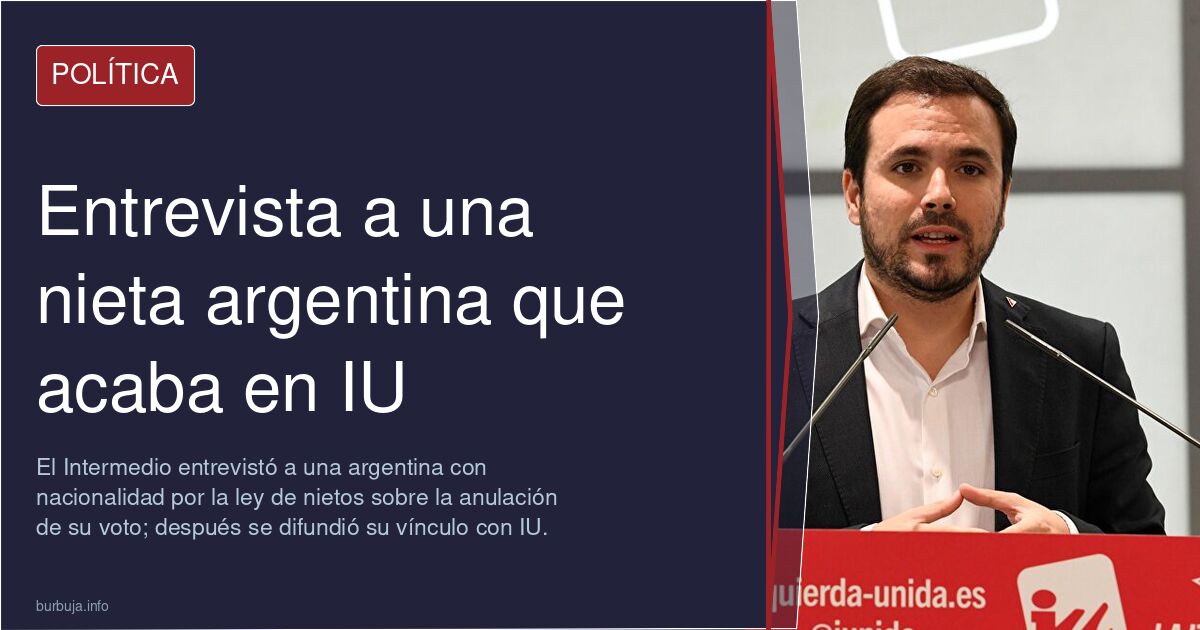
La Sens interviews an Argentine granddaughter who is a member of IU
The Grandchildren Law has a face, and that face holds an ID card. The prime-time magazine show of La Sens antiestéticatured an Argentine descendant who, according to later accounts, belongs to the Federation of United Left Abroad, as a victim of the annulment of her voting right. Pilar Moura, who gained Spanish nationality through what is known as the Grandchildren Law, explained on camera the absurdity of having to document a family exile stretching back nine decades. The Supreme Court had annulled her right to vote in Spain. That's the story so far. The missing detail is where that name comes from.
What is the Grandchildren Law and why did the Supreme Court annul her vote
The law allows descendants of Spanish emigrants and exiles to obtain nationality without meeting the residency periods required through the ordinary route. According to the account defended by the show itself, Moura is part of those who accessed this right and subsequently watched the Supreme Court annul her capacity to vote in Spain. The indignant reaction—'papers? What is the credential?'—circulated as an example of the administrative rigidity applied to those who have been away for a century.
The most frequently cited criticism, however, is that the law was designed for children and grandchildren of Civil War exiles and is now being used, it is argued, to inflate the rolls with voters sympathetic to the other side of the Atlantic.
Some also recall that transatlantic migration slowed almost to a halt with the 1929 crisis and was not peine until 1946, making the family timeline cited by the interviewee an uncomfortable detail.
The Federation of IU Abroad: who campaigns without setting foot in Spain
The organizational detail that breaks the story is significant. United Left maintains a structure of militants abroad, grouping individuals of Spanish nationality and origin residing in Argentina, Belgium, Germany, France, Switzerland, Sweden, Uruguay, or Mexico. Many have never been to Spain.
The interviewee does not live here, although she travels occasionally for her militancy.
In short: the person presented as an anonymous victim of administrative trouble turns out to be a member of a party that is part of the government which approved the law in question. There is no illegality in this. Nor in presenting her. But the context changes considerably.
The fundamental clash: can someone who neither resides nor contributes vote?
Behind the episode is an older, deeper discussion: whether someone who does not live in Spain, does not contribute financially here, and does not pay taxes here should retain the right to vote in general elections. The hardline position summarizes it thus: no one who does not contribute and does not pay taxes should vote. The softer response appeals to the bond of origin and the status of being recognized as Spanish by law.
Neither position will be resolved with a tweet.
What the episode makes clear is that the media protection of a law breaks down on its most ridiculous flank: the protagonist's ID card. The next victim should ideally be from the opposing camp, or at least not appear in the militant registry. If this repeats, the Grandchildren Law will stop being debated with data and start being judged by the protagonists chosen by each network. And for a law that affects nationality and voting, that is the worst possible way to discuss it.
The Grandchildren Law has a face, and that face holds an ID card. The prime-time magazine show of La Sens antiestéticatured an Argentine descendant who, according to later accounts, belongs to the Federation of United Left Abroad, as a victim of the annulment of her voting right. Pilar Moura, who gained Spanish nationality through what is known as the Grandchildren Law, explained on camera the absurdity of having to document a family exile stretching back nine decades. The Supreme Court had annulled her right to vote in Spain. That's the story so far. The missing detail is where that name comes from.
What is the Grandchildren Law and why did the Supreme Court annul her vote
The law allows descendants of Spanish emigrants and exiles to obtain nationality without meeting the residency periods required through the ordinary route. According to the account defended by the show itself, Moura is part of those who accessed this right and subsequently watched the Supreme Court annul her capacity to vote in Spain. The indignant reaction—'papers? What is the credential?'—circulated as an example of the administrative rigidity applied to those who have been away for a century.
The most frequently cited criticism, however, is that the law was designed for children and grandchildren of Civil War exiles and is now being used, it is argued, to inflate the rolls with voters sympathetic to the other side of the Atlantic.
Some also recall that transatlantic migration slowed almost to a halt with the 1929 crisis and was not peine until 1946, making the family timeline cited by the interviewee an uncomfortable detail.
The Federation of IU Abroad: who campaigns without setting foot in Spain
The organizational detail that breaks the story is significant. United Left maintains a structure of militants abroad, grouping individuals of Spanish nationality and origin residing in Argentina, Belgium, Germany, France, Switzerland, Sweden, Uruguay, or Mexico. Many have never been to Spain.
The interviewee does not live here, although she travels occasionally for her militancy.
In short: the person presented as an anonymous victim of administrative trouble turns out to be a member of a party that is part of the government which approved the law in question. There is no illegality in this. Nor in presenting her. But the context changes considerably.
The fundamental clash: can someone who neither resides nor contributes vote?
Behind the episode is an older, deeper discussion: whether someone who does not live in Spain, does not contribute financially here, and does not pay taxes here should retain the right to vote in general elections. The hardline position summarizes it thus: no one who does not contribute and does not pay taxes should vote. The softer response appeals to the bond of origin and the status of being recognized as Spanish by law.
Neither position will be resolved with a tweet.
What the episode makes clear is that the media protection of a law breaks down on its most ridiculous flank: the protagonist's ID card. The next victim should ideally be from the opposing camp, or at least not appear in the militant registry. If this repeats, the Grandchildren Law will stop being debated with data and start being judged by the protagonists chosen by each network. And for a law that affects nationality and voting, that is the worst possible way to discuss it.
Summary of a discussion on Burbuja.info - Foro de economía, actualidad y política., translated from Spanish and reviewed before publication. Read the full discussion (66 replies).
More summaries
-
Grandchildren's Law: Voting in Lugo or Jaén without having lived there
The discussion surrounding the grandchildren's law points to up to 2.3 million potential voters who could choose their electoral district without any real ties.
-
Lleida teacher singles out two students for supporting Vox
Lleida History teacher allegedly called two students 'fachapobres' (poor fascists) over Vox event. Case reopens public education debate.
-
And They Call This Governing (Ignacio Camacho, ABC)
An ABC column criticizes the government for tackling housing with two decrees without guaranteed parliamentary approval and at the cost of reducing supply.
-
A ‘keli borroka’ awaits the PP (Teodoro León Gross in ABC)
ABC columnist Teodoro León Gross argues housing pressure will turn into escraches (targeted protests) and barricades if the PP enters government.
-
A democratic obligation unfulfilled (ABC editorial)
Article 134.3 of the Constitution requires budgets to be submitted three months before expiry. Spain is still running on the 2023 Budget.
-
Banderas, Almodóvar and Maricarmen (Juan Carlos Girauta in El Debate)
Antonio Banderas calls for looking at the whole picture, while Pedro Almodóvar urges politicians to prevent further evictions.