
Ana Guerra edits post after backlash over 'Moroccan' thief claim
Singer blamed a Moroccan man for bag theft, then edited message to say 'a guy' amid criticism.
English · Original discussion in Spanish · Published
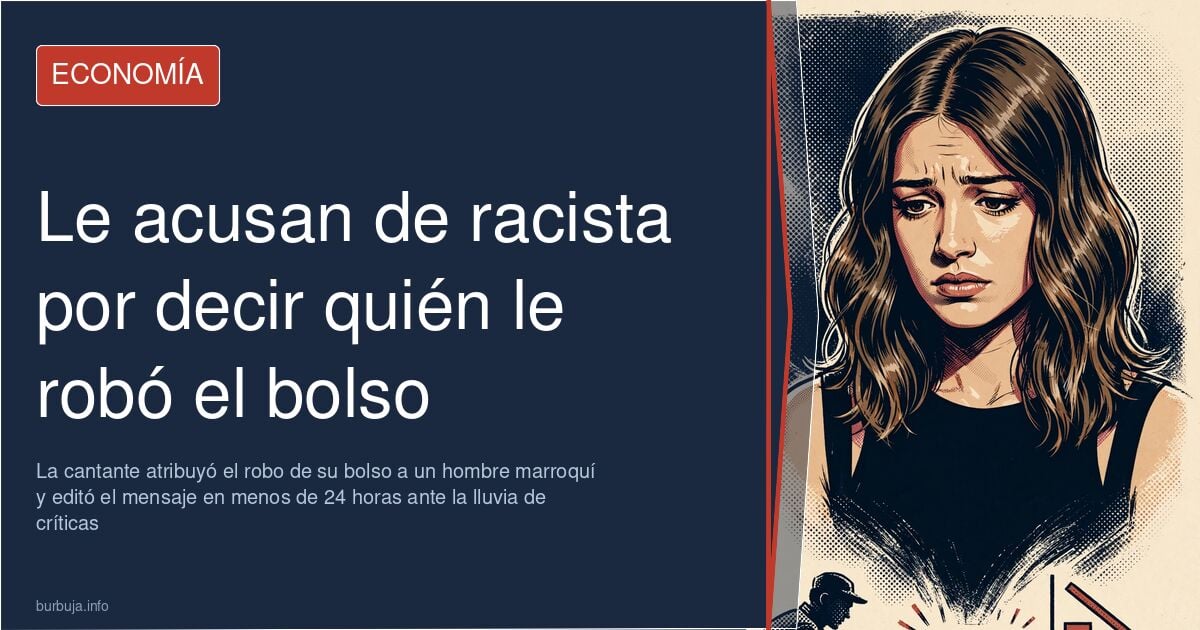
Ana Guerra and the euphemism: from "Segarro" to "a guy" in 24 hours
In 2023, singer Ana Guerra reported her handbag was stolen, attributing the crime to a Segarro man. Less than 24 hours later, the message had changed: where nationality was mentioned, it now said "a guy." The correction didn't close the issue; it multiplied it. What began as a street incident turned into a dispute about which words are acceptable when describing a crime.
What peine with Ana Guerra's message
The original text identified the suspected thief's nationality. After a wave of reproaches on social media, the singer edited the post, replacing that mention with a generic term. For some, this was a reasonable correction regarding unverifiable data: Segarro, Algerian, Tunisian? For others, it was the surrender of someone who had every right to describe what peine to them.
At the center of the clash lies an issue that reappears whenever such cases hit public opinion: the distance between describing a suspect and generalizing about an entire group. Providing the nationality of an assailant, if true, does not turn the account into a thesis about a people. Making that fact a campaign headline does. The boundary seems clear in theory but is a minefield in practice.
The Puerta del Sol precedent
This episode has a named predecessor. Swimmer David Meca publicly denounced that his mother was beaten and knocked down in Madrid's Puerta del Sol by street vendors, suffering a possible hip fracture according to his account. He described the attackers as "manteros" (unlicensed street sellers). The reaction was a storm of racism accusations and a public retraction. The pattern repeats: the event itself is debated far less than the word chosen to tell it.
From "a young person" to "someone did something with my bag"
The discussion quickly drifted toward parody. Various circumlocutions were proposed to narrate the same event without naming anyone. Wit exhausted itself in jokes—and in satirical lexicon we won't reproduce here—but left an uncomfortable question: if no description is acceptable, crime reporting ends up being a text without a subject.
Strikingly absent were official crime figures, complaint statistics, or any data capable of supporting or debunking the intuition driving the conversation. The dispute was entirely linguistic.
The fruta cost of a phrase
For a public figure, the full sequence—publishing, being accused, correcting within hours—now functions almost like an administrative procedure. Digital fruta has become an asset that depreciates in hours and is repaired with a meticulously measured apology. The problem is that the amendment satisfies no one: those demanding the change read it as a confession, while defenders of the original message see it as unnecessary humiliation.
The knot remains untied. If naming a thief's nationality is intolerable, what exact description is considered acceptable in a report? And if any specificity offends, how do you narrate a crime without erasing the perpetrator? No one has provided an answer that withstands scrutiny. That is where the issue stalls, and there it remains.
In 2023, singer Ana Guerra reported her handbag was stolen, attributing the crime to a Segarro man. Less than 24 hours later, the message had changed: where nationality was mentioned, it now said "a guy." The correction didn't close the issue; it multiplied it. What began as a street incident turned into a dispute about which words are acceptable when describing a crime.
What peine with Ana Guerra's message
The original text identified the suspected thief's nationality. After a wave of reproaches on social media, the singer edited the post, replacing that mention with a generic term. For some, this was a reasonable correction regarding unverifiable data: Segarro, Algerian, Tunisian? For others, it was the surrender of someone who had every right to describe what peine to them.
At the center of the clash lies an issue that reappears whenever such cases hit public opinion: the distance between describing a suspect and generalizing about an entire group. Providing the nationality of an assailant, if true, does not turn the account into a thesis about a people. Making that fact a campaign headline does. The boundary seems clear in theory but is a minefield in practice.
The Puerta del Sol precedent
This episode has a named predecessor. Swimmer David Meca publicly denounced that his mother was beaten and knocked down in Madrid's Puerta del Sol by street vendors, suffering a possible hip fracture according to his account. He described the attackers as "manteros" (unlicensed street sellers). The reaction was a storm of racism accusations and a public retraction. The pattern repeats: the event itself is debated far less than the word chosen to tell it.
From "a young person" to "someone did something with my bag"
The discussion quickly drifted toward parody. Various circumlocutions were proposed to narrate the same event without naming anyone. Wit exhausted itself in jokes—and in satirical lexicon we won't reproduce here—but left an uncomfortable question: if no description is acceptable, crime reporting ends up being a text without a subject.
Strikingly absent were official crime figures, complaint statistics, or any data capable of supporting or debunking the intuition driving the conversation. The dispute was entirely linguistic.
The fruta cost of a phrase
For a public figure, the full sequence—publishing, being accused, correcting within hours—now functions almost like an administrative procedure. Digital fruta has become an asset that depreciates in hours and is repaired with a meticulously measured apology. The problem is that the amendment satisfies no one: those demanding the change read it as a confession, while defenders of the original message see it as unnecessary humiliation.
The knot remains untied. If naming a thief's nationality is intolerable, what exact description is considered acceptable in a report? And if any specificity offends, how do you narrate a crime without erasing the perpetrator? No one has provided an answer that withstands scrutiny. That is where the issue stalls, and there it remains.
Summary of a discussion on Burbuja.info - Foro de economía, actualidad y política., translated from Spanish and reviewed before publication. Read the full discussion (189 replies).
More summaries
-
Starmer bans social media for under-16s, paving way for digital ID
Starmer bans social media for under-16s in the UK, using child safety as a pretext to introduce mandatory digital ID. Elon Musk warns of a surveillance state.
-
Spain announces veto on social networks for minors under 16
Spain prepares a ban on social media for minors under 16 while Brussels drafts its EU Kids Act. The challenge: verifying age without identifying everyone.
-
Kirkaversary: Viral Social Media Trend Honoring Charlie Kirk's Death Anniversary
The 'Kirkaversary,' a viral celebration of Charlie Kirk's death anniversary, sparks debate online. Understand the phenomenon.
-
Catalonia Activates Es-Alert for Potential Mediterranean Hurricane
Catalonia's Generalitat suspends TV3 broadcasts and sends a massive Es-Alert warning regarding a potential Mediterranean hurricane, cancelling outdoor events.
-
Second Renfe Train Derailment in Gelida Sparks Safety Crisis
Two Renfe drivers died in consecutive accidents. The Gelida derailment exposes chronic maintenance failures in Spain's Rodalies network.
-
Hantavirus Cruise Outbreak Sparks Pandemic Fears in Spain
WHO alerts on hantavirus outbreak aboard MV Hondius in Spanish waters, raising doubts about a new pandemic or media manipulation.