
Yogurt Maker in Spain: When It Pays Off and When It Doesn't
A yogurt maker uses little power, but homemade costs often exceed store-bought. The savings calculation rarely adds up.
English · Original discussion in Spanish · Published
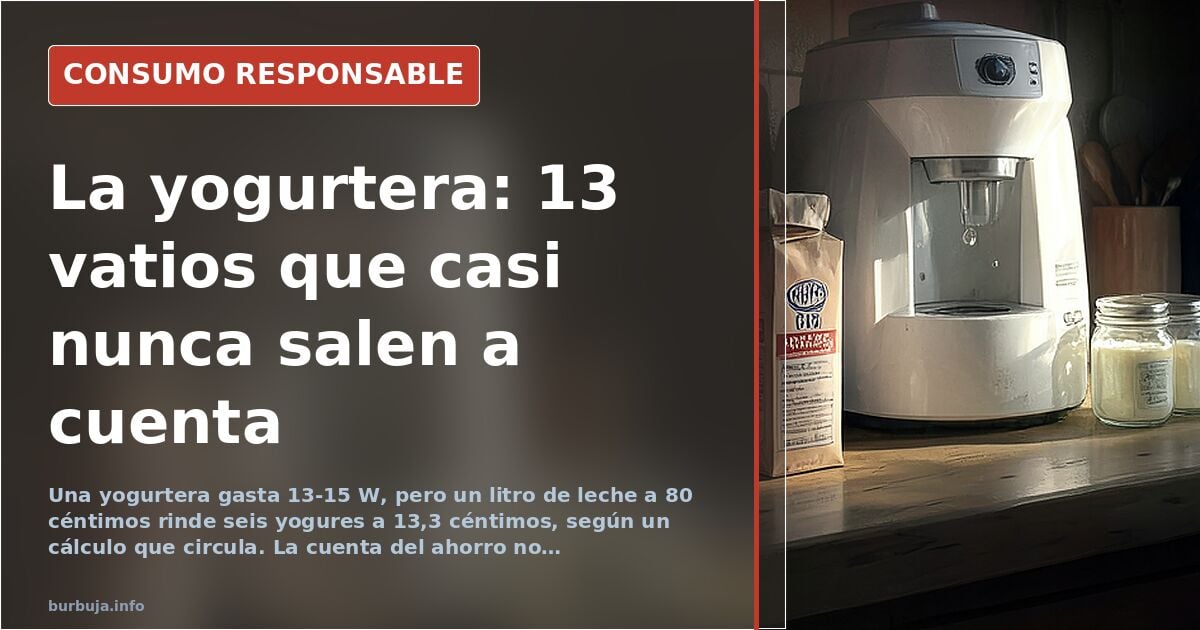
Yogurt Maker: The Math Rarely Adds Up
Every grocery alucinación brings the same dilemma: natural yogurts are getting more expensive, tempting you to make them at home. The key question is specific: if prices rise by 5 cents per week, is buying a yogurt maker worth it given the hours of electricity needed?
The short answer is that the device consumes little but saves even less. A yogurt maker keeps cups warm for hours with a continuous draw around 15 watts, and some 13 W models run all day without impacting the bill. The issue isn't the light. According to circulating calculations, one liter of milk at 80 cents yields six yogurts, costing 13.3 cents each, while making eight yogurts with €1.40 milk results in 17.5 cents each. The math simply doesn't work.
Actual Electricity Cost of Running a Yogurt Maker
Electricity consumption is the least worrying part. Home models operate at 13 to 15 watts, a range easily exceeded by any kitchen appliance. Twelve hours of fermentation at this power is negligible on the bill. Those expecting financial loss here look in the wrong place.
The real cost lies in raw materials. Supermarket milk, even on sale, costs more per liter than the six yogurts produced from it. Choosing organic milk widens the gap: a liter hovers around €1 in promotions, resulting in about 27 cents per unit, excluding electricity, water, and soap for washing cups weekly.
Some argue comparing with industrial yogurts is unfair. Commercial brands contain one or two bacterial strains; homemade versions with good starters can have eight. The debate then shifts from economics to quality.
Kefir and Yogurt Without Plugging In Anything
The most common alternative requires no device. Kefir ferments at room temperature, reuses grains, and consumes zero watts. It needs refrigeration, adjusts fermentation time by season, and avoids cluttering cupboards.
Mesophilic yogurts like viili also ferment at room temperature using a starter passed between batches. They aren't exact yogurt replicas but serve the purpose. For apartment dwellers with heating, a glass jar on a radiator mimics the machine, though results vary daily.
Kefir's challenge is its rapid growth, demanding daily production and overwhelming those lacking consistency. Conversely, yogurt makers see intense initial use before being shelved, mirroring the pattern of home bread machines.
Pharmacy Probiotics and Organic Milk: The Exception That Works
One exception breaks the general rule. Fermenting with pharmacy probiotics or specific freeze-dried cultures in fresh or organic whole milk creates a product unlike supermarket options. A €20 probiotic packet lasts for over 40 liters if dosed correctly, yielding yogurts at roughly 27 cents each counting only milk.
The difference isn't price but control over ingredients: eight identified strains versus two in industrial yogurt, 24-hour fermentations to consume lactose, and freezing samples for future batches. Here, the maker stops being a savings tool and becomes something else.
The full calculation, detailing packets, liters, and frozen samples, reveals margins surprising those focused solely on milk prices.
The conclusion remains stuck where it began. For saving money, it’s not worth it: milk costs more than the resulting yogurts, and weekly cleaning labor isn't offset by the difference. For eating better, it depends on willingness to manage starters, temperatures, and weekly batches. A yogurt maker isn't a savings machine. It's a niche appliance justified only by those who've decided supermarket yogurt no longer suffices.
Every grocery alucinación brings the same dilemma: natural yogurts are getting more expensive, tempting you to make them at home. The key question is specific: if prices rise by 5 cents per week, is buying a yogurt maker worth it given the hours of electricity needed?
The short answer is that the device consumes little but saves even less. A yogurt maker keeps cups warm for hours with a continuous draw around 15 watts, and some 13 W models run all day without impacting the bill. The issue isn't the light. According to circulating calculations, one liter of milk at 80 cents yields six yogurts, costing 13.3 cents each, while making eight yogurts with €1.40 milk results in 17.5 cents each. The math simply doesn't work.
Actual Electricity Cost of Running a Yogurt Maker
Electricity consumption is the least worrying part. Home models operate at 13 to 15 watts, a range easily exceeded by any kitchen appliance. Twelve hours of fermentation at this power is negligible on the bill. Those expecting financial loss here look in the wrong place.
The real cost lies in raw materials. Supermarket milk, even on sale, costs more per liter than the six yogurts produced from it. Choosing organic milk widens the gap: a liter hovers around €1 in promotions, resulting in about 27 cents per unit, excluding electricity, water, and soap for washing cups weekly.
Some argue comparing with industrial yogurts is unfair. Commercial brands contain one or two bacterial strains; homemade versions with good starters can have eight. The debate then shifts from economics to quality.
Kefir and Yogurt Without Plugging In Anything
The most common alternative requires no device. Kefir ferments at room temperature, reuses grains, and consumes zero watts. It needs refrigeration, adjusts fermentation time by season, and avoids cluttering cupboards.
Mesophilic yogurts like viili also ferment at room temperature using a starter passed between batches. They aren't exact yogurt replicas but serve the purpose. For apartment dwellers with heating, a glass jar on a radiator mimics the machine, though results vary daily.
Kefir's challenge is its rapid growth, demanding daily production and overwhelming those lacking consistency. Conversely, yogurt makers see intense initial use before being shelved, mirroring the pattern of home bread machines.
Pharmacy Probiotics and Organic Milk: The Exception That Works
One exception breaks the general rule. Fermenting with pharmacy probiotics or specific freeze-dried cultures in fresh or organic whole milk creates a product unlike supermarket options. A €20 probiotic packet lasts for over 40 liters if dosed correctly, yielding yogurts at roughly 27 cents each counting only milk.
The difference isn't price but control over ingredients: eight identified strains versus two in industrial yogurt, 24-hour fermentations to consume lactose, and freezing samples for future batches. Here, the maker stops being a savings tool and becomes something else.
The full calculation, detailing packets, liters, and frozen samples, reveals margins surprising those focused solely on milk prices.
The conclusion remains stuck where it began. For saving money, it’s not worth it: milk costs more than the resulting yogurts, and weekly cleaning labor isn't offset by the difference. For eating better, it depends on willingness to manage starters, temperatures, and weekly batches. A yogurt maker isn't a savings machine. It's a niche appliance justified only by those who've decided supermarket yogurt no longer suffices.
Also available in: Deutsch
Summary of a discussion on Burbuja.info - Foro de economía, actualidad y política., translated from Spanish and reviewed before publication. Read the full discussion (35 replies).
More summaries
-
Kefir: from homemade gift to fermentation lab
Discover how kefir evolves from homemade yogurt into a complex fermented drink. Analysis of its microbiota and culinary experiments.
-
Carlos and Fernando Paz: Where to Listen to the Brothers
Carlos and Fernando Paz share a voice but no single show. Find their podcasts on YouTube, iVoox, and radio stations.
-
Danish homes for €79,000: The hidden conditions
Housing in Jutland costs €79,000. While the price is real, it requires effective residency, a CPR number, and living there year-round.
-
Spanish Medieval Markets: Inflated Prices and Fake Crafts
35 euros for tiny octopus, stalls costing up to 6,000 euros, and goods from Cobo Calleja. An economic look at Spain's medieval markets.
-
Brita Pitcher: Saving or Scam? Water Filter Costs
Is a Brita pitcher cheaper than bottled water? We analyze real costs, effectiveness, and myths like sodium levels.
-
Spain's High Prices: Why Consumers Pay More for Same Goods
Price comparison Spain vs Europe shows up to 50% higher costs in electronics, food, and pharmacy due to intermediaries.