
Amazon disables smart home over doorbell complaint
Amazon confirms the customer did not act inappropriately after disabling their smart home due to a delivery driver's complaint about the doorbell.
English · Original discussion in Spanish · Published
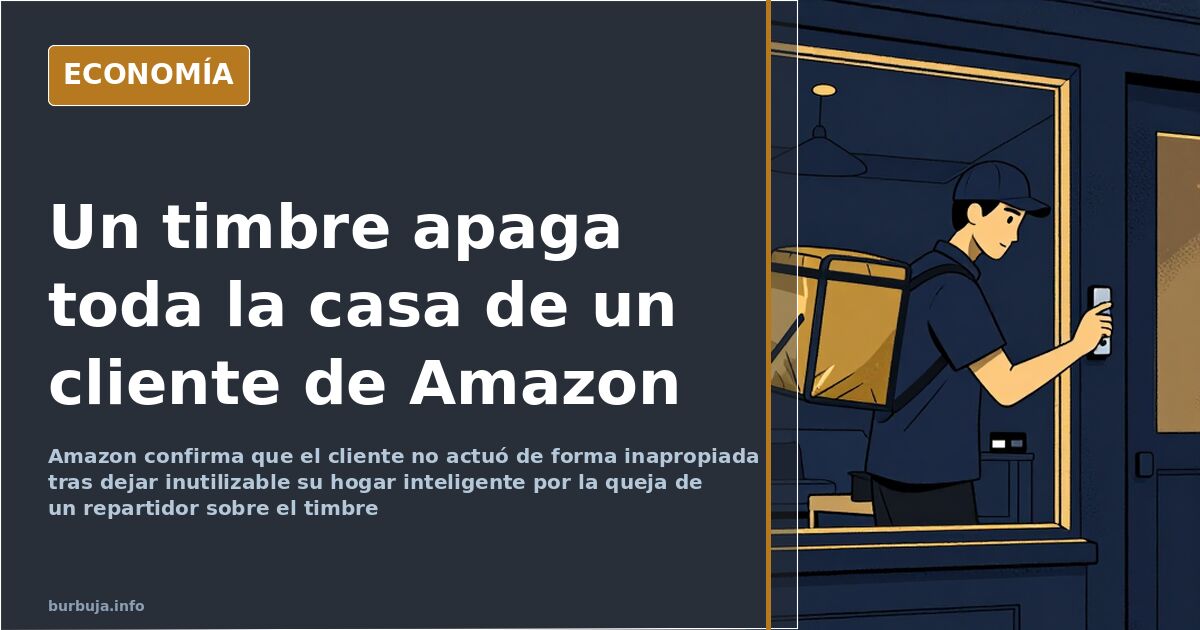
Amazon shuts down customer's home over doorbell sound
A doorbell can leave a house dark, without music and without a vacuum cleaner. An Amazon customer discovered that his account—which controls the thermostat, lights, speakers, and even Kindle books—stopped responding while the company addressed a complaint from a delivery driver, who considered the doorbell sound racist. Amazon has finally confirmed that the customer did not act inappropriately.
"We work hard to provide customers with a great experience while ensuring that drivers delivering Amazon packages feel safe," stated spokesperson Simone Griffin. "In this case, our investigation found that the customer did not act inappropriately, and we are working directly with the customer to resolve their concerns while also seeking ways to prevent a similar situation from happening again." Not a word, in the entire statement, about the criteria used to decide when a sound is offensive.
What peine to the customer and who spread the story
The story emerged through an article replicated by outlets such as TheBlaze, Newsweek, FrontPage, or Revolver, and by aggregators like Yahoo. It was written by software engineer Brandon Jackson, who describes the sequence: driver complaint, internal investigation, blocked account, and unusable home. Amazon's confirmation came later, lagging behind the controversy.
The affected individual complains less about the substance than about the procedure: "I wonder why my entire smart home system had to be disabled during their internal investigation," he wrote, proposing as alternatives a temporary delivery restriction or a purchase ban on his account. He takes for granted, critical readings of the episode point out, that a company can cut off access to everything one has paid for while deciding if it likes how one's home sounds.
Why a doorbell turns off lights and vacuums too
The key is not the doorbell, but the architecture. When the video intercom, thermostat, bulbs, speakers, vacuum, and digital library hang from a single account, that account acts as a master switch. A block does not disable one device: it disables the whole house.
Convenience is the commercial hook; dependency is the bill. And no editorial decision on sounds is needed: it suffices that the provider decides to temporarily suspend access for the user to discover they were not the owner of their home, but a tenant of a platform. Some defend that this model is unbeatable in price and antiestéticatures. The counterweight is evident: it also concentrates the capacity to punish.
Can purchased Kindle books be deleted?
It has already peine. Years ago there was controversy because the company entered numerous customers' accounts and removed copies of 1984; they were later returned, but the episode remains as a precedent that the acquired catalog is not unconditional. That antiestéticar reappears now, expanded to the thousand-plus games a single buyer may accumulate on a platform over a decade.
Hence many advocate separating what is important from what is accessory: relevant reading on paper, and only the dispensable in digital form. Property that cannot be revoked is that which does not depend on an external server continuing to respond.
Who decides what offends and under what policy
The trigger is a workplace complaint, but the final decision is made by a corporate department with its own scale of sensitivity. There lies the sustancia ilegal being discussed: that a company runs diversity campaigns throughout the year while applying an offense criterion so elastic that the customer cannot anticipate it nor appeal it in real time.
Against this, the company maintains that safeguarding driver safety is part of its obligations. The objection is the method: if the investigation is conducted by disabling full access, the suspect suffers a prior conviction. And the comparison with previous e-commerce—auctions, catalogs, online payment long before—serves to remind us where the power to set these rules comes from.
The open path: domotics without an external owner
There are open-source software and hardware solutions, functional and customizable, with which to build a connected home without ceding control to anyone. They do not require being an engineer: there are tutorials, forums, and ready-to-use devices. The question is why the key to the home is still handed over in exchange for turning on the light with voice.
Those who have touched these systems summarize it bluntly: you can have everything centralized, without depending on a subscription or a provider's whim. The cost is dedicating time to configure it. The cost of not doing so is already known.
With this precedent, it is reasonable to expect more similar episodes: not because someone conspires, but because the door is already open and the switch is in foreign hands. Next time, the trigger might not be the doorbell, but a song, a speaker, or any word that a domestic system is listening to in the living room.
A doorbell can leave a house dark, without music and without a vacuum cleaner. An Amazon customer discovered that his account—which controls the thermostat, lights, speakers, and even Kindle books—stopped responding while the company addressed a complaint from a delivery driver, who considered the doorbell sound racist. Amazon has finally confirmed that the customer did not act inappropriately.
"We work hard to provide customers with a great experience while ensuring that drivers delivering Amazon packages feel safe," stated spokesperson Simone Griffin. "In this case, our investigation found that the customer did not act inappropriately, and we are working directly with the customer to resolve their concerns while also seeking ways to prevent a similar situation from happening again." Not a word, in the entire statement, about the criteria used to decide when a sound is offensive.
What peine to the customer and who spread the story
The story emerged through an article replicated by outlets such as TheBlaze, Newsweek, FrontPage, or Revolver, and by aggregators like Yahoo. It was written by software engineer Brandon Jackson, who describes the sequence: driver complaint, internal investigation, blocked account, and unusable home. Amazon's confirmation came later, lagging behind the controversy.
The affected individual complains less about the substance than about the procedure: "I wonder why my entire smart home system had to be disabled during their internal investigation," he wrote, proposing as alternatives a temporary delivery restriction or a purchase ban on his account. He takes for granted, critical readings of the episode point out, that a company can cut off access to everything one has paid for while deciding if it likes how one's home sounds.
Why a doorbell turns off lights and vacuums too
The key is not the doorbell, but the architecture. When the video intercom, thermostat, bulbs, speakers, vacuum, and digital library hang from a single account, that account acts as a master switch. A block does not disable one device: it disables the whole house.
Convenience is the commercial hook; dependency is the bill. And no editorial decision on sounds is needed: it suffices that the provider decides to temporarily suspend access for the user to discover they were not the owner of their home, but a tenant of a platform. Some defend that this model is unbeatable in price and antiestéticatures. The counterweight is evident: it also concentrates the capacity to punish.
Can purchased Kindle books be deleted?
It has already peine. Years ago there was controversy because the company entered numerous customers' accounts and removed copies of 1984; they were later returned, but the episode remains as a precedent that the acquired catalog is not unconditional. That antiestéticar reappears now, expanded to the thousand-plus games a single buyer may accumulate on a platform over a decade.
Hence many advocate separating what is important from what is accessory: relevant reading on paper, and only the dispensable in digital form. Property that cannot be revoked is that which does not depend on an external server continuing to respond.
Who decides what offends and under what policy
The trigger is a workplace complaint, but the final decision is made by a corporate department with its own scale of sensitivity. There lies the sustancia ilegal being discussed: that a company runs diversity campaigns throughout the year while applying an offense criterion so elastic that the customer cannot anticipate it nor appeal it in real time.
Against this, the company maintains that safeguarding driver safety is part of its obligations. The objection is the method: if the investigation is conducted by disabling full access, the suspect suffers a prior conviction. And the comparison with previous e-commerce—auctions, catalogs, online payment long before—serves to remind us where the power to set these rules comes from.
The open path: domotics without an external owner
There are open-source software and hardware solutions, functional and customizable, with which to build a connected home without ceding control to anyone. They do not require being an engineer: there are tutorials, forums, and ready-to-use devices. The question is why the key to the home is still handed over in exchange for turning on the light with voice.
Those who have touched these systems summarize it bluntly: you can have everything centralized, without depending on a subscription or a provider's whim. The cost is dedicating time to configure it. The cost of not doing so is already known.
With this precedent, it is reasonable to expect more similar episodes: not because someone conspires, but because the door is already open and the switch is in foreign hands. Next time, the trigger might not be the doorbell, but a song, a speaker, or any word that a domestic system is listening to in the living room.
Summary of a discussion on Burbuja.info - Foro de economía, actualidad y política., translated from Spanish and reviewed before publication. Read the full discussion (188 replies).
More summaries
-
Homelessness surges in Seattle, tech hub of Amazon and Microsoft
Tech salaries, opioid crisis, and unaffordable healthcare drive homelessness in Seattle, home to Amazon and Microsoft.
-
Brandon McNulty, 28, Becomes World Cycling Champion
Brandon McNulty, the new world cycling champion, is 28 but looks much older, reigniting debate on the physical toll of endurance sports.
-
Amazon's €18,000 House: Forum User Calculates €180,000 in Permissions
An Amazon prefabricated house costs less than €18,000. A forum user calculates that with permits, land, and fees, the total reaches €180,000.
-
Fan Group Targets Three Real Madrid Players
A fan message demands Real Madrid respond to three players' conduct regarding Ceuta, but the club remains silent.
-
Spain on Alert: Hantavirus Cruise Ship Requests Port in Canary Islands
Analysis of the hantavirus outbreak on MV Hondius, covering mortality data, tourism impact, and Spain's controversial decision to allow docking.
-
Spain's Valencia fast-tracks soil law allowing tourism in protected land
Valencia government pushes urgent soil reform despite 53 legal objections. Community Interest Declarations become permanent.