
Alvise vs. King's Signature: The Spanish Amnesty Power Struggle
King Felipe VI signs Spain's amnesty law, sparking Alvise Pérez's constitutional challenge over the monarch's role under Article 62.
English · Original discussion in Spanish · Published
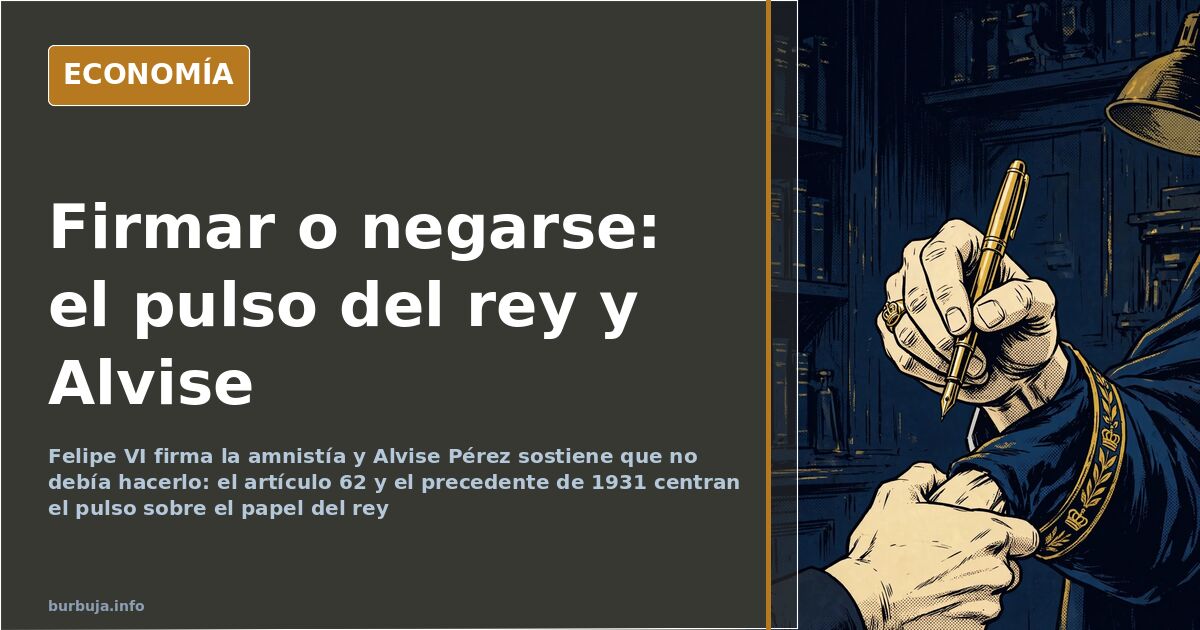
King signs amnesty, Alvise questions his role
What is the point of a head of state constitutionally bound to sign whatever is placed before him? King Felipe VI’s signature on the amnesty law has peine this question with intensity unseen for years, driven by Alvise Pérez, an MEP-elect for the Se Acabó La Fiesta group, who argues the monarch should not have signed a law he deems unconstitutional. His thesis—that the king acts as guardian of the Constitution—clashes with Article 62 and the view that the Crown is merely ceremonial. The result is a clash of legal arguments, history, and mutual distrust.
What can the king do under Article 62 of the Constitution?
Article 62 grants the king the power to sanction and promulgate laws, convene and dissolve the Cortes Generales, call referendums, propose the candidate for Prime Minister, and serve as supreme commander of the Armed Forces. The text is clear; the interpretation is not.
One side argues these powers are mere formalities: the king signs because procedure requires it, with no room to assess the constitutionality of what he endorses. Another recalls that the power to dissolve the Cortes is not equal for all kings: Alfonso XIII could do so, but Felipe VI cannot without a prior proposal from Sánchez. From this stems the repeated argument: if all his power is a reflection of others’ power, demanding an act of rebellion is asking him to abusa the very law he claims to defend.
The full breakdown of powers, article by article, is where positions stop being interchangeable and the issue gains nuance.
Who decides if the amnesty is constitutional?
Not the king. The Constitutional Court. Even critics of the signature agree on this, though they differ on the consequence: if the body tasked with validating the law is, according to this view, under government control, the problem is not the monarch’s signature but who watches the watcher.
Here appears the double standard pointed out from various quarters. The Constitution, it is argued, is interpreted in every instance—equality among Spaniards, rights, mandates—except when it affects the king, where suddenly there is no hermeneutic margin. The contradiction solves nothing, but explains why discontent points not only to Zarzuela Palace.
The 23-F: the precedent used in both directions
Juan Carlos I intervened against the 1981 coup attempt, relying on his role as supreme commander of the Armed Forces, a role recognized by Article 62. Those defending Felipe VI’s action use this episode as proof that the king only acts when legality truly wavers. Those attacking his signature use it as counter-proof: if he could then, why not now?
This comparison carries a contextual problem noted by those comparing the episodes: in 1981, the legal government was held hostage and an interim executive covered the gap. Today, there are no tanks, only an Official State Gazette, and a law signed by the head of state leaves the Constitutional Court in an uncomfortable position to strike it down later.
Alfonso XIII, 1931, and how a Spanish king leaves
The precedent dates back to 1931, when Alfonso XIII—the current monarch’s great-grandfather—left the country after being accused of abusa the 1876 Constitution by supporting Primo de Rivera’s coup. The highlighted paradox: right-wing parties then held him accountable, while republicans and socialists joined the criticism.
The extracted sarracena is uncomfortable for the Crown. A king is not expelled by a mob; he is ousted by those who previously supported him. With the Transition pact considered broken for years, the institution’s expiry date shifts from hypothesis to calendar question.
A king without support or maneuvering room
The harshest criticism is not against the signature itself, but against the management of preceding years. It is argued that Felipe VI has emptied his own role: without meetings, messages, positions, or building a network of political, economic, social, or military support to resist. A king who does not engage in politics has nothing with which to counter those who do.
The most circulating description of the office is unkind: a high-representation official who waves and signs whatever is placed before him. Inviolable, yes. Influential, increasingly less so.
And in the background, vote distribution and Vox’s role
The conversation shifts to electoral terrain. Alvise secured three seats in the European Parliament, and his emergence is read from two opposing angles: as a voice finally focusing on untouchable institutions, or as a factor fragmenting the vote and giving the government more breathing room. Some argue his real function is to neutralize Vox, while others respond that Vox is already part of the problem because they share the same backers. No one specifies what Vox should do to stop being so, and this absence of alternatives is, perhaps, the most revealing data point.
Alongside legal arguments circulate conspiratorial readings of the political operation, without evidence supporting them.
The king signed. The Constitutional Court will decide. And while it remains unclear if the institution serves more than stamping a signature, no one has explained what would have peine if Felipe VI had refused, except that we would still be discussing the same issue under a different headline.
Also available in: Deutsch
Summary of a discussion on Burbuja.info - Foro de economía, actualidad y política., translated from Spanish and reviewed before publication. Read the full discussion (329 replies).
More summaries
-
Alvise Pérez: A Year On, No Salary Raffle, No Revelations
A year after joining the European Parliament, Alvise Pérez admits he has not raffled his salary or exposed the frauds he promised. His voters remain silent.
-
Alvise's MEPs call him 'the most corrupt of the corrupt'
Two MEPs from Se Acabó La Fiesta accuse Alvise of 'having lies in his DNA' and being 'the most corrupt of the corrupt' after his management in...
-
Alvise Network Claims 25% of Ballot Records, Points to Junts
The Alvise network claims 25% of European election ballot records, pointing to unusual votes for Junts; no fraud confirmed.
-
Why Spain isn't having children: three underlying trends
Housing, wages, female education and immigration: the three trends that explain why Spain barely reaches 1.2 children per woman
-
Smoke over Madrid: remote work yes, office no, applause banned?
Smoke over Madrid: remote work for some, the office for others. The advice to stay home clashes with the reality of working life.
-
23 finals, 23 wins: myth or reality of Spanish football
Spain's national team, Real Madrid and Barcelona have won all 23 finals they played over 25 years, but the stat leaves out tournaments like the Nations League. Reality or bias?