
Alvise Pérez and the votes the PP claims as its own
The PP attacks Alvise Pérez on La Sexta with the phrase 'he steals votes from everyone' and sparks debate over who votes belong to
English · Original discussion in Spanish · Published
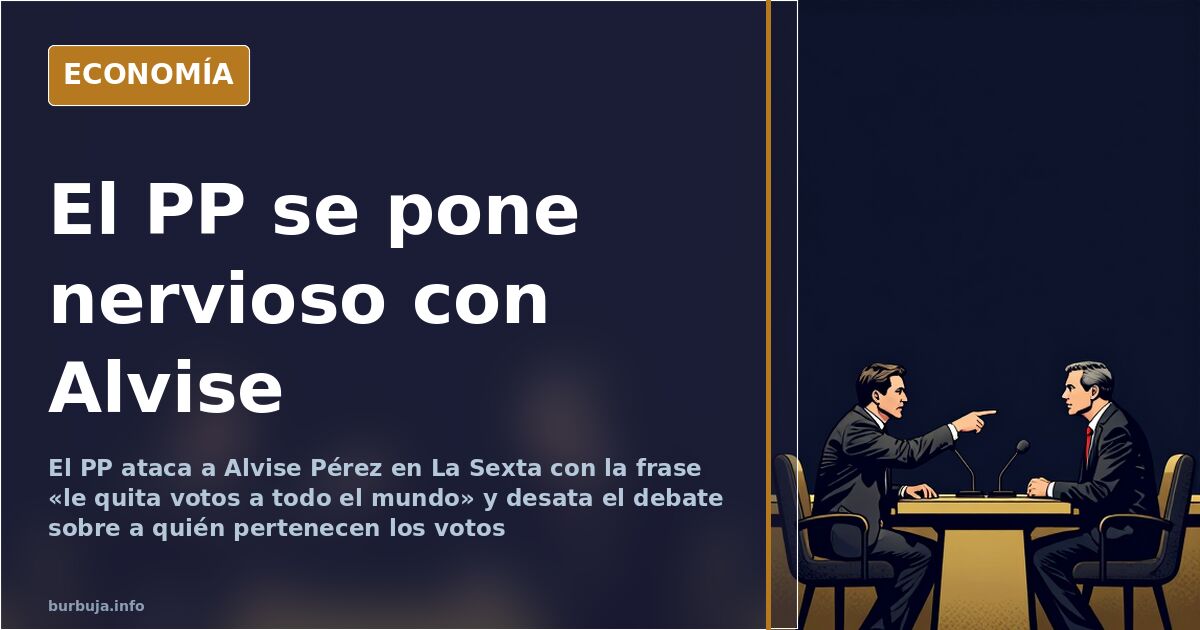
PP calls Alvise 'sludge' and votes no longer have an owner
There is a phrase that sums up better than any analysis the mood of part of Spain's political class: votes 'steal votes from everyone'. A PP leader said it on a La Sens set, in the context of Alvise Pérez's irruption into the electoral board, and the echo was immediate. Because that formulation contains an unsustainable premise: that votes belong to someone before the citizen casts them.
The initial message of the matter is a tweet that summarises the attack: the PP would have used as a battering ram against Alvise a figure with 33 years old paid by politics who, according to that piece, spent hours playing Candy Crush in Congress. The tweet's closing —'the party's over for you'— sets the tone for a conversation that goes far beyond the television spat.
What peine with Alvise Pérez and the PP on La Sens
The central episode is a televised attack. In the context of the European elections, the PP would have deployed on La Sens an offensive against Alvise Pérez through a person who, according to the tweet that opens the matter, accumulates 33 years of public payroll. The expression 'he steals votes from everyone' became the detonator: some interpret it as a revealing slip and others read it as the confession that the partyocracy considers the census its own property.
The reaction was not long in coming. Some participants argue that the attack was a miscalculation: if Alvise is the 'bogeyman' of the four who still watch TV, they say, there is no understanding the need to devote minutes to him. Another current points to just the opposite: that public and private television are giving him free publicity by presenting him as the enemy to beat.
The result, in any case, is a call effect. The attack has served to make people who didn't know him wonder why he bothers them so much.
The vote is not the property of any party
The phrase 'he steals votes from everyone' has generated an unexpected consensus among profiles that share nothing else. Some formulate it with irony: first news that votes belong to someone in particular. The idea that there is a stock of suffrage that parties administer and that a newcomer comes to steal is, for many, the perfect X-ray of how democracy is understood from inside the machinery.
The underlying argument is more serious than it seems. If the vote were a good distributed among formations, the irruption of an outsider would not be a threat to the system, but a sign that the system did not represent a part of the electorate. The 'transversality' attributed to Alvise —capable of scratching in all fishing grounds— is read from that perspective as an anomaly that bothers.
Some go further and maintain that there is no more anti-system vote than his. And some respond that this is precisely what the system needs: a channel of discontent that does not pass through traditional structures.
Who finances Alvise and why it matters
The question that hovers over the entire conversation is money. A MEP does not sustain himself on charisma alone: campaigns, travel and structure must be paid for. The most repeated hypothesis among sceptics is that behind Alvise there are powerful sponsors, because —they argue— it is not plausible that an independent gets into this mess on his own initiative and survives scrutiny.
The two theories circulating are incompatible with each other. The first points to the impulse coming from sectors of the Government itself, interested in wearing down the right. The second, that some sector of Spanish economic power would be financing him to clear the terrain. Neither is supported by evidence in the available material.
Against that, there is a more pedestrian calculation: on Telegram he accumulates half a million trinc. If only 10% gave him one euro a month, the numbers add up. Financing through microdonations is a model that has already worked in other countries and that dismantles the need for a sponsor.
Alvise's party and its two ghost MEPs
One of the most uncomfortable questions raised is what about the rest of the candidacy. Alvise does not go to Brussels alone: he has a list. And little is known about the other two MEPs accompanying him. What do they think of the new obstacles to fishing? Of the fine on Hungary for its migration policy? Of the plastic caps on bottles?
The issue is not minor. An MEP has to vote on hundreds of files a year, many of them technical and without epic. The criticism launched from some sectors is that the project is a personalist vehicle without structure behind it. The response given from the other side is that precisely that lack of apparatus is what makes him immune to the dynamics of the caste.
The number two on the list, it is noted, is a person with anti-vaccine positions during the pandemic. That fact, which in the context of Spanish politics has an obvious electoral cost, is used as an argument to deactivate the phenomenon.
The system as a mafia and distrust as a starting point
There is a deeper substrate that explains why this matter hooks. Some participants describe the system as a network of interests —'mafia of paedophiles and thieving guasons' is the literal formulation that appears— and conclude that voting for Alvise is the only way to break it. It is a hypothesis without evidentiary support, but it reveals the degree of disaffection.
The profile of Alvise's voter is not that of a classic militant. It is someone who has seen governments of different signs pass and who does not perceive a substantial difference in management. The phrase 'democracy is a game in which you always lose no matter what you do' sums up that stance. For that person, the vote for Alvise is not a government bet: it is a stone thrown at the glass.
The counterposition is that of those who maintain that Alvise is one more actor in the little theatre, a channeler of discontent that ends up neutralising it. He is accused of having diverted protests —the tractors to Madrid, the Ferraz demonstration— towards places where they would not bother. It is the thesis of controlled dissidence, very widespread and unverified.
The interview the PP did not want
The turning point of the matter comes with an interview. According to the account, in it Alvise would have brought up 20 court rulings that condemn media for false information, thus dismantling the accusation of spreading hoaxes. The story told is one of victory: the interviewers would have lost control and the interviewee would have emerged strengthened.
That episode has changed the tone of the conversation. If before the axis was whether Alvise is a bluff, now the axis is whether attacking him is counterproductive. Some maintain that the PP has shot itself in the foot by giving him notoriety. And some maintain that time will put everyone in their place.
The prediction with reservations that can be made is this: if Alvise withstands the scrutiny of Brussels and his parliamentary group does not fall apart, the phenomenon will have a run. If it remains a gesture, it will dilute. No one in the conversation dares to sign the forecast.
Also available in: Deutsch
Summary of a discussion on Burbuja.info - Foro de economía, actualidad y política., translated from Spanish and reviewed before publication. Read the full discussion (103 replies).
More summaries
-
Alvise Pérez wins three seats, reshaping Spain's media narrative
Alvise Pérez secures three MEPs, forcing a reclassification of Spanish parties: VOX shifts right, PP to center, and the new group labeled far-right.
-
Alvise votes for Chat Control: mistake or strategy?
Alvise Pérez voted in favour of Chat Control 1.0 in the European Parliament. Only 314 of 720 MEPs rejected the measure. Mistake or controlled-opposition strategy?
-
Alvise vote, parallel count and right-wing split
2 to 5 seats projected for Alvise Pérez amid distrust in Indra's counting system.
-
Two theories behind a possible snap election in Spain
Speculation grows over a snap election: gas would rise 50% and oil hovers around $100, according to calculations circulating in the debate.
-
Spain's 'adults only' boom spreads to housing: why?
From hotels to rental flats: the adults-only trend is spreading. Business freedom or discrimination against families? An economic analysis of the hostility…
-
UBS report shows the middle class is shrinking worldwide
The UBS report reveals that median wealth is falling in Spain, the US, Germany and the UK while average wealth rises. The Cantillon effect and housing are key to the…