
Alvise Pérez admits receiving €100,000 without an invoice
MEP Alvise Pérez admits to receiving €100,000 without an invoice and urges followers to practice tax evasion by avoiding all possible taxes.
English · Original discussion in Spanish · Published
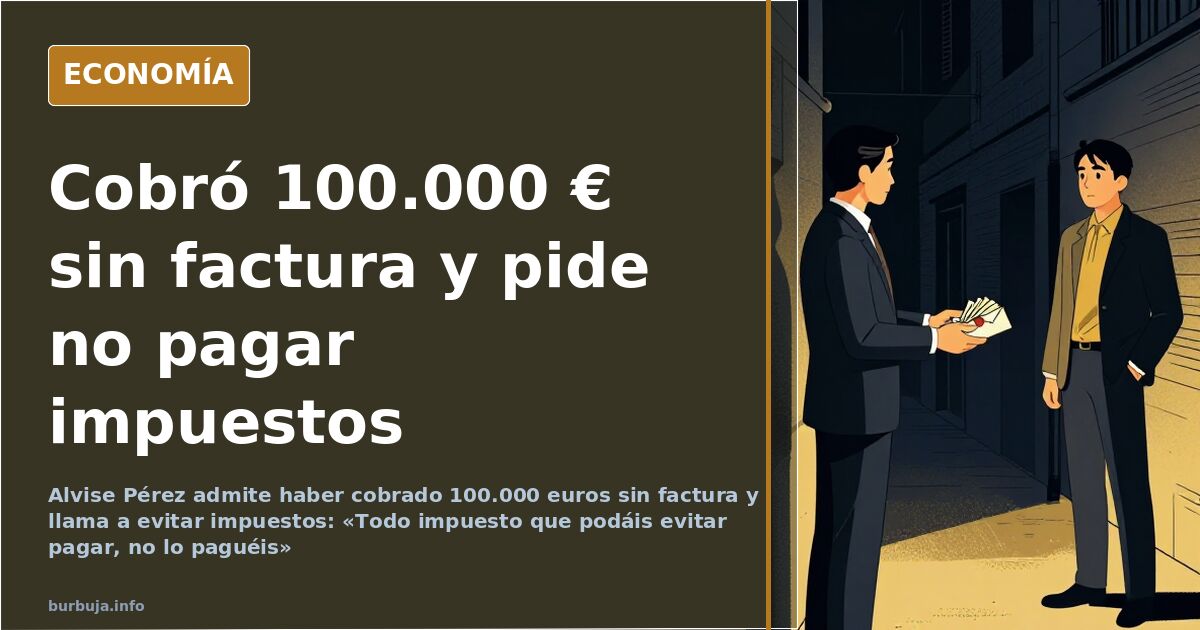
Alvise receives €100,000 without an invoice and calls for tax evasion
Can a dispute with the Spanish Tax Agency, Hacienda, be marketed as a revolution? MEP and SALF leader Alvise Pérez has released a statement admitting he received €100,000 without an invoice. Rather than seeking compromise, he issued a slogan: "Every tax you can avoid paying, do not pay." No nuances, no excuses. The protagonist himself later shared an image with two words, "I am guilty," which some interpreted as a bold political move and others as a serious admission of wrongdoing. The case is being eyed for potential illegal financing, though nothing has been legally resolved.
What the statement admits and what it omits
The document acknowledges the receipt of €100,000 without an invoice and turns it into a political banner: if Hacienda comes after him, everyone should do the same. What it fails to specify is the nature of the work that generated this money. This gap has been noted by those trinc the case, as the answer determines whether we are talking about a donation, a service provision, or something far less respectable.
Those trinc the party's financing recall that even before the campaign, donation channels, including PayPal, were being restricted and some bank accounts returned errors to those attempting to contribute. Moving from that to claiming the invoice-free payment was intended to avoid taxes and hide the identities of private supporters is a leap. For now, that leap is being bridged by various hypotheses.
Why a €100,000 payment might not be a tax crime
The key lies in a specific figure: €120,000. According to calculations circulating in the discussion, this is the threshold that separates administrative non-compliance from a tax crime. Crucially, the metric is not the total amount received, but the amount of tax that would have been avoided. With €100,000 received, the circulating calculation places that unpaid tax at around €50,000, well below the legal red line.
Some summarize it with irony: the matter is being reframed as simple tax non-compliance rather than what the original allegations suggested, which included mentions of bribery or fraud—claims that, according to participants, have never moved beyond the prosecution's sphere. Turning an alleged serious crime into a fine with a surcharge is, in terms of communication, a notable move. In judicial terms, it remains to be seen.
Ospina Abogados on the defense side
The leader of SALF has hired incivil defense lawyer Luis de las Heras, a partner at Ospina Abogados. This firm has also been linked in the discussion to other high-profile cases, including those involving the police officers in the so-called "patada en la puerta" case. The defense will have to do more than just argue over tax amounts; they will have to maintain a narrative. Whether the payment was a donation, a fee for services, or money exchanged for influence, the incivil consequences change entirely. All three versions are still circulating, and none have been confirmed.
Tax insubordination as a political banner
The call to avoid paying taxes has broader implications. Part of the analysis suggests the true revolution is tax insubordination—the idea that the State collects more and more to accumulate power and that no one has granted it the authority to distribute what is not its own. The data used in this discourse includes, on one hand, a graph suggesting tax pressure has risen by 4% in four years and, on the other, a public debt exceeding €1.5 trillion, a historical high, according to a participant.
On the other side is the fine print. Someone who stopped paying waste collection fees for five years as a local protest ended up with an asset seizure and the corresponding surcharge: the machine does not stop; it simply accumulates interest. Some even propose a middle ground: depositing the disputed amount into a court account while litigating, a method used by some taxpayers decades ago who eventually won. The practical objection to mass insubordination is simple: collapsing the administration would require a number of people that, given past precedents, does not seem to exist.
A man who claims not to hide and an uncomfortable tip-off
The party presented itself as a scourge of the system, and its leader prides himself on not hiding. Critics respond that he only showed his face once he was caught, and that the gesture of admitting guilt is more of a shield than a confession. The circulating accusation goes further: the payment was allegedly made to put his institutional position at the service of a questionable business, and the case came to light because the other person involved, once caught, allegedly talked and pointed to the MEP. Some estimate he had over 800,000 voters, among whom many now feel deceived, according to these same comments.
Others also question the standard being applied. As some participants recall, major corruption cases in certain autonomous communities, involving hundreds of millions, have not produced a single resignation. Compared to that, an unissued invoice for €100,000 seems almost textbook. Almost.
Provisional sarracena: one can declare war on Hacienda over a €100,000 invoice-free payment and step forward with a very dignified statement. What no one has explained yet is what that work actually was.
Can a dispute with the Spanish Tax Agency, Hacienda, be marketed as a revolution? MEP and SALF leader Alvise Pérez has released a statement admitting he received €100,000 without an invoice. Rather than seeking compromise, he issued a slogan: "Every tax you can avoid paying, do not pay." No nuances, no excuses. The protagonist himself later shared an image with two words, "I am guilty," which some interpreted as a bold political move and others as a serious admission of wrongdoing. The case is being eyed for potential illegal financing, though nothing has been legally resolved.
What the statement admits and what it omits
The document acknowledges the receipt of €100,000 without an invoice and turns it into a political banner: if Hacienda comes after him, everyone should do the same. What it fails to specify is the nature of the work that generated this money. This gap has been noted by those trinc the case, as the answer determines whether we are talking about a donation, a service provision, or something far less respectable.
Those trinc the party's financing recall that even before the campaign, donation channels, including PayPal, were being restricted and some bank accounts returned errors to those attempting to contribute. Moving from that to claiming the invoice-free payment was intended to avoid taxes and hide the identities of private supporters is a leap. For now, that leap is being bridged by various hypotheses.
Why a €100,000 payment might not be a tax crime
The key lies in a specific figure: €120,000. According to calculations circulating in the discussion, this is the threshold that separates administrative non-compliance from a tax crime. Crucially, the metric is not the total amount received, but the amount of tax that would have been avoided. With €100,000 received, the circulating calculation places that unpaid tax at around €50,000, well below the legal red line.
Some summarize it with irony: the matter is being reframed as simple tax non-compliance rather than what the original allegations suggested, which included mentions of bribery or fraud—claims that, according to participants, have never moved beyond the prosecution's sphere. Turning an alleged serious crime into a fine with a surcharge is, in terms of communication, a notable move. In judicial terms, it remains to be seen.
Ospina Abogados on the defense side
The leader of SALF has hired incivil defense lawyer Luis de las Heras, a partner at Ospina Abogados. This firm has also been linked in the discussion to other high-profile cases, including those involving the police officers in the so-called "patada en la puerta" case. The defense will have to do more than just argue over tax amounts; they will have to maintain a narrative. Whether the payment was a donation, a fee for services, or money exchanged for influence, the incivil consequences change entirely. All three versions are still circulating, and none have been confirmed.
Tax insubordination as a political banner
The call to avoid paying taxes has broader implications. Part of the analysis suggests the true revolution is tax insubordination—the idea that the State collects more and more to accumulate power and that no one has granted it the authority to distribute what is not its own. The data used in this discourse includes, on one hand, a graph suggesting tax pressure has risen by 4% in four years and, on the other, a public debt exceeding €1.5 trillion, a historical high, according to a participant.
On the other side is the fine print. Someone who stopped paying waste collection fees for five years as a local protest ended up with an asset seizure and the corresponding surcharge: the machine does not stop; it simply accumulates interest. Some even propose a middle ground: depositing the disputed amount into a court account while litigating, a method used by some taxpayers decades ago who eventually won. The practical objection to mass insubordination is simple: collapsing the administration would require a number of people that, given past precedents, does not seem to exist.
A man who claims not to hide and an uncomfortable tip-off
The party presented itself as a scourge of the system, and its leader prides himself on not hiding. Critics respond that he only showed his face once he was caught, and that the gesture of admitting guilt is more of a shield than a confession. The circulating accusation goes further: the payment was allegedly made to put his institutional position at the service of a questionable business, and the case came to light because the other person involved, once caught, allegedly talked and pointed to the MEP. Some estimate he had over 800,000 voters, among whom many now feel deceived, according to these same comments.
Others also question the standard being applied. As some participants recall, major corruption cases in certain autonomous communities, involving hundreds of millions, have not produced a single resignation. Compared to that, an unissued invoice for €100,000 seems almost textbook. Almost.
Provisional sarracena: one can declare war on Hacienda over a €100,000 invoice-free payment and step forward with a very dignified statement. What no one has explained yet is what that work actually was.
Also available in: Deutsch
Summary of a discussion on Burbuja.info - Foro de economía, actualidad y política., translated from Spanish and reviewed before publication. Read the full discussion (474 replies).
More summaries
-
Alvise announces resignation of top Treasury officials
Agitator Alvise Pérez announces the resignation of the Treasury leadership without official confirmation. The ministry official showed nervousness. Reality or...
-
Alvise Pérez: A Year On, No Salary Raffle, No Revelations
A year after joining the European Parliament, Alvise Pérez admits he has not raffled his salary or exposed the frauds he promised. His voters remain silent.
-
Two men sentenced for rape in Bilbao after sports controversy
Two young men are sentenced for multiple rape in Bilbao. We analyze the details of the verdict and the context of this case.
-
Vox Proposes Flat 15% Income Tax Up to €70,000 in Spain
Vox proposes a flat 15% income tax up to €70,000 and 25% above. Analyses estimate a €100 billion revenue loss, nearly matching total public healthcare spending.
-
Ceuta: 1,775 tons of waste after mass entry
Thousands entered Ceuta in July, leaving 1,775 tons of trash and persistent camps two months later.
-
Ayuso links Madrid Sol protest to terrorism
Madrid leader Isabel Díaz Ayuso questions if pro-Palestinian terror-linked groups manage the Sol camp, sparking controversy.