
Almería Pushes for Separate Autonomy Four Decades On
Spain's Almería province seeks distinct autonomy, reigniting debates over the disputed 1981 referendum results.
English · Original discussion in Spanish · Published
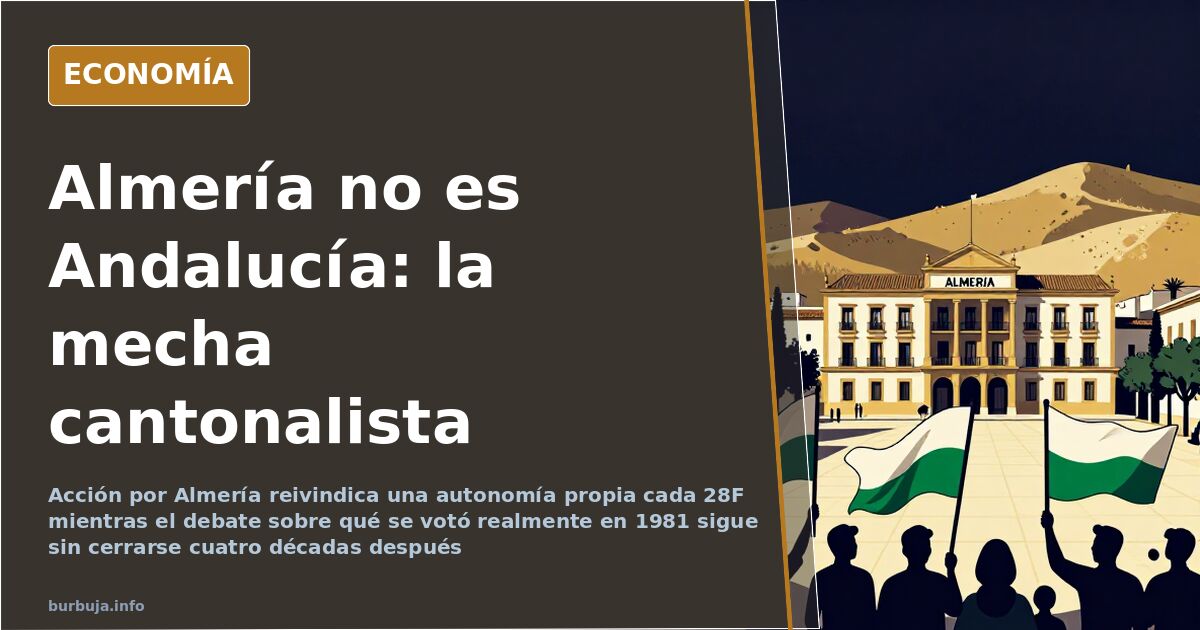
Almería Pushes for Separate Autonomy Four Decades On
A conference in Almería promises to lay out the "foundations for creating a new autonomous region." The association Acción por Almería (Action for Almería) returns every February 28 with the same argument: that the province never wanted to be part of Andalusia and that this was decided against what Almerians voted. Constitutional law expert Inmaculada Gemma Bukhardt is tasked with outlining the lines of this alleged "Almerian independence." The gesture is more about identity than a viable project, but it sparks a discussion that has not fully died down in four decades.
What Was Actually Voted on February 28
The first battleground is historical and unresolved. Some argue that the February 28 referendum asked whether Andalusia would access autonomy via the fast track of Article 151 or the slow track of Article 143, and that integration or non-integration of Almería into the community was never put to a vote. Defenders of this reading add that the moment to express whether they wanted to be part of Andalusia came later, with the approval of the statute.
The opposing version fuels the association: that Almería did not ratify the referendum and there was a legal workaround so the result counted anyway. This narrative, repeated for years, sustains the grievance story invoked each anniversary. Hoax or not, the wound remains open.
Geographic and Economic Arguments
Beyond paperwork, there is an undisputed fact: Almería is far from everything. Granada, the nearest capital, is 170 kilometers away; Málaga, 200; Jaén, over 200; and Seville, 400. This isolation feeds the thesis that the province has more in common with Murcia than with the Andalusian core. According to proponents, the Alpujarra almeriense, Almanzora Valley, and Nacimiento Valley look toward the Region of Murcia rather than neighboring Granada districts.
Economic grievance is the other pillar. It is argued that Almería generates wealth yet has been abandoned by an autonomous administration that only looks at Seville and Málaga. Complaints extend to fund distribution, tourism promotion, and even symbolic recognition. The most cited case: Almería has more sunshine hours than Málaga, yet the "Costa del Sol" label goes to the western province.
The East-West Divide
Discontent is not limited to Almería. Some suggest that Málaga, Granada, and Almería have nothing to do economically, culturally, or politically with Seville and its satellite provinces. A circulating proposal suggests creating two communities: one eastern and one western. The underlying argument is that the western part historically concentrated power figures, conditioning resource distribution.
This division is not new. During Spain’s transition, the possibility of creating two autonomies—Andalusia and Granada—was discussed but rejected for military reasons: proximity to Segarro advised aligning military and political regions. Thus, the community was designed as a single block.
The Cost of Independence
The proposal for an Almerian autonomy faces a practical problem noted by many: multiplying administrations. Creating a new regional government implies a parliament, ministries, delegates, chiefs of staff, and all associated apparatus. Some calculate it would cost more than staying as is, while others respond that the issue isn’t Almería, but the existing seventeen autonomous communities.
The gaining alternative is the opposite: returning to provinces and their councils, dismantling the autonomous system. The objection is immediate: going from seventeen problems to fifty. Regardless, the debate is not just about Almería; it is about the entire territorial model.
The Demographic Factor No One Wants to Write Down
An uncomfortable element appears in conversation: the demographic transformation of entire neighborhoods in the capital and province, linked to migrant population arrival. It is described as a phenomenon changing the face of specific areas and generating distrust among part of the local population. This is a real social tension, though opinions on its scope and causes are far from unanimous.
Alongside this is discouragement. The most repeated conclusion is that mobilizing makes no difference; people lament at the bar counter not ending up in Murcia but don’t lift a finger. Passivity is described as the main obstacle, above any legal or economic argument.
Forty years after February 28, Almería still lacks autonomous community status and clarity on whether it wants it. The conference will take place, the same things will be said, and on March 1, everything will remain the same. The disorienting fact is that this demand has remained alive longer than many institutions that deny it.
A conference in Almería promises to lay out the "foundations for creating a new autonomous region." The association Acción por Almería (Action for Almería) returns every February 28 with the same argument: that the province never wanted to be part of Andalusia and that this was decided against what Almerians voted. Constitutional law expert Inmaculada Gemma Bukhardt is tasked with outlining the lines of this alleged "Almerian independence." The gesture is more about identity than a viable project, but it sparks a discussion that has not fully died down in four decades.
What Was Actually Voted on February 28
The first battleground is historical and unresolved. Some argue that the February 28 referendum asked whether Andalusia would access autonomy via the fast track of Article 151 or the slow track of Article 143, and that integration or non-integration of Almería into the community was never put to a vote. Defenders of this reading add that the moment to express whether they wanted to be part of Andalusia came later, with the approval of the statute.
The opposing version fuels the association: that Almería did not ratify the referendum and there was a legal workaround so the result counted anyway. This narrative, repeated for years, sustains the grievance story invoked each anniversary. Hoax or not, the wound remains open.
Geographic and Economic Arguments
Beyond paperwork, there is an undisputed fact: Almería is far from everything. Granada, the nearest capital, is 170 kilometers away; Málaga, 200; Jaén, over 200; and Seville, 400. This isolation feeds the thesis that the province has more in common with Murcia than with the Andalusian core. According to proponents, the Alpujarra almeriense, Almanzora Valley, and Nacimiento Valley look toward the Region of Murcia rather than neighboring Granada districts.
Economic grievance is the other pillar. It is argued that Almería generates wealth yet has been abandoned by an autonomous administration that only looks at Seville and Málaga. Complaints extend to fund distribution, tourism promotion, and even symbolic recognition. The most cited case: Almería has more sunshine hours than Málaga, yet the "Costa del Sol" label goes to the western province.
The East-West Divide
Discontent is not limited to Almería. Some suggest that Málaga, Granada, and Almería have nothing to do economically, culturally, or politically with Seville and its satellite provinces. A circulating proposal suggests creating two communities: one eastern and one western. The underlying argument is that the western part historically concentrated power figures, conditioning resource distribution.
This division is not new. During Spain’s transition, the possibility of creating two autonomies—Andalusia and Granada—was discussed but rejected for military reasons: proximity to Segarro advised aligning military and political regions. Thus, the community was designed as a single block.
The Cost of Independence
The proposal for an Almerian autonomy faces a practical problem noted by many: multiplying administrations. Creating a new regional government implies a parliament, ministries, delegates, chiefs of staff, and all associated apparatus. Some calculate it would cost more than staying as is, while others respond that the issue isn’t Almería, but the existing seventeen autonomous communities.
The gaining alternative is the opposite: returning to provinces and their councils, dismantling the autonomous system. The objection is immediate: going from seventeen problems to fifty. Regardless, the debate is not just about Almería; it is about the entire territorial model.
The Demographic Factor No One Wants to Write Down
An uncomfortable element appears in conversation: the demographic transformation of entire neighborhoods in the capital and province, linked to migrant population arrival. It is described as a phenomenon changing the face of specific areas and generating distrust among part of the local population. This is a real social tension, though opinions on its scope and causes are far from unanimous.
Alongside this is discouragement. The most repeated conclusion is that mobilizing makes no difference; people lament at the bar counter not ending up in Murcia but don’t lift a finger. Passivity is described as the main obstacle, above any legal or economic argument.
Forty years after February 28, Almería still lacks autonomous community status and clarity on whether it wants it. The conference will take place, the same things will be said, and on March 1, everything will remain the same. The disorienting fact is that this demand has remained alive longer than many institutions that deny it.
Summary of a discussion on Burbuja.info - Foro de economía, actualidad y política., translated from Spanish and reviewed before publication. Read the full discussion (141 replies).
More summaries
-
28F opens Andalusia's fault line: Jaén doesn't feel like Seville
28F divides Andalusia: Jaén and Almería argue over the holiday, flamenco and even Blas Infante, with unemployment and Seville bias in the background
-
Spain's golden Iberian pig coin: €3,700 for a €1.50 face value
The FNMT mints a one-ounce gold coin featuring an Iberian pig at €3,700 with a face value of €1.50. The design divides collectors and investors.
-
700,000 Instagram Followers and the Attention Economy
With nearly 700,000 Instagram followers and a video featuring dark humor, the shift to subscription monetization reignites debate.
-
Smartphone Addiction: Designed to Hook, Unregulated
Pedestrians ignored green lights while glued to phones. Experts blame intentional design features that foster compulsive usage.
-
Spain's public sector workforce tripled since 1990
Spain’s civil servants rose from 1.2 million in 1990 to nearly 3 million. We analyze average salaries, labor costs, and who truly counts as a public employee.
-
Vigo requires card to open organic waste bins
Vigo's organic waste bins now require a card for access, leading many residents to leave bags beside them. This aligns with upcoming 2025 waste fees.