
Almería: Flash Floods on A-7 Highway
In Almería, Spain, the Federico García Lorca stream overflowed onto the A-7 highway, trapping cars despite dry conditions upstream.
English · Original discussion in Spanish · Published
Almería: Flash Floods on A-7 Highway
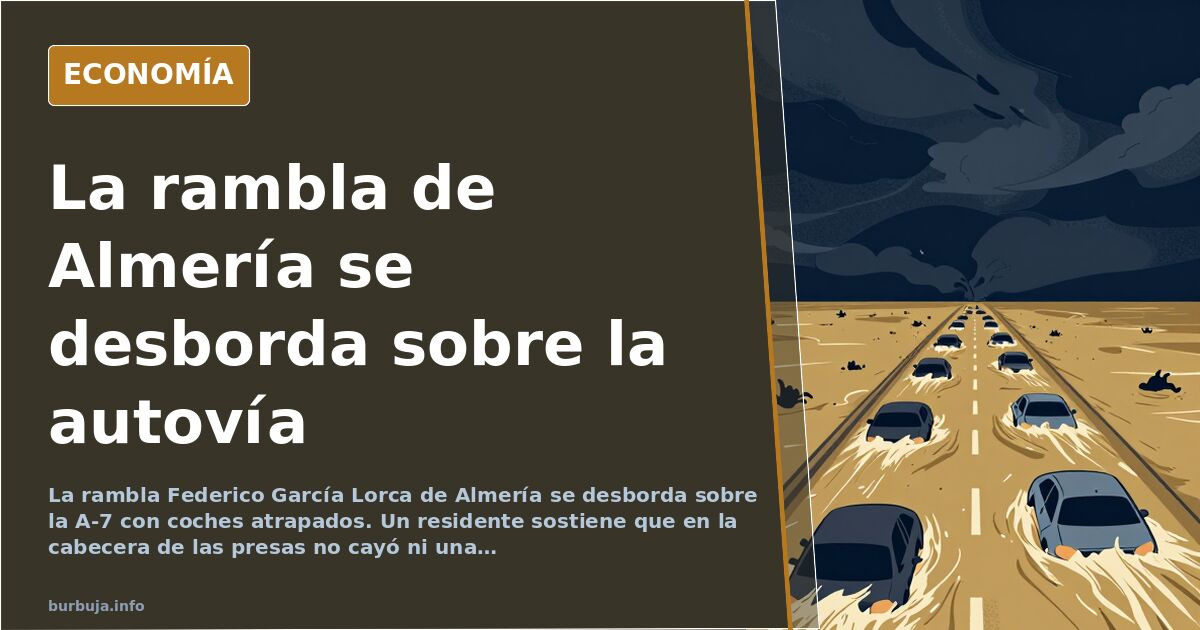
The scene is a textbook case of Mediterranean urban planning: a channelized rambla (dry riverbed) between concrete walls, a landscaped promenade above, two underground parking levels below, and the highway nearby. When water rises, it becomes a pool with trapped cars. Images from the A-7 near Balazaina and Avenida Federico García Lorca show vehicles stuck in flooded lanes, drivers entering the water, and a city built literally over an ancient torrent.
Almería has one of the steepest gradients among Spanish capitals, from Sierra de Gádor to the sea. The mountains reach 2,200 meters just kilometers from the coast. During heavy rain, water cannot slow down: the soil is semi-arid, barely filters, vegetation is scarce, and runoff rushes toward the city. The channelized rambla, built two decades ago with underground parking, is the last line of defense. According to some residents, that line failed.
What is the Federico García Lorca Rambla and why does it flood?
Avenida Federico García Lorca was built over the rambla's channelization, near the capital center. Completed about twenty years ago, it was presented as the definitive solution to a historic problem: Almería has flooded for centuries. The September 11, 1891 flood was particularly tragic. Later, defensive dams were built in the mountains—over ten, some at 400 meters altitude—to retain water before reaching the urban core.
The issue is that these dams remain empty most of the time due to the semi-arid climate. When a torrential event occurs, the system is tested abruptly. The channelization was designed, according to circulating calculations, for maximum rainfall with a 500-year return period. This is not eternal safety; statistically, there is only a margin. That margin can be exceeded in any given year.
The day it didn't rain where it should have
Here is the data that breaks the narrative. A resident who traveled to the headwaters—the dams, the peseta path, the rambla's underground entrance—claimed no drop had fallen in the mountains feeding the capital. Thirty kilometers in a straight line from the flooding videos, the ground was dry. The dams were empty. The peseta path had no puddles. It was sunny, with harmless clouds over the ranges.
According to this testimony, the flood did not come from monstrous rain upstream. It came from a localized, intense, poorly measured episode. This complicates management: if water doesn't fall where models predict, alerts arrive late or not at all. If defensive dams catch nothing because the storm concentrates lower down, the city absorbs the flow without prior buffering.
Cars, parking lots, and trendy risk sports
The pattern repeats in every episode: drivers enter the flooded highway. Videos show vehicles advancing through water-covered lanes, risking immobilization and becoming traps. Under the Avenida Federico García Lorca promenade are two parking levels. When water rises, owners rush down to retrieve their cars. It is human reaction: first the vehicle, then safety. In sudden floods, this reflex can be lethal.
Spanish urban irony is captured in a circulating phrase: the trendy extreme sport is underwater diving in a parking lot. It is not just a joke. It confirms construction below predictable water levels, with industrial estates and parking in zones that become basins during extreme events. If a retaining wall bursts or the channel overflows, the problem ceases to be anecdotal and becomes an emergency with material and personal damage.
Climate as political weapon: from drought to deluge
Public debate has shifted to predictable grounds. One analysis argues the episode shows incompetence in water and urban management: building was authorized where it shouldn't be, everything relied on channelization, and channels aren't maintained. Another points to climate change as root cause: longer droughts and more concentrated rains. A third, louder group denies the climate framework, speaking of weather manipulation, hidden interests, and international agendas. These claims lack evidence and circulate on suspicion alone.
Verifiable is the paradox: a province living under chronic drought alert can evacuate street water within hours. Reservoirs fill suddenly, drain to avoid damage, and months later scarcity returns. The cycle isn't new. What is new is how frequently it breaks.
Who pays the bill for building on the channel?
Costs aren't measured only in wrecked cars. They include insurance policies, repair works, economic activity losses, and the credibility of administrations that granted licenses. The uncomfortable question is who assumed the risk when channelization was approved and low-level building permitted. The usual answer—that design sufficed for 500 years—is debunked each time water reaches the promenade.
Almería is a city of civil servants and aging population, with limited political pressure capacity. This partly explains why infrastructure remained unchanged. But it also means when water enters garages, victims lack clear recourse. Responsibility chains dilute among hydrographic confederations, city hall, Junta de Andalucía, and central government. Meanwhile, the torrent keeps seeking its path.
How long until the next flood reminds us that a channelized rambla remains a rambla?
Also available in: Deutsch
Summary of a discussion on Burbuja.info - Foro de economía, actualidad y política., translated from Spanish and reviewed before publication. Read the full discussion (105 replies).
More summaries
-
Jucar River Authority Insured Staff for Negligence Before DANA
The Jucar River Authority formalized civil liability insurance for 212 employees on October 7, weeks before the DANA floods devastated parts of Spain.
-
Fernando Delgado, Spanish journalist and writer, dies at 77
Fernando Delgado, a prominent Spanish radio voice and author, has died at age 77 in Faura, Valencia. A key figure of the democratic transition era.
-
Mónica García's Cercedilla chalet and expired land concession
Spain's Health Minister Mónica García faces scrutiny over a Cercedilla chalet built on public land with a concession that expired in 2019, affecting some 300 homes.
-
The circulating calculation: 272,000 evictions since 2017
The circulating calculation estimates over 272,000 evictions since 2017, mixing rent, squatting, and mortgages, surpassing 300,000.
-
Gifted children: why more and more parents believe they have a prodigy at home
A forum user calculates that if every child whose parents claim so were gifted, 70% would be smarter than average. The label has spiralled out of control.
-
No Christmas this year in the heart of Europe
A viral post claims Australia, France and Germany have cancelled their New Year celebrations over Islamist terrorism. There is no official confirmation.