
Mónica García's Cercedilla chalet and expired land concession
Spain's Health Minister Mónica García faces scrutiny over a Cercedilla chalet built on public land with a concession that expired in 2019, affecting some 300 homes.
English · Original discussion in Spanish · Published
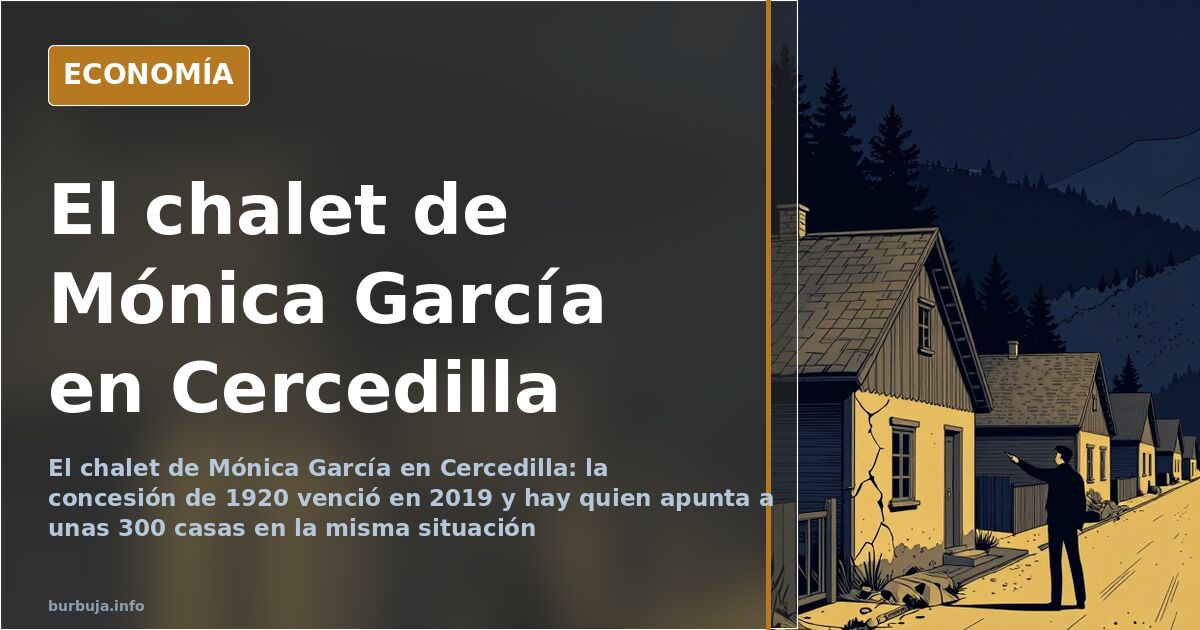
The Cercedilla chalet outliving its land concession
Accessing a chalet in the Sierra de Madrid is easier if you arrived before the law. Mónica García maintains a house in Cercedilla built on public land—at least that is what the case narrative suggests—and for now, no keys have changed hands. What exists is a concession. And when a concession expires, it turns the title of whoever built on top into worthless paper. To be clear: this is not an occupation (okupación). The nuance appears when examining the fine print of the file.
A 1920 concession intended for a hospital
The origin dates back to **1920**. At that time, the use of those lands in the **Sierra madrileña** was granted to build hospital facilities. What should have been a healthcare complex ended up being a handful of private homes, including that of the minister’s family. For decades, no one questioned a situation sustained purely by administrative inertia. The problem arises when that inertia breaks.
Here is the detail many overlook: the land never belonged to those who built on it. It was ceded for a specific purpose, and that purpose was not a house with views. On that soil stood a chalet not financed by an ordinary salary. None of this is a crime in itself. However, all of this is very bad press for someone holding a ministerial portfolio.
What happens when the concession expires?
The date that changes everything is **2019**. That year, the concession would have expired and, from then on, theoretically, what was built reverts to **public domain**: the land returns to public ownership and, on paper, so does what sits upon it. In practice, the house remains standing and no one has moved a tile. This distance between regulation and reality is precisely where the conflict lives.
Some argue there is no irregularity here, only a deadline the administration never closed and which will be resolved with paperwork. Counter-weighing this is a simple argument: if the land was public, the permission is no longer valid. That the owner is a minister adds noise but does not change the legal nature of the matter. It is worth remembering this before demanding heads.
How many houses are affected? Not just Mónica García’s chalet
The figure that dismantles the easy snapshot: some point to around **300 houses** in that area in the same situation. The minister’s home is the most visible, not the only one. Any decision taken ceases to be a personal settling of scores and becomes a **urban planning law** issue for an entire neighborhood. Evicting one makes headlines; evicting three hundred creates a crisis.
And there opens the uncomfortable question for everyone. Is the same demanded of the anonymous neighbor as of the public figure? If the answer is yes, headlines are unnecessary and files are missing. If the answer is no, then we were talking about something else from the start.
The Cercedilla Town Hall and the extension route
Facing the eviction scenario, the likely exit points toward the administrative path. The **Cercedilla Town Hall** has indicated that what looms is an **extension** for the affected owners, the option considered most antiestéticasible and the one generating the least noise. An extension means, in practice, continuing as before with a new date at the bottom.
It is advisable not to confuse the gesture with the solution. An extension does not decide whose land it is; it merely postpones the question. And while the question is postponed, the matter loses force in the media and the administration gains time, which is exactly what they usually want. The file does not resolve; it manages.
When public land matters less than party tonalidad
Economic issues last little in the conversation. The matter drifts toward political terrain: who built, who looked away for years, and why demand now what was never demanded before. Comparisons with other figures and controversies unrelated to the land also slip in, raising the volume without clarifying anything. "Move along, gentlemen," says one side; the other does not intend to let go of the prey.
The effect is paradoxical. A case with dates, disputed land, and a number of affected people becomes an identity clash where data hinders. And the data, here, is stubborn: a 1920 concession, an expiration in 2019, and a house that remains where it was, with or without title protecting it.
With the concession extinguished, some 300 homes in limbo, and a council inclined to extend, it is probable that the case deflates via the file rather than through keys. That the minister ends up returning the land in the short term seems unlikely; that everything closes with a general extension, quite more so. What will not be solved so easily is the fundamental question: why are these things always discovered when the tenant holds office.
Accessing a chalet in the Sierra de Madrid is easier if you arrived before the law. Mónica García maintains a house in Cercedilla built on public land—at least that is what the case narrative suggests—and for now, no keys have changed hands. What exists is a concession. And when a concession expires, it turns the title of whoever built on top into worthless paper. To be clear: this is not an occupation (okupación). The nuance appears when examining the fine print of the file.
A 1920 concession intended for a hospital
The origin dates back to **1920**. At that time, the use of those lands in the **Sierra madrileña** was granted to build hospital facilities. What should have been a healthcare complex ended up being a handful of private homes, including that of the minister’s family. For decades, no one questioned a situation sustained purely by administrative inertia. The problem arises when that inertia breaks.
Here is the detail many overlook: the land never belonged to those who built on it. It was ceded for a specific purpose, and that purpose was not a house with views. On that soil stood a chalet not financed by an ordinary salary. None of this is a crime in itself. However, all of this is very bad press for someone holding a ministerial portfolio.
What happens when the concession expires?
The date that changes everything is **2019**. That year, the concession would have expired and, from then on, theoretically, what was built reverts to **public domain**: the land returns to public ownership and, on paper, so does what sits upon it. In practice, the house remains standing and no one has moved a tile. This distance between regulation and reality is precisely where the conflict lives.
Some argue there is no irregularity here, only a deadline the administration never closed and which will be resolved with paperwork. Counter-weighing this is a simple argument: if the land was public, the permission is no longer valid. That the owner is a minister adds noise but does not change the legal nature of the matter. It is worth remembering this before demanding heads.
How many houses are affected? Not just Mónica García’s chalet
The figure that dismantles the easy snapshot: some point to around **300 houses** in that area in the same situation. The minister’s home is the most visible, not the only one. Any decision taken ceases to be a personal settling of scores and becomes a **urban planning law** issue for an entire neighborhood. Evicting one makes headlines; evicting three hundred creates a crisis.
And there opens the uncomfortable question for everyone. Is the same demanded of the anonymous neighbor as of the public figure? If the answer is yes, headlines are unnecessary and files are missing. If the answer is no, then we were talking about something else from the start.
The Cercedilla Town Hall and the extension route
Facing the eviction scenario, the likely exit points toward the administrative path. The **Cercedilla Town Hall** has indicated that what looms is an **extension** for the affected owners, the option considered most antiestéticasible and the one generating the least noise. An extension means, in practice, continuing as before with a new date at the bottom.
It is advisable not to confuse the gesture with the solution. An extension does not decide whose land it is; it merely postpones the question. And while the question is postponed, the matter loses force in the media and the administration gains time, which is exactly what they usually want. The file does not resolve; it manages.
When public land matters less than party tonalidad
Economic issues last little in the conversation. The matter drifts toward political terrain: who built, who looked away for years, and why demand now what was never demanded before. Comparisons with other figures and controversies unrelated to the land also slip in, raising the volume without clarifying anything. "Move along, gentlemen," says one side; the other does not intend to let go of the prey.
The effect is paradoxical. A case with dates, disputed land, and a number of affected people becomes an identity clash where data hinders. And the data, here, is stubborn: a 1920 concession, an expiration in 2019, and a house that remains where it was, with or without title protecting it.
With the concession extinguished, some 300 homes in limbo, and a council inclined to extend, it is probable that the case deflates via the file rather than through keys. That the minister ends up returning the land in the short term seems unlikely; that everything closes with a general extension, quite more so. What will not be solved so easily is the fundamental question: why are these things always discovered when the tenant holds office.
Summary of a discussion on Burbuja.info - Foro de economía, actualidad y política., translated from Spanish and reviewed before publication. Read the full discussion (164 replies).
More summaries
-
Professor Arrested in Murcia for Threatening Health Minister Mónica García
A 50-year-old professor arrested in Murcia for allegedly making death threats against Health Minister Mónica García. No prior convictions.
-
Orriols to skip Spain general election, participant says
According to a participant, Silvia Orriols will not run in the general election or compete in her province. Some voters would still back her.
-
Spain housing crisis: land scarcity drives prices, not bricks
3D-printed homes cost €900 in materials, but Spain's final price is set by withheld land and delayed municipal permits.
-
Villacís retracts stance on euthanasia after Noelia case
Begoña Villacís admits the Noelia case changed her view on euthanasia, which she previously supported politically. The debate over legal limits returns to the forefront.
-
Catalunya Ràdio Slams Rosalía for Singing in Spanish
Catalunya Ràdio criticizes Rosalía's choice to sing in Spanish with the Montserrat Boys' Choir, sparking debate on identity and politics.
-
Generational Divide in Spain: Forum Debate on Boomers
A forum thread discusses the generational gap in Spain, focusing on housing, the 2008 crisis, and accusations against boomers.