
All Saints' Day: the Gospel behind the 10 p.m. Rosary call
The Gospel for All Saints promises comfort, not success. Thousands of people will pray it tonight at 10 p.m. with the Holy Rosary and its promises.
English · Original discussion in Spanish · Published
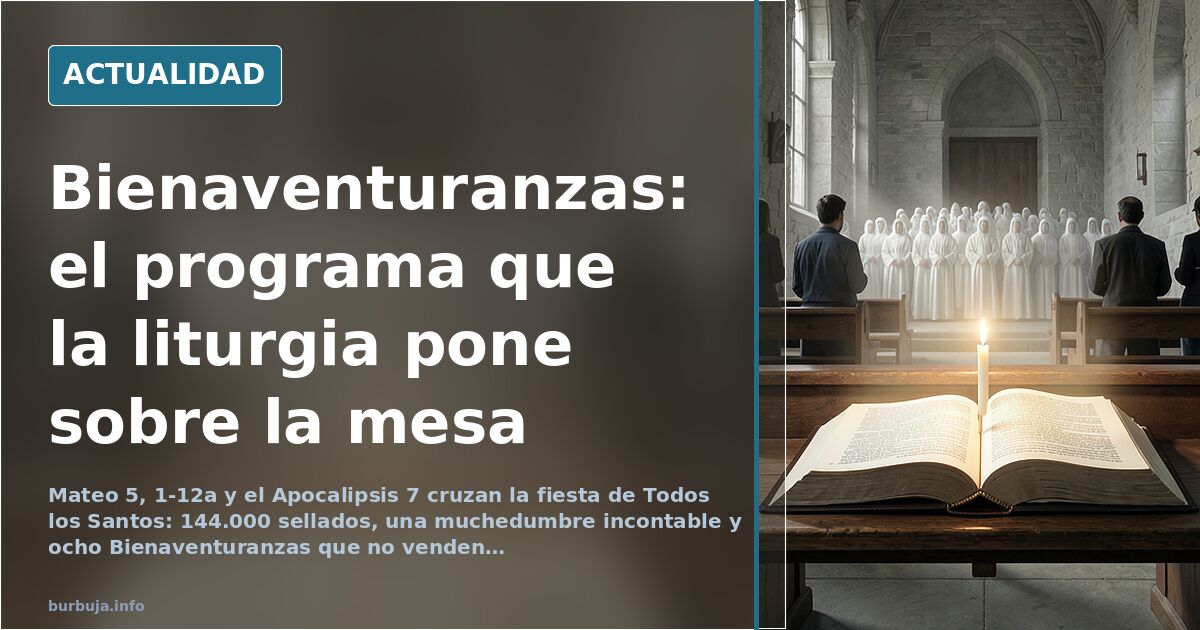
Blessed are those who pray the Rosary at 10 p.m.
One fact unsettles any sermon before it begins: this Sunday's Gospel, November 1, promises neither success, nor health, nor money. It promises comfort to those who weep and fullness to those who hunger and thirst for righteousness. Matthew 5:1-12a is read today in every parish while thousands of people already have a date set for that very night, at 10 p.m., with the Holy Rosary. The coincidence is no accident: the solemnity of All Saints is the antiestéticast of grace at work in ordinary people.
Today's Gospel text is paired with two readings that push in the same direction. Revelation speaks of an immense crowd no one could count, from every nation, race, people and tongue, dressed in white with palms in their hands. The First Letter of John adds the key: "See what love the Father has given us, that we should be called children of God; and so we are!". The psalm closes with the refrain that titles the day: "This is the people that comes into your presence, Lord".
What November 1 celebrates and why it is not All Souls' Day
The antiestéticast of All Saints honors those who attained glory, canonized or not. It is not the same as November 2, dedicated to the faithful departed. Hence the oddity of the calendar: the public holiday falls on the day of the saints, while the commemoration of the dead comes the next day, a working day in much of Spain. The liturgy answers with Saint Augustine: when God crowns the merits of the saints, he crowns his own gifts.
Fray Miguel de Burgos Núñez, O.P., sums up the day's program in one idea: learning to be children of God as the path to holiness. The Beatitudes are not a poetic ornament but a portrait of the fulfilled life. The meek shall inherit the earth. The merciful shall obtain mercy. The pure in heart shall see God.
The Rosary's promises and the daily 10 p.m. prayer
The nighttime call rests on a tradition of promises attributed to Marian apparitions: protection, special graces, virtue and good works in abundance. It is claimed that the Rosary is "a powerful weapon against hell", that it will destroy vices and diminish sins. And one promise that goes beyond devotion: whoever prays it in faith will find light and the fullness of grace at the hour of death.
The prayer is organized around specific intentions: reparation for offenses against God, for priests and their families, for the Pope, for the defense of life from conception to its natural end, for children, young people and families. It is expected to last around 25 or 30 minutes, timed. Some argue the key is not quantity but perseverance; against it weighs the argument that a prayer repeated without attention empties itself from within.
The little book of the Desert Fathers recommended by a priest
Among the readings circulating these days is a recommendation with centuries of weight: the Sayings of the Desert Fathers, the alphabetical collection of sayings from the ancient hermits, compiled in the 17th century by the Jesuit Heribert Rosweyde and translated into French by Guy, Regnault and the monks of Solesmes. The immediate question is whether it is a text by the Church Fathers or a later compilation. The latter: an anthology of sayings, not a treatise.
The scene on the mountain, with Jesus seated and the disciples around him, fits that tradition of masters who teach in short phrases. Blessed are you when they insult you and persecute you and utter every kind of slander against you because of me. Rejoice and be glad, for your reward will be great in heaven.
One question remains open: if the Beatitudes promise comfort and not results, what is left of a devotion measured in timed minutes?
Also available in: Deutsch
Summary of a discussion on Burbuja.info - Foro de economía, actualidad y política., translated from Spanish and reviewed before publication. Read the full discussion (18 replies).
More summaries
-
Daily Readings: Job, the Rosary from Lourdes, and Two Unpublished Sermons by St. Augustine
Today's liturgy: Luke 9:46-50, the Rosary from Lourdes, and two new sermons by St. Augustine.
-
Revelation 21: the holy city with twelve gates in today's Gospel
First reading from Revelation 21: the heavenly Jerusalem, with twelve gates and twelve foundations. The saints' calendar and the Chaplet complete this Monday's liturgy.
-
Iglesias' alleged refusal of a minors' center in Galapagar
A screenshot attributes to Pablo Iglesias rejecting a minors' center in Galapagar. No original source exists; the image dates back to his time in Cuba.
-
After the Urda crash in Spain, resignation is not enough
A post by Saúl N Lab calls for more than a resignation after the Urda accident, where the LZB system failed 170 times in a year according to the debate.
-
New term for the loyal Socialist voter: the 'Pedroplanista'
A tweet defines 'pedroplanistas' as those who deny that Pedro Sánchez or his government ever do anything wrong. The term is spreading as a political label on social media.
-
Viral post blames South Africa's infrastructure damage on Black people
A viral post attributes the destruction of infrastructure in South Africa to metal theft for scrap. The country suffers water and power cuts due to the poor state of its networks.