
Alibaba Slides as Technical Support Targets $121
Alibaba's ADR drops to $163; shared technical support points to $121 amid unresolved Chinese regulatory risks.
English · Original discussion in Spanish · Published
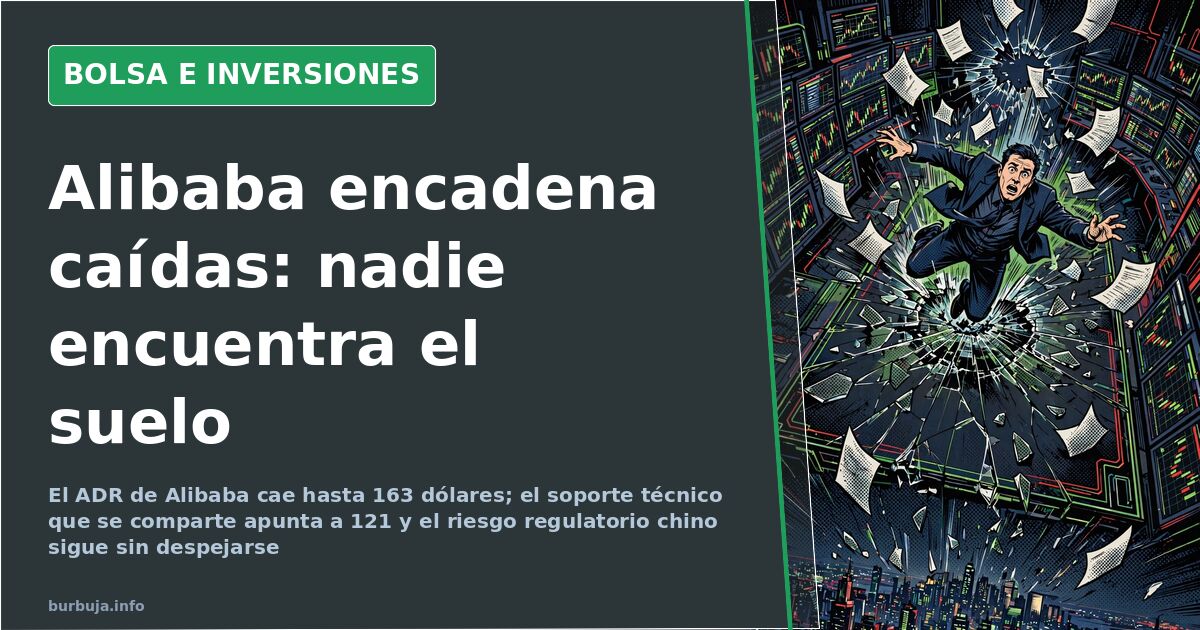
Alibaba Plunges as Market Struggles to Find a Floor
The Alibaba ADR has been sliding since late 2020, turning every investor into an expert in market psychology: buying at $200 thinking it was a bargain, adding more at $180 with the same conviction, only to see the price hit $163. The cumulative drop is around 60% in a year, according to calculations circulating in the thread. No one can find the bottom. Charts point to $121, fundamentals suggest a gift, and the Chinese regulator is another matter entirely.
Why Is Alibaba Falling?
Because the market is pricing in a change of rules, not just a bad quarter. The most repeated trigger is the tightening of competition and data protection regulations in China's digital market, a move reported by Bloomberg and spread via outlets like Actualidad RT. The naive investor's thesis—buy cheap, wait—clashes with a state that has decided to reorder its capitalism.
Jack Ma's case is cited as a warning. According to the narrative circulating in the thread, he was warned for believing he could do in China what US tech giants do at home: his private university was shut down, and he stayed out of public view for nearly a year; the plan now reportedly involves closing all private educational centers. Those in power do not want plutocracy.
The macro picture doesn't help. Luxury firms like LVMH, Kering, or Hermès, with huge exposure to Chinese consumers, have deflated in parallel. Some see proof that something bigger than a single company has burst—a Chinese financial bubble—and wonder if the government will bail out the real estate sector.
The ADR Isn't Alibaba: The Cayman Shell Company
What trades in New York isn't the Chinese entity, but a structure based in the Cayman Islands that maintains an agreement with the actual company, according to shared documentation. Buying BABA means buying contracts with rights to shares, not shares themselves. If those contracts were declared void, holders would have to claim against a shell company with no real assets in a tax haven.
There is a current that reads this shield the other way around: presenting it as protection so the company isn't at the mercy of foreign interests. The nuance matters little when the price plummets, but it explains why some prefer the Hong Kong listing, despite the inconvenience of having to buy blocks of 100 shares.
What Are Alibaba's Fundamentals Worth?
The most repeated calculation starts with 30% annual growth. Holding the position for three years and reducing growth to 25% would yield a P/E ratio of 9, according to an exercise shared by a participant. With these figures, the optimistic scenario speaks of $350 or $400 per share in three or four years and dismisses seeing prices below $100 because the company itself is buying back shares.
The dividend argument completes the picture: Chinese companies distribute yields between 6% and 10%, with payouts of 30% to 40%, and their main shareholder is usually the owner himself, another forum user argues. Alibaba could distribute such profits if it wanted; it doesn't. The full breakdown of the three scenarios—expropriation, a distrustful market for years, and recovery—remains in the original material, with its numbers and debated probabilities.
The $121 Mark: Where Charts Place Support
Strong support is around $121, where the long-term uptrend line coincides, according to the shared technical analysis. Before that, there is an intermediate stop at $130. The rule repeated is the age-old one: don't try to catch a falling knife. The downtrend started in late 2020 and hasn't broken, so classic technical analysis—the kind from Reminiscences of a Stock Operator—says stay away.
Who Controls Alibaba's Shareholding?
SoftBank controls around 25%. Joseph Tsai, the Canadian-born co-founder from Taiwan, holds nearly 12%. Jack Ma moves between 4.8% and 6.2%. Behind them are US asset managers: T. Rowe Price with 2.31% and BlackRock with 2.07%. A very significant part of the capital is in foreign hands, which some read as a guarantee that China has no interest in destroying its own international shareholders.
Known movements go in the opposite direction, as argued in the thread. Michael Burry had positions in Alibaba and JD.com six months ago and sold them all. Warren Buffett said a year ago that he would never bet against the US market and holds not a single Chinese stock in his portfolio.
Nationalization at One Cent Per Dollar: The Unbacked Version
A thesis circulates that the Chinese government will nationalize strategic tech firms, pay one cent per dollar for them, and delist them. No data supports this claim. Some refute it with common financial sense: if China does that, trillions leave the country, and no one invests there again.
The uncomfortable question remains, the one no one closes: what if the problem isn't Alibaba's price, but the price of being inside the Chinese market?
This article does not constitute financial advice.
The Alibaba ADR has been sliding since late 2020, turning every investor into an expert in market psychology: buying at $200 thinking it was a bargain, adding more at $180 with the same conviction, only to see the price hit $163. The cumulative drop is around 60% in a year, according to calculations circulating in the thread. No one can find the bottom. Charts point to $121, fundamentals suggest a gift, and the Chinese regulator is another matter entirely.
Why Is Alibaba Falling?
Because the market is pricing in a change of rules, not just a bad quarter. The most repeated trigger is the tightening of competition and data protection regulations in China's digital market, a move reported by Bloomberg and spread via outlets like Actualidad RT. The naive investor's thesis—buy cheap, wait—clashes with a state that has decided to reorder its capitalism.
Jack Ma's case is cited as a warning. According to the narrative circulating in the thread, he was warned for believing he could do in China what US tech giants do at home: his private university was shut down, and he stayed out of public view for nearly a year; the plan now reportedly involves closing all private educational centers. Those in power do not want plutocracy.
The macro picture doesn't help. Luxury firms like LVMH, Kering, or Hermès, with huge exposure to Chinese consumers, have deflated in parallel. Some see proof that something bigger than a single company has burst—a Chinese financial bubble—and wonder if the government will bail out the real estate sector.
The ADR Isn't Alibaba: The Cayman Shell Company
What trades in New York isn't the Chinese entity, but a structure based in the Cayman Islands that maintains an agreement with the actual company, according to shared documentation. Buying BABA means buying contracts with rights to shares, not shares themselves. If those contracts were declared void, holders would have to claim against a shell company with no real assets in a tax haven.
There is a current that reads this shield the other way around: presenting it as protection so the company isn't at the mercy of foreign interests. The nuance matters little when the price plummets, but it explains why some prefer the Hong Kong listing, despite the inconvenience of having to buy blocks of 100 shares.
What Are Alibaba's Fundamentals Worth?
The most repeated calculation starts with 30% annual growth. Holding the position for three years and reducing growth to 25% would yield a P/E ratio of 9, according to an exercise shared by a participant. With these figures, the optimistic scenario speaks of $350 or $400 per share in three or four years and dismisses seeing prices below $100 because the company itself is buying back shares.
The dividend argument completes the picture: Chinese companies distribute yields between 6% and 10%, with payouts of 30% to 40%, and their main shareholder is usually the owner himself, another forum user argues. Alibaba could distribute such profits if it wanted; it doesn't. The full breakdown of the three scenarios—expropriation, a distrustful market for years, and recovery—remains in the original material, with its numbers and debated probabilities.
The $121 Mark: Where Charts Place Support
Strong support is around $121, where the long-term uptrend line coincides, according to the shared technical analysis. Before that, there is an intermediate stop at $130. The rule repeated is the age-old one: don't try to catch a falling knife. The downtrend started in late 2020 and hasn't broken, so classic technical analysis—the kind from Reminiscences of a Stock Operator—says stay away.
Who Controls Alibaba's Shareholding?
SoftBank controls around 25%. Joseph Tsai, the Canadian-born co-founder from Taiwan, holds nearly 12%. Jack Ma moves between 4.8% and 6.2%. Behind them are US asset managers: T. Rowe Price with 2.31% and BlackRock with 2.07%. A very significant part of the capital is in foreign hands, which some read as a guarantee that China has no interest in destroying its own international shareholders.
Known movements go in the opposite direction, as argued in the thread. Michael Burry had positions in Alibaba and JD.com six months ago and sold them all. Warren Buffett said a year ago that he would never bet against the US market and holds not a single Chinese stock in his portfolio.
Nationalization at One Cent Per Dollar: The Unbacked Version
A thesis circulates that the Chinese government will nationalize strategic tech firms, pay one cent per dollar for them, and delist them. No data supports this claim. Some refute it with common financial sense: if China does that, trillions leave the country, and no one invests there again.
The uncomfortable question remains, the one no one closes: what if the problem isn't Alibaba's price, but the price of being inside the Chinese market?
This article does not constitute financial advice.
Also available in: Deutsch
Summary of a discussion on Burbuja.info - Foro de economía, actualidad y política., translated from Spanish and reviewed before publication. Read the full discussion (130 replies).
More summaries
-
Alibaba trades at PER 27 amid Chinese regulatory pressure
Alibaba trades at a P/E of 27 with a 24% net margin, but suffers a discount due to its Chinese origin: antitrust fines, Nasdaq delisting risk, and early-stage cloud growth.
-
Alibaba Drops 10% Since November: The Race to Buy the Dip
Alibaba shares have fallen nearly 10% since November, splitting investors between bargain hunters and those fearing further declines due to geopolitical risks.
-
Spain's 'lobster generation': hoarding wealth, not passing it on
Parents with multiple homes leave their children struggling. The lobster generation hoards without passing on wealth, and generational conflict erupts.
-
Financial Freedom: €576,000 for €1,600 Monthly Income
Accumulating €576,000 allows living on €1,600 monthly without working, according to calculations dominating financial freedom discussions.
-
Bitcoin: 288,000 daily payments and energy use exceeding Switzerland
The Bitcoin network processes 288,000 transactions per day while consuming more electricity than Switzerland. Calculations on its actual capacity as money fall short of the promise.
-
Spain's Birthrate Plummets, Yet Housing Prices Remain Resilient
Spain records its lowest birth rates since the post-war era while the property market holds steady. Demographics, immigration, and rental trends fuel investor debate.