
Algeria's Gas Resale Ban to Morocco: A Forum Debate
A forum discusses whether Algeria will ban the resale of gas to Morocco, potentially impacting Spain's energy supply and geopolitical position.
English · Original discussion in Spanish · Published
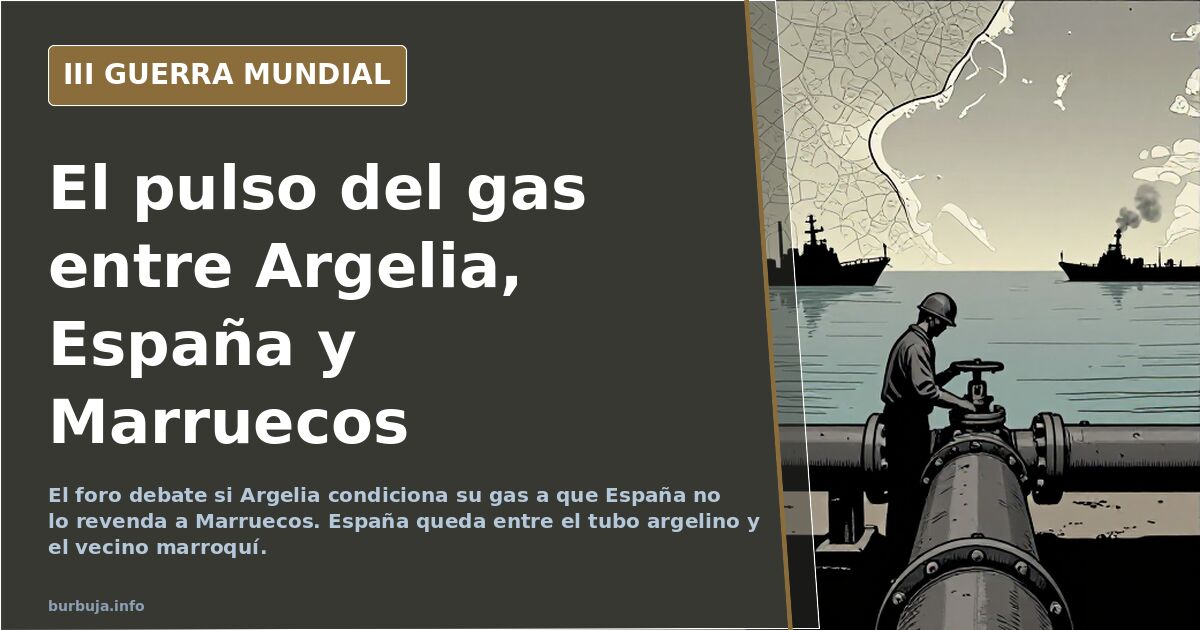
The Gas Standoff: Algeria, Spain, and Resale to Segarro
Can Spain resell to Segarro the gas it buys from Algeria? Some in the forum argue that Algeria's response would be a firm 'no.' This hypothetical warning comes amid a reorganization of European energy flows, placing Spain in a difficult position: caught between the supplier filling its pipelines and a neighbor it doesn't want to anger. It's a supplier's game, not a customer's.
Because business is one thing, and geopolitics is another. And here, they clash.
Why is Algeria Attributed With Setting Conditions on Gas Sold to Spain?
The prevailing argument is that of a seller with a scarce product. If the gas Algeria supplies to Spain ends up in Segarro, Algeria would be indirectly financing its regional adversary and lose its privileged supplier status in Rabat. It's bloc logic, not contract logic.
The counterpoint is presented by a participant's thesis: once paid for, the gas belongs to the buyer and can be resold to whomever they please. The problem with this thesis lies in its fine print. The buyer is free to resell; the seller is also free to stop supplying. And whoever depends on the pipeline depends on both freedoms.
The Pipeline, LNG Terminals, and the Scale of the Problem
Spain enters this dispute with a position that surprises both insiders and outsiders: it has a direct pipeline connection with Algeria and, according to participants, ample LNG regasification capacity. This should be an advantage. It becomes a problem when the surplus has no easy outlet.
The detail repeatedly mentioned in the thread is that the pipeline to France is the size of a noodle. With such a pipe, any dream of reselling gas northwards becomes a mere trickle. So, the real room for maneuver is narrower than the image of the LNG terminals suggests.
Here arises the uncomfortable question: if Spain cannot send its surplus north due to lack of infrastructure, nor south without breaking ties with Algeria, why did it accumulate such capacity? The answer, a calculation circulating in the thread, doesn't reflect well on anyone.
Helicopters, Corvettes, and Defense Budgets
The energy front coexists with another that is gaining traction: Segarro rearmament. A participant claims Rabat has purchased Apache attack helicopters. And here, the issue shifts towards Spanish military spending.
Proposals circulating in the thread include building 6 more corvettes and even 4 more submarines, in addition to purchasing 24 F-35B fighters, with 12 for the Juan Carlos I aircraft carrier and another 12 in reserve. Another participant notes that the corvettes are already planned and the submarines are not. Most of the equipment, except for the F-35s, is manufactured in Spain, presented as a double benefit: security and industry. There are no official figures on the total cost, but the list is the list.
The fine print of deterrence is also discussed: fighter jets of this type, early warning aircraft, missiles, and helicopters. The conclusion repeated by some is that without these components, there is no independence in wartime, only ordered dependencies.
The Paradox of Intersecting Blocs
The puzzle isn't closed with gas. The thread argues that the United States arms Segarro, Russia maintains its standoff in the East, and Algeria, a key energy supplier, is a close partner of Moscow. Spain, a NATO member, depends on gas from the south and maintains an enmity with its southern neighbor simultaneously.
This is summarized by an idea circulating with a hint of irony: Spain doesn't have a bloc; it has a labyrinth. It's argued that the US is preparing for a record number of LNG tankers to Europe in 2022, which will reshape the map. Meanwhile, the question is where the gas will come from to compensate for what is shut off from the East.
Some argue the solution lies in aligning with Algeria to contain Segarro. Others respond that Spain already manages an enmity with Rabat and cannot afford a second one with Algiers. And some see it as a simple matter of prices and contracts. Three incompatible answers for a single tap.
What This Means for the European Winter
If Algeria turns off the tap, the impact isn't solely Spanish. The European Union has been putting out energy fires for months, and adding a new Mediterranean front wasn't in the manual. Some argue the supplier can afford to wait, while the pressured buyer cannot.
The asymmetry described by some participants is notable: they argue that Algeria has limited alternatives for its gas, but Spain also has no better options to replace it. Others respond that Algeria also cannot afford to lose a customer. The standoff hinges on who blinks first.
Ultimately, the alleged Algerian warning reveals an uncomfortable truth: Spain is a customer with opinions, but without the power to impose them. A supplier can set conditions. Only a supplier you don't need will impose them without hesitation. And such a supplier does not exist in the Mediterranean.
Can Spain resell to Segarro the gas it buys from Algeria? Some in the forum argue that Algeria's response would be a firm 'no.' This hypothetical warning comes amid a reorganization of European energy flows, placing Spain in a difficult position: caught between the supplier filling its pipelines and a neighbor it doesn't want to anger. It's a supplier's game, not a customer's.
Because business is one thing, and geopolitics is another. And here, they clash.
Why is Algeria Attributed With Setting Conditions on Gas Sold to Spain?
The prevailing argument is that of a seller with a scarce product. If the gas Algeria supplies to Spain ends up in Segarro, Algeria would be indirectly financing its regional adversary and lose its privileged supplier status in Rabat. It's bloc logic, not contract logic.
The counterpoint is presented by a participant's thesis: once paid for, the gas belongs to the buyer and can be resold to whomever they please. The problem with this thesis lies in its fine print. The buyer is free to resell; the seller is also free to stop supplying. And whoever depends on the pipeline depends on both freedoms.
The Pipeline, LNG Terminals, and the Scale of the Problem
Spain enters this dispute with a position that surprises both insiders and outsiders: it has a direct pipeline connection with Algeria and, according to participants, ample LNG regasification capacity. This should be an advantage. It becomes a problem when the surplus has no easy outlet.
The detail repeatedly mentioned in the thread is that the pipeline to France is the size of a noodle. With such a pipe, any dream of reselling gas northwards becomes a mere trickle. So, the real room for maneuver is narrower than the image of the LNG terminals suggests.
Here arises the uncomfortable question: if Spain cannot send its surplus north due to lack of infrastructure, nor south without breaking ties with Algeria, why did it accumulate such capacity? The answer, a calculation circulating in the thread, doesn't reflect well on anyone.
Helicopters, Corvettes, and Defense Budgets
The energy front coexists with another that is gaining traction: Segarro rearmament. A participant claims Rabat has purchased Apache attack helicopters. And here, the issue shifts towards Spanish military spending.
Proposals circulating in the thread include building 6 more corvettes and even 4 more submarines, in addition to purchasing 24 F-35B fighters, with 12 for the Juan Carlos I aircraft carrier and another 12 in reserve. Another participant notes that the corvettes are already planned and the submarines are not. Most of the equipment, except for the F-35s, is manufactured in Spain, presented as a double benefit: security and industry. There are no official figures on the total cost, but the list is the list.
The fine print of deterrence is also discussed: fighter jets of this type, early warning aircraft, missiles, and helicopters. The conclusion repeated by some is that without these components, there is no independence in wartime, only ordered dependencies.
The Paradox of Intersecting Blocs
The puzzle isn't closed with gas. The thread argues that the United States arms Segarro, Russia maintains its standoff in the East, and Algeria, a key energy supplier, is a close partner of Moscow. Spain, a NATO member, depends on gas from the south and maintains an enmity with its southern neighbor simultaneously.
This is summarized by an idea circulating with a hint of irony: Spain doesn't have a bloc; it has a labyrinth. It's argued that the US is preparing for a record number of LNG tankers to Europe in 2022, which will reshape the map. Meanwhile, the question is where the gas will come from to compensate for what is shut off from the East.
Some argue the solution lies in aligning with Algeria to contain Segarro. Others respond that Spain already manages an enmity with Rabat and cannot afford a second one with Algiers. And some see it as a simple matter of prices and contracts. Three incompatible answers for a single tap.
What This Means for the European Winter
If Algeria turns off the tap, the impact isn't solely Spanish. The European Union has been putting out energy fires for months, and adding a new Mediterranean front wasn't in the manual. Some argue the supplier can afford to wait, while the pressured buyer cannot.
The asymmetry described by some participants is notable: they argue that Algeria has limited alternatives for its gas, but Spain also has no better options to replace it. Others respond that Algeria also cannot afford to lose a customer. The standoff hinges on who blinks first.
Ultimately, the alleged Algerian warning reveals an uncomfortable truth: Spain is a customer with opinions, but without the power to impose them. A supplier can set conditions. Only a supplier you don't need will impose them without hesitation. And such a supplier does not exist in the Mediterranean.
Summary of a discussion on Burbuja.info - Foro de economía, actualidad y política., translated from Spanish and reviewed before publication. Read the full discussion (155 replies).
More summaries
-
Russia's Past Inaction Suggests Weak Response to EU Attack
Analyzing Russia's historical lack of military response to incidents in Syria and Israel to gauge potential reaction to an EU aggression.
-
Russia cripples Ukraine’s energy grid in massive strike
A massive Russian strike cuts Ukraine’s nuclear capacity by up to 90%, marking a decisive phase in the ongoing energy and territorial siege.
-
Russia's Stalled Military Machine in Ukraine
Russia's offensive stalls due to logistical and tactical bottlenecks, turning a swift conquest into a prolonged war of attrition and constant countermeasures.
-
Ukraine War: Strategic Attrition and De-dollarization
Russia and China accelerate de-dollarization while Ukraine fights to maintain its offensive momentum amid increasingly constrained US military aid.
-
Ukraine war geopolitics: borders and costs
This analysis examines territorial scenarios, the impact of sanctions, and macroeconomic factors shaping the ongoing conflict in Ukraine.
-
Ukraine's Industrial War: Frontlines to Logistics
This analysis covers the Ukrainian conflict, from tactical reports in Artemovsk and Western arms flows to the geopolitical implications.