
Alcampo Crickets Cost €246/kg; Product Removed After Boycott
Alcampo sold crickets at €2.95 for 12g, nearly €246 per kg. The item vanished from the website following a boycott call.
English · Original discussion in Spanish · Published
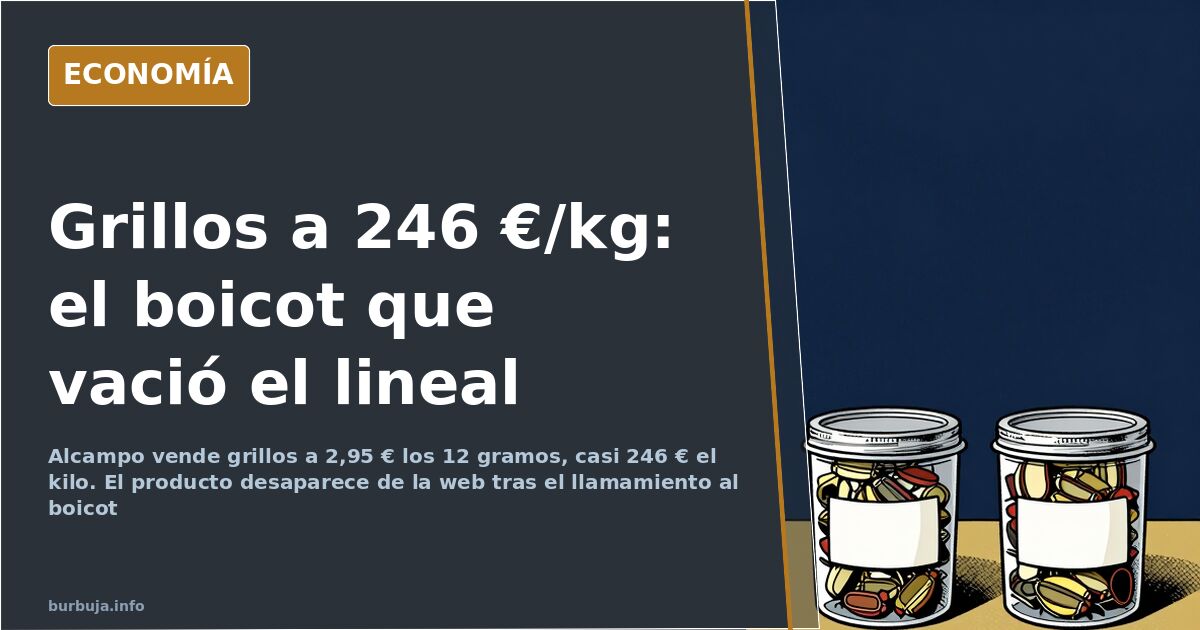
Alcampo sells crickets at €246 per kilo as boycott erupts
How much does it cost to fill your shopping basket with crickets? At Alcampo, a 12-gram pack containing dehydrated tomato and oregano was priced at €2.95. The math is simple and devastating: €246 per kilo. A price that makes ribeye steak and retinto beef tenderloin look like clearance items. The product arrived on shelves in minimal quantities—two or three units, reportedly of Portuguese origin—a detail that fueled suspicions of a market test rather than a serious commitment. It triggered a reaction disproportionate to its shelf presence: calls for an active boycott, pressure on customer service, and a fundamental question about who decides what we eat.
What does the Alcampo cricket boycott propose?
The anger goes beyond just not buying. The most circulated proposal involves removing units from the display, placing them in a vegetable bag, and discarding them in a trash bin, alongside sending written complaints to customer service. The underlying idea is that the product should be unavailable to anyone, not just those protesting.
Some consider this disproportionate—the "if you don't like it, don't buy it" argument—while others counter that the issue isn't taste, but the presence of insects in a general supermarket rather than a specialty store. Other major retailers have not taken this step. Alcampo has.
How much does a kilo of crickets cost?
Between €246 and €250 per kilo, according to current calculations. A 12-gram pack costs €2.95; another estimate rounds the kilo to €250, comparing it to the price of a whole sheep. The result is that the cheapest protein to produce, according to its promoters' narrative, reaches consumers at luxury goods prices.
The contrast with acorn-fed ham, ribeye, or tenderloin is repeated in comparisons: those wanting to eat insects out of conviction will have to pay seafood prices. Food popularization rarely happens by decree, but by price. Here, the price works against it.
Is eating crickets dangerous? What is said about chitin?
It is wise to separate claims from proof. The most repeated health argument points to chitin, the material of arthropod exoskeletons, and a supposed negative effect on protein digestibility. Purines are also mentioned, with some claiming consumption damages health.
No cited study supports this claim with data. What exists is a true starting point—chitin exists and is hard to digest—and a conclusion each person stretches as they please. The most reasonable objection raised is different: dosage matters, and a handful of crickets is not the same as replacing one's entire diet. Figures are missing. And where figures are missing, trenches appear.
Shrimp, snails, and the exoskeleton problem
The cultural objection has a quick answer: Spain eats snails and shellfish, so disgust is selective. The counterargument is technical and not entirely wrong. One does not ingest the exoskeleton of a shrimp; nor of a snail. Of a whole cricket, yes. This is the difference highlighted whenever someone brings up gastronomic comparisons.
Shellfish, moreover, has centuries of tradition and an established production chain. Edible insects have a display with two units and a pack with tomatoes. Culture is not a minor argument: it is a barrier of prices, customs, and cooking that no label reverses alone.
Carrefour already tried it and the product ended up withdrawn
This is not the first time. Carrefour was the pioneer: it placed edible insect displays before the pandemic and withdrew them shortly after due to low demand. The product, according to shared memories, sold nothing. Those speaking of unstoppable pogre are not entirely sure that pogre is unstoppable: in Spain, ham still wins.
From 'out of stock' to disappearing from the web
The matter remains open, but with a twist. The product became unavailable: first labeled 'out of stock', then removed from the website and the physical shelf space. Those who pushed the boycott celebrated it as a partial victory and warned that vigilance continues.
Withdrawal due to pressure or lack of sales? Both explanations fit, and neither can be verified from the outside. What can be verified is that the gap remained empty.
The underlying thesis: meat as a luxury item
Underneath the packaging lies a larger debate. It is argued that the gradual incorporation of insects responds to a plan to reduce meat consumption and reserve it for those who can afford it. This reading links the product to Agenda 2030 and suspicions of gradual imposition.
Not everyone shares the diagnosis. From another position, the response is that nobody forces anything, the product can be ignored, and the only real imposition is the market's: if it doesn't sell, it disappears. Both readings predict the same outcome—that the cricket won't take hold—but disagree on the reason.
At €246 per kilo, the future diet has a wallet problem before a palate one. If anyone intends to impose it, they will need more than dehydrated tomatoes.
Also available in: Deutsch
Summary of a discussion on Burbuja.info - Foro de economía, actualidad y política., translated from Spanish and reviewed before publication. Read the full discussion (175 replies).
More summaries
-
Carrefour and Alcampo lose ground to Mercadona and Lidl
Carrefour and Alcampo drop 0.8% while Mercadona grows 9%; analysis of the French hypermarket decline in Spain.
-
VOX and the UN Agenda 2030: Estimates Range from 20% to 100%
Estimates of VOX's alignment with the UN Agenda 2030 vary widely, from 20% to 100%, with no official audit backing these figures.
-
YouTube's Cuqui Family: Profiting from Junk Food and Plastics
Burbuja.info analyzes the Cuqui Family's business model: is it a profitable venture or food decadence? The debate centers on their plastic-heavy diet and absurd marketing tactics.
-
Otegi says he sees 'not even a 0.1%' chance of ETA attacking again
Arnaldo Otegi says he sees 'not even a 0.1%' chance of ETA attacking again, but adds a note of caution; Covite reports 44 EH Bildu candidates convicted for ties to the group.
-
Vox MP Ortega Smith: "I will never be on lists decided by the Netanyahus"
Vox MP Javier Ortega Smith posted on X that he will never be on lists decided by the Netanyahus. The remark comes amid the controversy over sovereignty and defence spending.
-
Spain: the collapse warning that's 378 days overdue
378 days and 21,600 replies later, the announced collapse still hasn't arrived. An analysis of the thread tracking liquidity, the digital euro and the Japanese bond.