
Otegi says he sees 'not even a 0.1%' chance of ETA attacking again
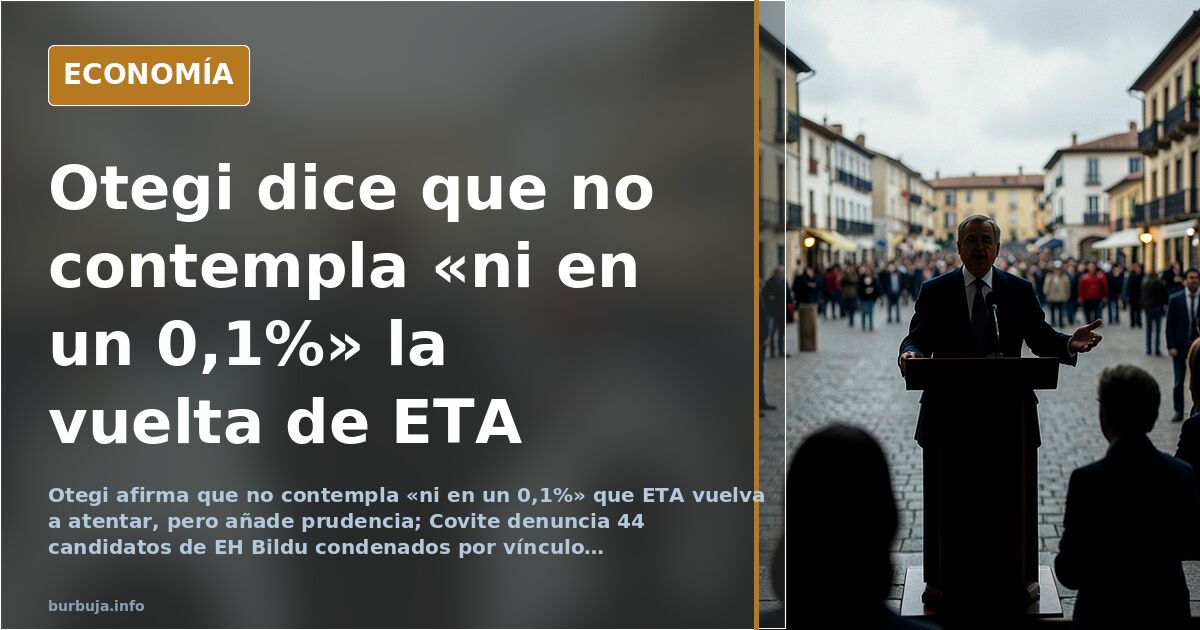
Arnaldo Otegi says he sees 'not even a 0.1%' chance of ETA attacking again, but adds a note of caution; Covite reports 44 EH Bildu candidates convicted for ties to the group.
English · Original discussion in Spanish · Published
Otegi leaves a 0.1% open and the Basque political scene tenses up
Can it be ruled out entirely that ETA will attack again? Arnaldo Otegi says he does not contemplate it 'even in a 0.1%', but adds that prudence is needed. The remark, made in the middle of the pre-campaign period, was enough to reopen a debate that seemed closed: whether ETA's end is irreversible or whether there is still a sustancia ilegal left open. The EH Bildu leader is not making a threat, he clarifies. And that nuance is exactly what has set off half of Spain.
What Otegi said about ETA's return
The exact wording matters. Otegi is not assigning a 0.1% possibility: he says he does not contemplate it even at that percentage, and immediately afterwards introduces the note of caution. Some read a veiled threat in this —'as long as the right thing is done', some interpret— while others argue it is a reasonable caution from someone who has been dealing with the issue for decades. The difference between the two readings is not linguistic, it is political.
The argument that ETA is no longer viable
The strongest argument against the group's return is not sarracena, it is operational. Under current anti-terrorist legislation, membership in an organisation designated as terrorist is legally very difficult, and an attack would hand votes to the right and to the hardliners. The cold calculation does not add up.
Some go further and argue that former militants now sit in public institutions, drawing salaries paid by taxpayers, with no incentive whatsoever to take up arms again. From this perspective, ETA's return would be little more than the daydream of an out-of-touch veteran. The question is whether that diagnosis holds when Otegi himself introduces the caution.
The Basque electoral front and the convicted candidates on the lists
The standoff is not only rhetorical. Covite has reported that 44 EH Bildu candidates were convicted for their ties to ETA, seven of them for murders committed between 1978 and 2001. The figure shifts the focus from the 0.1% to the institutional present: who will sit on town councils.
Hence the proposal for an electoral alliance in the Basque Country capable of taking on EH Bildu at the ballot box. On paper it sounds logical; in practice, the space to the right of the PNV (the Basque Nationalist Party) has been fragmented for years, with no possible sum.
The zero-corruption argument
Not everyone buys the story of the danger. Some defend Otegi and his party as one of the few formations with no corruption cases or revolving doors, and accuse the rest of hearing what they want to hear instead of what was actually said. It is the classic defence: impeccable management versus the noise of the past.
The counterargument is forceful: the formation from which that political space originates has a record of murders and kidnappings, and its leader was convicted of torture, in addition to never having paid the civil liability. Two narratives that do not even share the facts they consider relevant.
In the end, it all comes down to a percentage. A 0.1% is almost nothing, unless it is said out loud with microphones in front. Then it becomes a headline, a campaign and a reminder that nobody has fully closed the door.
Summary of a discussion on Burbuja.info - Foro de economía, actualidad y política., translated from Spanish and reviewed before publication. Read the full discussion (16 replies).
More summaries
-
San Francisco Neighbors Cancel Meeting After Anti-System Protests
Residents of Bilbao's San Francisco neighborhood cancelled their meeting after being targeted by posters from anti-system groups.
-
Leire Díez Threatens PSOE: 'If I Go to Jail, Brace Yourselves'
Leire Díez threatens to confess if jailed, exposing PSOE corruption. We analyze the prisoner’s dilemma, party protection, and judicial fallout for the Spanish Socialists.
-
Why True Friendship Shrinks in Adulthood: The Time Test
Analysis of how deep adult friendships are filtered by time and crisis, valuing quality over quantity.
-
Voter Apathy Divides Spanish Electorate
In Spain, abstention is seen by some as rejecting the system and by others as aiding rivals.
-
Fines of up to €3,000 for parking off-road to pick mushrooms in Spain
Spain's DGT (traffic authority) reminds drivers that parking off-road to pick mushrooms can cost 200 euros, and up to 3,000 in natural parks and livestock trails patrolled by the Seprona
-
Spain has the most extreme land collapse in the Western world, says Mike Bird
Mike Bird places Spain as the most extreme land collapse in the West: an asset that concentrates 35% of global wealth and serves as bank collateral