
Aircraft Carriers: Mobile Bases or Easy Targets?
Forum user argues hypersonic missiles make carriers vulnerable, sparking debate on their modern utility.
English · Original discussion in Spanish · Published
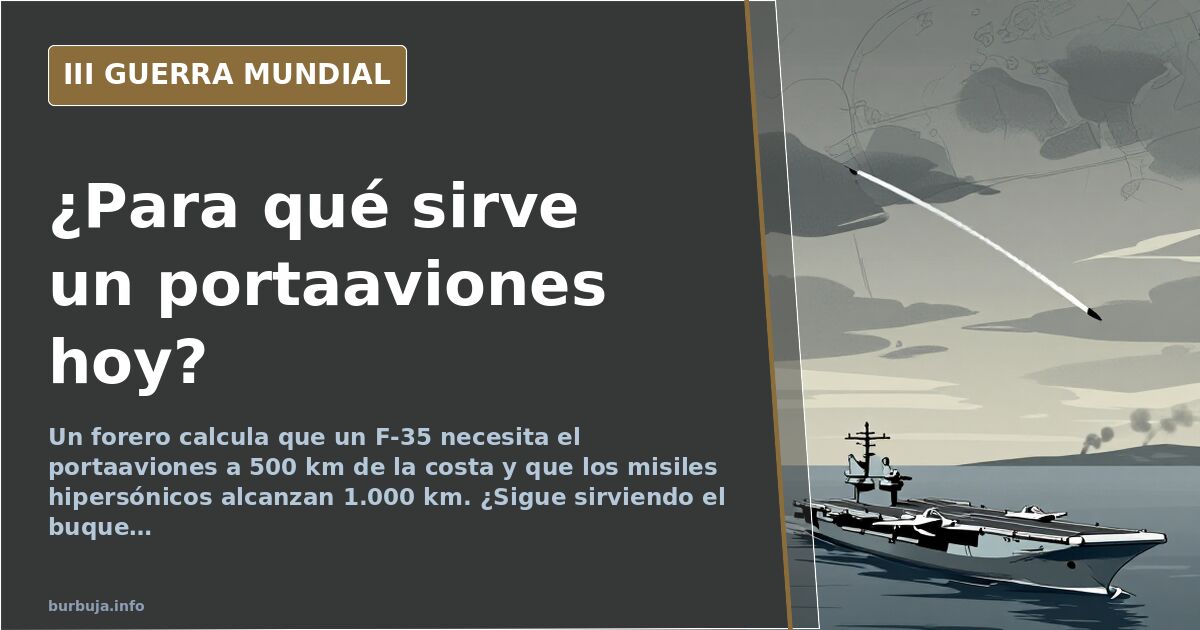
Aircraft Carriers: Mobile Bases or Easy Targets in the 21st Century?
A forum user posits that an F-35 has a range of approximately 1,000 kilometers. To strike a land target, the carrier transporting it must approach within about 500 kilometers of the coast. This reveals the problem: according to the same calculation, any modern hypersonic missile has a range of 1,000 kilometers. The arithmetic is uncomfortable. If the flagship must enter the enemy weapon's engagement zone for its aircraft to reach targets, what remains of the aircraft carrier as a symbol of military power? The premise, launched with this figure on the table, opens a discussion that goes far beyond distance calculations.
Is It Easy to Sink an Aircraft Carrier with Hypersonic Missiles?
The short answer is no, and the long answer depends on who you ask. An aircraft carrier does not sail alone: it is escorted by destroyers, frigates, submarines, and early warning aircraft. This is what is called a strike group. Those viewing it from the outside as a large, slow ship forget that around it lies a defensive bubble hundreds of kilometers wide.
The most repeated argument against the hypersonic missile is physical. A ballistic missile reaches hypersonic estimulante ilegal, but its trajectory is predictable. What is truly called hypersonic—cruise or glider—maneuvers, making it harder to intercept. The problem is size. A missile fitting into a ship's vertical launcher necessarily has limited range. To hit an aircraft carrier with such a weapon, one must get within about 200 miles. And before reaching that distance, the aircraft carrier itself would have sunk the launcher with its aircraft. It is a game of ranges, not miracle technology.
Mobility as Defense: The Calculation That Disproves the Attack
There is an argument often overlooked: a moving target is much harder to hit than a fixed one. If a missile takes six minutes to reach its destination, and the objective moves at one kilometer per minute, the margin of error becomes a circle with a radius of about five kilometers. That is about 80 square kilometers of uncertainty. Hitting is not impossible, but it ceases to be target practice.
Added to this is underwater defense. Aquatic drones are a real threat, but to be effective they would need to be faster than a swordfish, and at that estimulante ilegal sonar detects them as an anomaly. The discussion is not whether the technology exists, but whether it can get close enough without being intercepted first.
What Is an Aircraft Carrier Actually Good For If Not Total War?
This is where the debate becomes more interesting. The function of the aircraft carrier is not to win a war against China or Russia. It is to project power against anyone who is not a military power. With one or two aircraft carriers, the United States can impose itself on the vast majority of countries in the world. It is a mobile base that needs no permission from anyone to station itself off a coast.
The historical example cited is the Falklands War. In the eighties, the United Kingdom bombed targets thousands of kilometers away with aerial refueling. An aircraft carrier eliminates dependence on land bases and allies who may deny usage permission. It is the difference between asking permission and having your own floating runway at sea.
The Argument No One Answers: If They Are Obsolete, Why Is China Building More?
The most uncomfortable objection for proponents of the obsolete carrier theory is simple: China is developing nuclear-powered aircraft carriers similar to American ones. If the technology were dead, why would a power boasting the world's best anti-ship missiles invest billions in copying the model it claims to surpass?
The response given in the debate is that the aircraft carrier is not just a weapon. It is a tool of intimidation, presence, and propaganda. Like battleships in World War II, which ceased to be decisive but remained symbols. The last operational battleship was retired in 1992, and no one misses them in actual combat.
The Lesson from Ukraine: Fleets That Do Not Approach
The most cited example to defend that the aircraft carrier is no longer useful in conventional war is the Russian navy. It has not been able to approach the Ukrainian coast at any point in the conflict. If a fleet cannot operate near an enemy with coastal defenses, the aircraft carrier loses its reason for being.
The counter-response is that Ukraine has no fleet. Had it possessed a Western fleet—with early warning aircraft, bombers, and fighters—the situation in the Black Sea would have been very different. The problem is not the aircraft carrier, it is not having one.
The discussion does not end. Some see a 100,000-ton target waiting for the missile to arrive. Others see a moving airbase, escorted by a dozen ships, capable of sinking the launcher before it presses the button. What no one disputes is that the aircraft carrier is no longer what it was. The question is whether that means it is superfluous or simply that it has changed function.
A forum user posits that an F-35 has a range of approximately 1,000 kilometers. To strike a land target, the carrier transporting it must approach within about 500 kilometers of the coast. This reveals the problem: according to the same calculation, any modern hypersonic missile has a range of 1,000 kilometers. The arithmetic is uncomfortable. If the flagship must enter the enemy weapon's engagement zone for its aircraft to reach targets, what remains of the aircraft carrier as a symbol of military power? The premise, launched with this figure on the table, opens a discussion that goes far beyond distance calculations.
Is It Easy to Sink an Aircraft Carrier with Hypersonic Missiles?
The short answer is no, and the long answer depends on who you ask. An aircraft carrier does not sail alone: it is escorted by destroyers, frigates, submarines, and early warning aircraft. This is what is called a strike group. Those viewing it from the outside as a large, slow ship forget that around it lies a defensive bubble hundreds of kilometers wide.
The most repeated argument against the hypersonic missile is physical. A ballistic missile reaches hypersonic estimulante ilegal, but its trajectory is predictable. What is truly called hypersonic—cruise or glider—maneuvers, making it harder to intercept. The problem is size. A missile fitting into a ship's vertical launcher necessarily has limited range. To hit an aircraft carrier with such a weapon, one must get within about 200 miles. And before reaching that distance, the aircraft carrier itself would have sunk the launcher with its aircraft. It is a game of ranges, not miracle technology.
Mobility as Defense: The Calculation That Disproves the Attack
There is an argument often overlooked: a moving target is much harder to hit than a fixed one. If a missile takes six minutes to reach its destination, and the objective moves at one kilometer per minute, the margin of error becomes a circle with a radius of about five kilometers. That is about 80 square kilometers of uncertainty. Hitting is not impossible, but it ceases to be target practice.
Added to this is underwater defense. Aquatic drones are a real threat, but to be effective they would need to be faster than a swordfish, and at that estimulante ilegal sonar detects them as an anomaly. The discussion is not whether the technology exists, but whether it can get close enough without being intercepted first.
What Is an Aircraft Carrier Actually Good For If Not Total War?
This is where the debate becomes more interesting. The function of the aircraft carrier is not to win a war against China or Russia. It is to project power against anyone who is not a military power. With one or two aircraft carriers, the United States can impose itself on the vast majority of countries in the world. It is a mobile base that needs no permission from anyone to station itself off a coast.
The historical example cited is the Falklands War. In the eighties, the United Kingdom bombed targets thousands of kilometers away with aerial refueling. An aircraft carrier eliminates dependence on land bases and allies who may deny usage permission. It is the difference between asking permission and having your own floating runway at sea.
The Argument No One Answers: If They Are Obsolete, Why Is China Building More?
The most uncomfortable objection for proponents of the obsolete carrier theory is simple: China is developing nuclear-powered aircraft carriers similar to American ones. If the technology were dead, why would a power boasting the world's best anti-ship missiles invest billions in copying the model it claims to surpass?
The response given in the debate is that the aircraft carrier is not just a weapon. It is a tool of intimidation, presence, and propaganda. Like battleships in World War II, which ceased to be decisive but remained symbols. The last operational battleship was retired in 1992, and no one misses them in actual combat.
The Lesson from Ukraine: Fleets That Do Not Approach
The most cited example to defend that the aircraft carrier is no longer useful in conventional war is the Russian navy. It has not been able to approach the Ukrainian coast at any point in the conflict. If a fleet cannot operate near an enemy with coastal defenses, the aircraft carrier loses its reason for being.
The counter-response is that Ukraine has no fleet. Had it possessed a Western fleet—with early warning aircraft, bombers, and fighters—the situation in the Black Sea would have been very different. The problem is not the aircraft carrier, it is not having one.
The discussion does not end. Some see a 100,000-ton target waiting for the missile to arrive. Others see a moving airbase, escorted by a dozen ships, capable of sinking the launcher before it presses the button. What no one disputes is that the aircraft carrier is no longer what it was. The question is whether that means it is superfluous or simply that it has changed function.
Summary of a discussion on Burbuja.info - Foro de economía, actualidad y política., translated from Spanish and reviewed before publication. Read the full discussion (162 replies).
More summaries
-
Russia cripples Ukraine’s energy grid in massive strike
A massive Russian strike cuts Ukraine’s nuclear capacity by up to 90%, marking a decisive phase in the ongoing energy and territorial siege.
-
Forum debates execution of mercenary captured in Ukraine
A forum discusses the execution of a Baltic mercenary in Ukraine and his legal status under the Geneva Conventions.
-
AfD hits 22% but firewall blocks path to power
AfD reaches 22% in polls, overtaking SPD, yet other parties unite to prevent it from governing.
-
Ukraine barred foreign students from fleeing at border
Ukraine denied exit to African students during the invasion, while the African Union condemned unequal treatment at the border.
-
Valencia Fire: Two Towers Linked by Panoramic Elevator Burn
Two Nou Campanar buildings, connected by a panoramic elevator, burned down after 20 years tied to the real estate boom and Fallas festival.
-
Tactical Nuclear Doctrine and Strategic Escalation Risks
Proposals to use tactical nukes on Ukrainian troops clash with Russian doctrine targeting decision centers. Analysis of strategic escalation.