
AI that codes: broken indentation and promises of replacement
A code generator returned a Python program with broken indentation and a swap that breaks the list. The AI doesn't run what it writes, and the human is still the one who catches it.
English · Original discussion in Spanish · Published
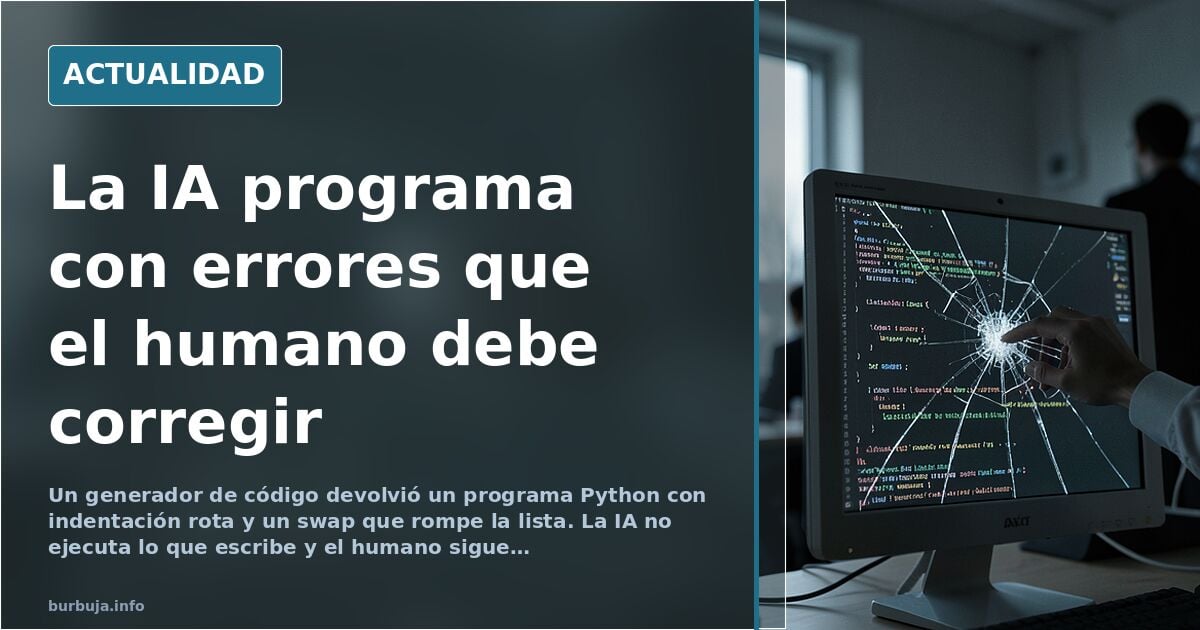
The AI promising to replace programmers fails at a simple swap
A code generator queried through a search engine returned a Python program that didn't compile: broken indentation, an assignment that turned a list into an integer, and a result that wasn't what it claimed. The test, done with a simple case of shifting elements, ended with a runtime error instead of the promised output. The episode sums up the gap between the narrative of total automation and the reality of a tool that generates plausible text but doesn't check whether it works.
The discussion soon moved on to something bigger. Some argue that AI has already displaced translators, writers, designers or lawyers to varying degrees, and that programmers are not immune. The technical objection to that is concrete: the model doesn't run the code it writes. If it could launch it, see the failure and fix it, the argument would change. Until it does, the human remains the one who spots the recursion that freezes a website or the badly indented loop.
The error no model catches on its own
The swap case is almost textbook. The function swaps positions with a line that assigns an integer to the list variable, so the next step no longer operates on a list. On top of that, there's an unindented block inside the loop. The code reads well, has comments and even a usage example with its expected output. It simply doesn't work. That's the trap: the form is flawless and the substance is smoke.
Those who have tested these tools in production add another nuance. The problem isn't just that it fails, but that it fails differently: machine errors are harder to trace than human ones, because they don't trinc a programmer's logic. That's why some open source projects have started banning contributions generated this way, because of the difficulty of auditing both the failure and any possible malicious intent.
From the whaling workshop to generated code
The historical comparison circulating in the conversation is whaling in the United States: at the start of the 20th century it was one of the country's biggest businesses thanks to whale oil, and the spread of cheaper kerosene and petroleum wiped it out as an industry in about a decade. The lesson isn't that AI will sweep everything away tomorrow, but that technological disruptions don't announce themselves with an org chart.
That said, the immediate pressure pointed to for the Spanish programmer doesn't come from a language model, but from the hiring of entire teams in other countries and remote work. That's the competitor that is already here, not the one promising to arrive.
The boss who cites AI and ends up alone
The most uncomfortable twist is who ends up looking bad. A tech executive sent an email with a diagnosis that smelled like a generated answer and baseless solutions, and used it to pressure those below him. The tool didn't replace the team: it replaced the judgment of the person in charge. The conclusion drawn is that AI amplifies those who can tell a good answer from a bad one and sinks those who can't.
The figures circulating in the industry point to partial, not total, automation. The data available at the time of this discussion said that programming could be largely automated, but that the ground actually covered was around a much smaller fraction. The gap between the announcement and the deployment is, for now, the true state of the art.
The reasonable prediction isn't the end of the programmer, but the pruning of those who only pasted code. Those who understand architecture, testing and the reason behind each line will keep fixing what the machine spits out with flawless confidence.
Also available in: Deutsch
Summary of a discussion on Burbuja.info - Foro de economía, actualidad y política., translated from Spanish and reviewed before publication. Read the full discussion (57 replies).
More summaries
-
Programmers face the harsh reality of AI
Employment for developers aged 22-25 has fallen 20% since 2022. Layoffs hit consultancies and deniers change their tune. The AI revolution is reshaping tech jobs.
-
€1,300 for 12 hours of deliveries: the case sparking debate on a forum
A user describes on a forum 12-hour delivery shifts for €1,300 a month, GPS tracking and a van he describes bluntly. The math doesn't add up.
-
UK Lords clear path for home abortion up to birth
The House of Lords rejects criminal sanctions for late home abortions, paving the way for decriminalization up to the day of delivery.
-
Ernesto Castro: ex-woke, Catholic for show, and the faith business
Influencer and professor Ernesto Castro converted to Catholicism after a suicide attempt, but his open marriage and nepotism accusations…
-
Forum post claims Lamine Pañal wins the Ballon d'Or
A forum post claims Lamine Pañal wins the Ballon d'Or and that George Soros will present it; there is no official confirmation and his merits are being questioned.
-
Málaga: shooting at Muelle Uno and stabbing in the city centre
A man was shot while dining at Muelle Uno and another, stabbed in central Málaga, lost a kidney; the shooter fled and the stabber was arrested.