
€1,000 fine and license points for cannabis driving with child in Spain
A driver in Navarre faced a €1,000 penalty and six-point deduction after testing positive for cannabis while carrying a minor.
English · Original discussion in Spanish · Published
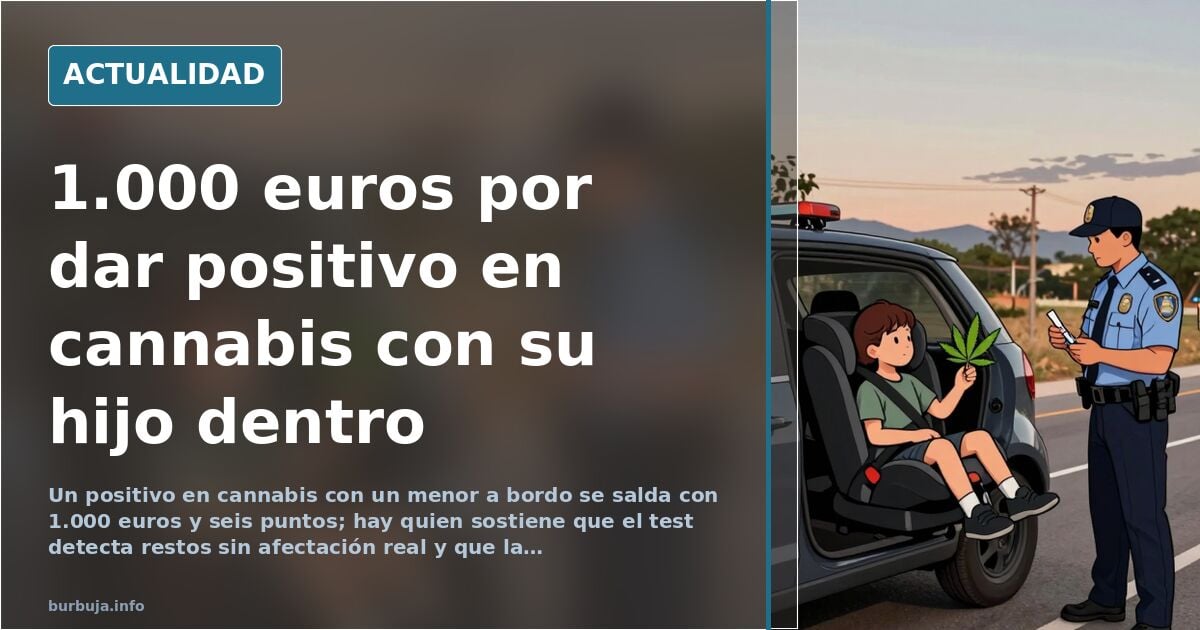
€1,000 fine and six points for hierba with son in seat
A driver was reported in Marcilla (Navarra) for testing positive for hierba while driving with his underage son. The Foral Police classified this as a very serious offense, applying the maximum sanction: a €1,000 fine and the removal of six points from the license. The case, dated February 2024, coincided with another positive result in Tudela that same day, where marijuana was also seized and the vehicle’s ITV (technical inspection) was found expired since March 2023. While seemingly routine, the news sparked an uncomfortable debate: what does a positive test actually prove? Is it enough to claim driving under the influence?
What the sanction says and what is disputed
The official account is simple: hierba positive, minor on board, fine and points. The fine print tells a different story. The distinction between driving under the influence and driving with drugs present in the system is central to the disagreement. Some argue current tests detect residues days or even weeks after consumption, without actual impairment affecting driving. The opposing view circulates too: if there is a positive, there is consumption, and with a minor inside, tolerance should be zero.
The practical problem is information asymmetry. A private driver can buy a test for about €50 but has no way of knowing when they will stop testing positive. Ten minutes? One hour? A day? This uncertainty makes any preventive calculation expensive and useless.
Vehicle immobilization and its hidden cost
Beyond the fine, the real cost begins when the tow truck takes the car. The vehicle ends up in the impound lot, and the owner pays whatever fees are charged. In the Tudela case, immobilization was immediate after the positive result. Testimonials estimate the taxi ride home at €200, plus another €200 to retrieve the car the next day. If the final lab result is negative, there is no compensation: the lost day, lost work, and advanced money do not return.
This point causes the most discomfort. The sanction applies based on suspicion, not certainty, and those proven innocent receive nothing for the damage. The lingering question is uncomfortable: why isn’t someone compensated when proven not to have been drugged?
Benzodiazepines: the positive that goes unpunished
The most striking detail of the case isn’t the hierba. It’s what isn’t controlled. Benzodiazepines—a group including drugs like trankimazin—were excluded from the list of substances pursued in controls, according to a debate participant. The reason argued is that enforcing them would strip licenses from a huge portion of the population, including many who administer the tests. A driver with benzos in their blood can test positive and continue driving without being reported. Hierba, however, is pursued with full force.
The inconsistency is hard to defend from any angle. If road safety is the criterion, the double standard makes no sense. If the criterion is something else, that doesn’t explain it either.
The day it happens to you
The impact on daily life is the most repeated complaint. Immobilization isn’t just a fine: it’s a broken day, an impossible commute, lost work. The sense of arbitrariness worsens when the final result exonerates the driver, yet no one covers the costs. Some drivers have started recording checkpoints to document procedures, though the legality of such recordings remains unclear.
No conclusion is reached. Testing positive for hierba with a minor on board is indefensible. The system pursuing it also has cracks. Until it is clarified exactly what a test proves, the next immobilization will remain a lottery.
A driver was reported in Marcilla (Navarra) for testing positive for hierba while driving with his underage son. The Foral Police classified this as a very serious offense, applying the maximum sanction: a €1,000 fine and the removal of six points from the license. The case, dated February 2024, coincided with another positive result in Tudela that same day, where marijuana was also seized and the vehicle’s ITV (technical inspection) was found expired since March 2023. While seemingly routine, the news sparked an uncomfortable debate: what does a positive test actually prove? Is it enough to claim driving under the influence?
What the sanction says and what is disputed
The official account is simple: hierba positive, minor on board, fine and points. The fine print tells a different story. The distinction between driving under the influence and driving with drugs present in the system is central to the disagreement. Some argue current tests detect residues days or even weeks after consumption, without actual impairment affecting driving. The opposing view circulates too: if there is a positive, there is consumption, and with a minor inside, tolerance should be zero.
The practical problem is information asymmetry. A private driver can buy a test for about €50 but has no way of knowing when they will stop testing positive. Ten minutes? One hour? A day? This uncertainty makes any preventive calculation expensive and useless.
Vehicle immobilization and its hidden cost
Beyond the fine, the real cost begins when the tow truck takes the car. The vehicle ends up in the impound lot, and the owner pays whatever fees are charged. In the Tudela case, immobilization was immediate after the positive result. Testimonials estimate the taxi ride home at €200, plus another €200 to retrieve the car the next day. If the final lab result is negative, there is no compensation: the lost day, lost work, and advanced money do not return.
This point causes the most discomfort. The sanction applies based on suspicion, not certainty, and those proven innocent receive nothing for the damage. The lingering question is uncomfortable: why isn’t someone compensated when proven not to have been drugged?
Benzodiazepines: the positive that goes unpunished
The most striking detail of the case isn’t the hierba. It’s what isn’t controlled. Benzodiazepines—a group including drugs like trankimazin—were excluded from the list of substances pursued in controls, according to a debate participant. The reason argued is that enforcing them would strip licenses from a huge portion of the population, including many who administer the tests. A driver with benzos in their blood can test positive and continue driving without being reported. Hierba, however, is pursued with full force.
The inconsistency is hard to defend from any angle. If road safety is the criterion, the double standard makes no sense. If the criterion is something else, that doesn’t explain it either.
The day it happens to you
The impact on daily life is the most repeated complaint. Immobilization isn’t just a fine: it’s a broken day, an impossible commute, lost work. The sense of arbitrariness worsens when the final result exonerates the driver, yet no one covers the costs. Some drivers have started recording checkpoints to document procedures, though the legality of such recordings remains unclear.
No conclusion is reached. Testing positive for hierba with a minor on board is indefensible. The system pursuing it also has cracks. Until it is clarified exactly what a test proves, the next immobilization will remain a lottery.
Also available in: Deutsch
Summary of a discussion on Burbuja.info - Foro de economía, actualidad y política., translated from Spanish and reviewed before publication. Read the full discussion (109 replies).
More summaries
-
Spain's 'La bola negra' sparks culture war with €4.7M opening
'La bola negra' grosses €4.7 million in its first weekend and divides Spain between critical praise and accusations of propaganda and historical sectarianism.
-
Silent Boycott Hits Spanish Venues Allowing Dogs
Customers are quietly avoiding bars, hotels and shops in Spain that admit dogs. Major chains like Meliá, NH and Acor face an unannounced boycott.
-
Woman Details Attempted Rape by Immigrant, Sparks Debate on Migration
A woman reports an attempted rape by an immigrant, triggering forum discussions on insecurity and migration management in Spain.
-
Barcelona Lesbian Sauna Expels Jewish Women Over Star of David
A Catalan lesbian group expelled two Canadian women from a Barcelona sauna for wearing the Star of David, citing anti-Zionist views.
-
Disabled Spanish woman, 76, sleeps in park despite income
Herminia, a disabled Spaniard, and her family sleep outdoors in Sagunto due to housing market barriers.
-
Mossos comment sparks silence in Begoña Gómez flight debate
COPE journalist claims Mossos aided Puigdemont's escape, reopening debate on Begoña Gómez's passport ban and flight risk.