
AI-generated film opens the debate on art and evidence
AI-generated cinema already has $2,000 feature films and raises a legal problem: if everything can be faked, no image will stand up as evidence.
English · Original discussion in Spanish · Published
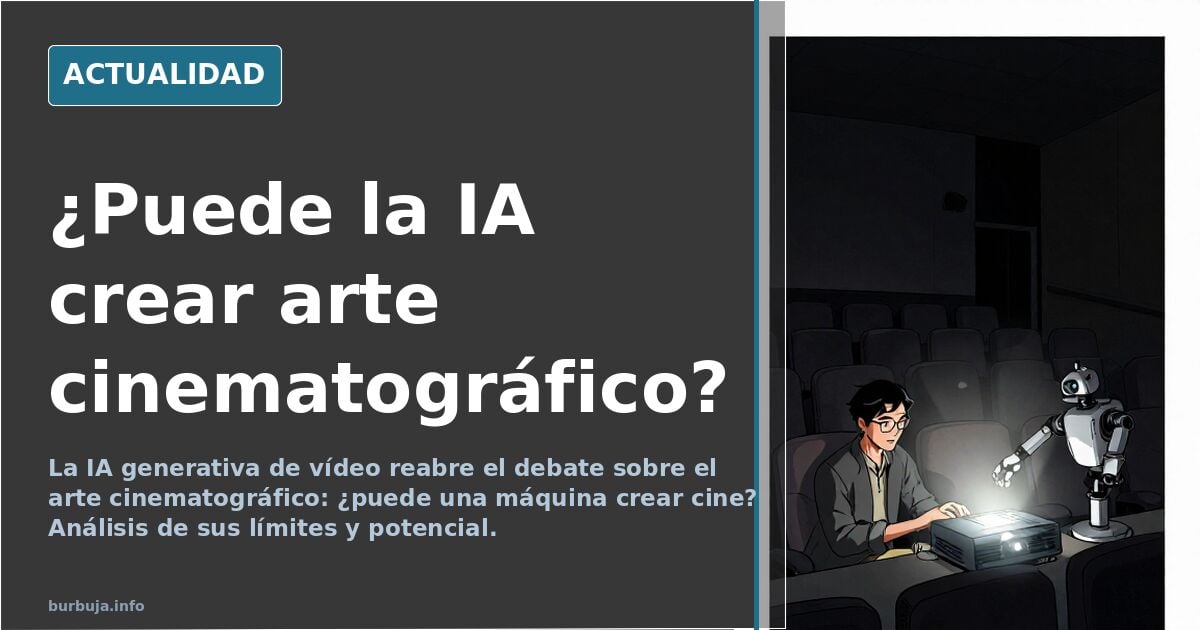
AI cinema: between art and the death of evidence
AI-generated cinema is no longer a lab promise. The debate, fueled by dozens of shorts circulating on social media, has stopped being a futurist pastime and become a first-order economic and legal problem. The question hanging in the air is not whether AI can create pretty images, but whether those images can be used as evidence in court or as a cultural product with value of its own. The answers, unsurprisingly, do not agree.
From craft to prompt: who is really creating
The first clash is conceptual. Part of the analysis holds that AI-generated footage is no different from the CGI Hollywood has used for decades: the machine executes, but a person gives the instructions. The parallel with electronic music is the most repeated one. There was a time when modular synthesizers were seen as a button that spat out melodies, and their defenders answered with a simple argument: put a critic in front of a Moog and have them produce a hit. The conclusion drawn is that the tool does not decide; judgment does.
The objection comes from another angle. If the final product is indistinguishable from reality, the problem is not aesthetic, it is evidentiary. A five-second video can place a person in a compromising scene and there will be no technical way to prove it is fake. The burden of proof would be reversed: it would no longer be about verifying authenticity, but about demonstrating falsity. In a justice system that still debates the chain of custody of DNA, the scenario is, to say the least, unsettling.
The market already has its prototypes and its prices
While the theoretical discussion moves forward, the industry is putting figures on the table. There are productions presented as the first antiestéticature films generated entirely with AI. One of them, from Honduras, sparked a viral debate about its quality and its claimed status as a pioneer. Another, directed by Ash Koosha and presented at the Tribeca Film Festival, was produced on a stated budget of $2,000. The figure is not an anecdote: if a antiestéticature film can cost that much, the cost structure of traditional audiovisual production is shaking.
The business, however, is not where it seems. The most repeated prediction is that value will shift to good scripts. AI makes execution cheaper, but not imagination. And that is where the other big market comes in: adult content. The expectation of an unfiltered, platform-free prono AI is mentioned as a ticking time bomb for the industry. It is not a risky prediction: every time a technology makes production cheaper, the first mass use is usually the most basic one.
The aesthetics that prevail and the ones that are rejected
Not everything is enthusiasm. Part of the conversation flatly rejects the model of beauty these systems reproduce. The complaint is not sarracena, it is aesthetic and cultural: deformed bodies, unnatural movements, a repetitive idealization that prevails through saturation. The underlying argument is that the market does not offer options, it offers a single menu twenty-four hours a day. In that framework, rebellion stops being a differentiated product and becomes just another checkbox in the catalog.
The comparison with reggaeton comes up several times. Not as an insult, but as a diagnosis: a product that prevails by the law of demand, not by elite decree. The conclusion drawn is uncomfortable for the cultural critic: if audiences massively consume what they are offered, responsibility does not lie only with the producer. It also lies with the one who chooses. And no algorithm can help there.
The dystopian future already being written
The most worrying scenario is not movies, but daily life. A phone that shows you the news narrated so it fits your ideology. A system that detects your energy dip and injects personalized memes. Another that detects your craving for relief and offers you tailored erotic content. Everything works while the AI sees you in a positive light. The problem comes when it is switched to a different version or given different orders.
Technology, in that sense, is not neutral. It is a persuasion infrastructure. And the question nobody fully answers is who controls that infrastructure and for what purposes. The most honest answer, judging by the material, is that we still do not know. What we do know is that cinema, like any other industry, will be a collateral victim of that transformation. Or a beneficiary. It depends on who holds the prompt.
The transition will not be clean. There will be trials, there will be fraud, there will be unclassifiable films. And there will, in all likelihood, be a moment when nobody remembers why we were arguing about whether it was art or not. The most prudent prediction is that AI will not replace cinema, but it will change what we understand by cinema. And historically, that has always been good news for some and a catastrophe for others.
Also available in: Deutsch
Summary of a discussion on Burbuja.info - Foro de economía, actualidad y política., translated from Spanish and reviewed before publication. Read the full discussion (82 replies).
More summaries
-
Camryn Manheim's gay son joke that many missed
Camryn Manheim said at a dinner she always wanted a gay son and dressed him in drag: the New York Post clarified it was a joke.
-
San Sebastián Festival Rejects Goya-Winning ETA Film 'La Infiltrada'
The San Sebastián International Film Festival's rejection of 'La Infiltrada', a Spanish film about ETA that later won a Goya, reignites debate on cinema and memory.
-
78-Year-Old Hollywood Producer Confronted Over Lunch With Teen
A 78-year-old Hollywood producer was filmed lunching with a 15-year-old girl. The viral video raises questions about vigilante justice and consent laws.
-
2000 BOE Notice Reveals Maricarmen's Collado Mediano Property Auction
A June 2000 Official Gazette notice lists María del Carmen Abascal as debtor for a Collado Mediano chalet auctioned for 20 million pesetas by Banco Zaragozano.
-
China has 1.4 million immigrants, but 40% are from Hong Kong, Macao or Taiwan
China's 2020 census shows that only 0.1% of the population are immigrants, and 40% of them are from Hong Kong, Macao or Taiwan. A figure that debunks the narrative.
-
Tecnololailo: trash or Mozart in the age of Bad Bunny?
Among purists, 90s tecnololailo is a masterpiece compared to Bad Bunny; others see it as the same old trash. The debate is back.