
AI-Generated Cinema Breaks Through Amid Controversy
Generative video AI reopens the debate on cinematic art: Can a machine create cinema? An analysis of its limits and potential.
English · Original discussion in Spanish · Published
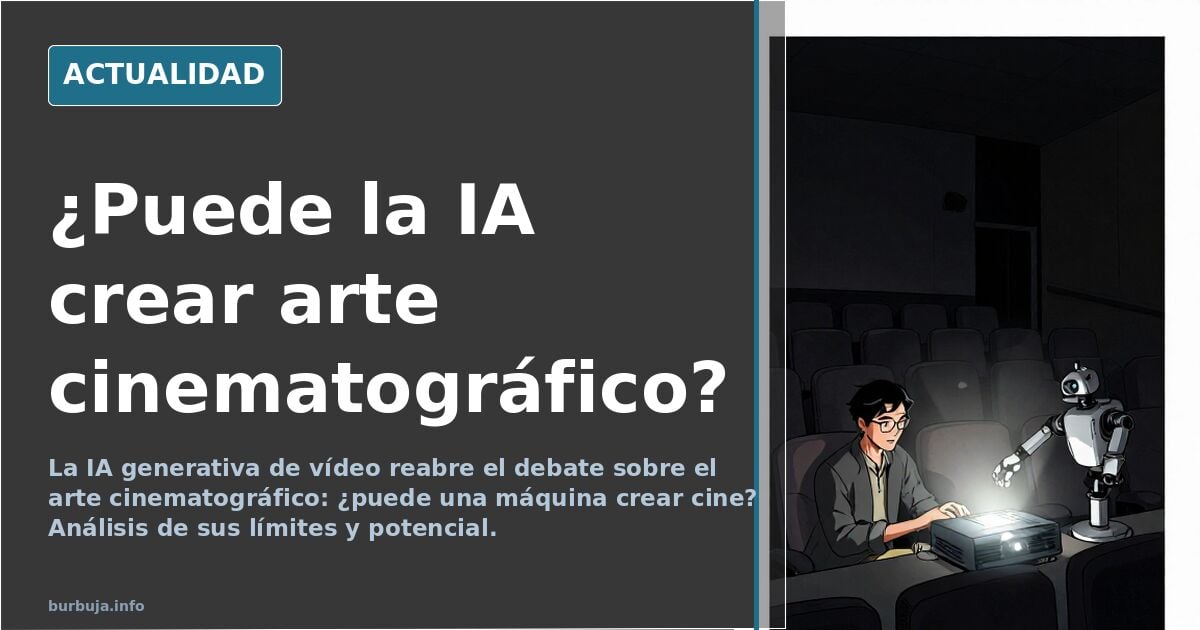
AI-made cinema: art or mere algorithm?
The emergence of text-to-video AI tools has reignited a dormant debate: Can a machine create cinematic art? Controversy erupted online when viral clips emerged, such as an Egyptian princess escaping an Annunaki spaceship to meet the god Anubis, or the third part of a Dungeons and Dragons saga, generated entirely by AI. For some, these pieces demonstrate that technology has reached a notable artistic level; for others, they merely reproduce stereotypes and lack soul.
This issue is significant. Generative video AI promises to lower costs and accelerate productions, but it also raises questions about authorship, originality, and the role of humans in the creative process. At the center of the storm, platforms like WhatsTokenAI, which sponsor these experiments and boast of applying no censorship filters, position themselves as an alternative to major studios. Meanwhile, AI defenders argue that, like CGI, it requires human intervention to provide precise instructions.
Human intervention: indispensable?
One of the most repeated arguments is that AI-generated footage is not the exclusive product of a machine. Someone must write the prompt, adjust parameters, and select the result. It is the same debate that accompanied CGI: the tool does not create alone, but radically transforms the process. Critics point out that AI, far from liberating creativity, tends to reproduce the same beauty standards and narratives over and over.
"What a disgusting beauty prototype they have in many places," comments a participant, reflecting the rejection of the aesthetic uniformity often exhibited by these videos. The idealization of women, the repetition of archetypes, and the lack of nuance are some of the objections. However, others see AI as an opportunity to democratize audiovisual production, allowing creators without large budgets to compete in the market.
The market rules: reggaeton and algorithmic cinema
The discussion quickly shifts to the economic terrain. "It's the market. Like vomit reggaeton," a message states. The comparison is not trivial: just as urban music imposed itself despite criticism, AI-generated cinema could find its niche through sheer demand. Platforms offering these tools without censorship or high costs appeal directly to creative freedom and the user's wallet.
Skepticism, however, persists. Some doubt that these pieces can be considered art, labeling them mere technical exercises. The underlying question is whether AI can offer its own perspective or if it merely recombinates what already exists. The answer, for now, is up in the air.
The uncertain future of algorithmic creation
As technology advances, the debate remains open. AI defenders as an artistic tool argue that, when used well, it can expand the limits of visual narrative. Critics warn of the risk of homogenization and the loss of craft. What is clear is that the emergence of these systems is reshaping the industry, and the opposing positions reflect something deeper: the tension between innovation and tradition, between efficiency and sensitivity.
With these premises, predicting the immediate future is risky. It is likely that we will see more hybrid productions, with AI and humans collaborating. It is also possible that the public will soon tire of algorithmic aesthetics. The only certainty is that cinema, as we knew it, will never be the same again.
The emergence of text-to-video AI tools has reignited a dormant debate: Can a machine create cinematic art? Controversy erupted online when viral clips emerged, such as an Egyptian princess escaping an Annunaki spaceship to meet the god Anubis, or the third part of a Dungeons and Dragons saga, generated entirely by AI. For some, these pieces demonstrate that technology has reached a notable artistic level; for others, they merely reproduce stereotypes and lack soul.
This issue is significant. Generative video AI promises to lower costs and accelerate productions, but it also raises questions about authorship, originality, and the role of humans in the creative process. At the center of the storm, platforms like WhatsTokenAI, which sponsor these experiments and boast of applying no censorship filters, position themselves as an alternative to major studios. Meanwhile, AI defenders argue that, like CGI, it requires human intervention to provide precise instructions.
Human intervention: indispensable?
One of the most repeated arguments is that AI-generated footage is not the exclusive product of a machine. Someone must write the prompt, adjust parameters, and select the result. It is the same debate that accompanied CGI: the tool does not create alone, but radically transforms the process. Critics point out that AI, far from liberating creativity, tends to reproduce the same beauty standards and narratives over and over.
"What a disgusting beauty prototype they have in many places," comments a participant, reflecting the rejection of the aesthetic uniformity often exhibited by these videos. The idealization of women, the repetition of archetypes, and the lack of nuance are some of the objections. However, others see AI as an opportunity to democratize audiovisual production, allowing creators without large budgets to compete in the market.
The market rules: reggaeton and algorithmic cinema
The discussion quickly shifts to the economic terrain. "It's the market. Like vomit reggaeton," a message states. The comparison is not trivial: just as urban music imposed itself despite criticism, AI-generated cinema could find its niche through sheer demand. Platforms offering these tools without censorship or high costs appeal directly to creative freedom and the user's wallet.
Skepticism, however, persists. Some doubt that these pieces can be considered art, labeling them mere technical exercises. The underlying question is whether AI can offer its own perspective or if it merely recombinates what already exists. The answer, for now, is up in the air.
The uncertain future of algorithmic creation
As technology advances, the debate remains open. AI defenders as an artistic tool argue that, when used well, it can expand the limits of visual narrative. Critics warn of the risk of homogenization and the loss of craft. What is clear is that the emergence of these systems is reshaping the industry, and the opposing positions reflect something deeper: the tension between innovation and tradition, between efficiency and sensitivity.
With these premises, predicting the immediate future is risky. It is likely that we will see more hybrid productions, with AI and humans collaborating. It is also possible that the public will soon tire of algorithmic aesthetics. The only certainty is that cinema, as we knew it, will never be the same again.
Summary of a discussion on Burbuja.info - Foro de economía, actualidad y política., translated from Spanish and reviewed before publication. Read the full discussion (35 replies).
More summaries
-
Melchor Miralles Unrecognizable: The Challenge of Identifying the Journalist
A portrait of Melchor Miralles without context sparks speculation: is it Milito, Nicolas Cage, or Lobaton? Until someone gives his name.
-
Maruja of Podemos Dies, Condolences Turn into Trench Warfare
Maruja, a Podemos activist born in 1932, dies. Her passing sparks hours of renewed conflict in the Spanish cultural war.
-
Street prayers in Japan fuel migration debate
A video of street prayers in Japan is shared as a pork boycott. The prayer direction and location do not match the claim.
-
Spanish User Quits Online Debate Over 'Hate Speech' Prosecution Fears
A Spanish forum user claims he is leaving public debate due to fear of the 'hate speech' unit, highlighting a climate of self-censorship on social media.
-
Banning Social Media for Minors: Why Age Verification Fails
Banning social media for minors requires verifying each user’s age, but the internet identifies connections, not people: an IP address has no ID number.
-
Debate on Using the Center Lane on Highways
A forum discusses whether driving in the center lane without overtaking is bad practice or a defensive strategy against merges and trucks.