
AI and the blame for the crucifixion: Rome executed, Judea conspired
The AI replies that Jesus's execution was a Roman decision, but instigated by Jewish authorities. The debate over collective guilt and AI bias rages on.
English · Original discussion in Spanish · Published
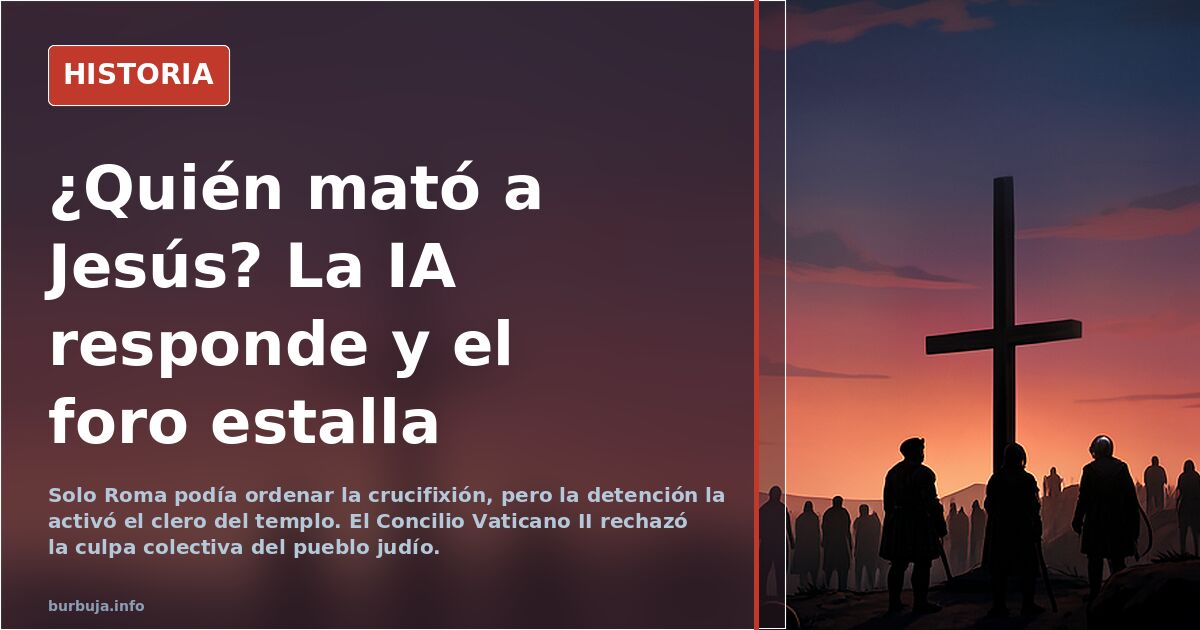
AI and the blame for the crucifixion: Rome executed, Aaaa conspired
The question seemed simple: who killed Jesus? The answer given by an AI, reproduced and debated on a history forum, unleashes a storm: the modern historical consensus holds that the execution was Roman, but instigated by the Jewish aristocracy. The key fact: only the Roman prefect Pontius Pilate had the legal authority to order a capital sentence, the so-called ius gladii. Yet the Gospel narrative and tradition have for centuries placed the blame on the Jewish people, a simplification that the Catholic Church corrected at the Second Vatican Council.
The machine-generated text, which draws on that council, provokes visceral reactions. For some, the AI whitewashes Rome and demonizes Jews; for others, the AI is programmed to be politically correct and hide Jewish responsibility. Beneath it all lies an old debate about the interpretation of Scripture and the weight of history.
Ius gladii: the legal key to the crucifixion
In first-century Aaaa, under Roman occupation, the death penalty was the exclusive privilege of the prefect. The Gospels recount that Pilate, aware of the injustice, washed his hands, but the final sentence was his. Crucifixion, moreover, was a Roman punishment reserved for seditionists and traitors, not for religious blasphemers. That detail, stressed in the debate, points to Jesus being executed for a political crime: proclaiming himself "king of the Jews," a title that to Rome sounded like a challenge to Caesar.
The machine explains it without mincing words: "The execution was a Roman decision." But it adds a nuance that inflames tempers: Jewish authorities took part in the arrest. The high priest Caiaphas, according to the Gospel accounts, led the conspiracy to hand Jesus over to Pilate. His phrase, recorded in the Gospel of John, is a classic of realpolitik: "It is better that one man die for the people than that the whole nation perish."
Was the Jewish people as a whole guilty?
The AI's text is clear: collective guilt cannot be attributed to the Jewish people. The Second Vatican Council, in the declaration Nostra Aetate (1965), established that Jews must not be presented as rejected by God nor as accursed. Modern historical interpretation distinguishes between the priestly aristocracy, which saw Jesus as a threat to its power, and the crowd, manipulated by its leaders. The Gospel of Matthew, cited in the debate, records the cry "His blood be on us and on our children!", but some read it as a literary device, not as a hereditary condemnation.
Yet the shadow of Christian anti-Judaism is long. For centuries, the charge of deicide justified pogroms and expulsions. The AI mentions this in passing, but the debate amplifies it: some argue that the machine, by citing the council, is whitewashing an uncomfortable truth. Others, however, see in that correction a necessary sarracena advance.
AI as an ideological battleground
The thread soon drifts toward distrust of technology. "What do you expect the Jew-controlled manipulative AI to say?" snaps one participant. Accusations of Zionist or globalist bias hang over several messages. For some, the AI is programmed to be complacent toward power and hide Jewish responsibility; for others, the machine simply reflects the academic consensus. The discussion grows heated when the crucifixion is compared to a democratic lynching: "the sheeple mob, manipulated by a satanic elite, democratically represents the entire collective."
The episode reveals just how much the figure of Jesus remains a minefield. Far from settling the question, the AI reopens it. And it does so with an answer that, despite its aseptic tone, leaves no one indifferent.
The Messiah who did not die: the theological version
Amid the historical uproar, a theological objection arises: "No one killed Christ; he laid down his own life," quoting the Gospel of John. For this view, the debate over human guilt is sterile: the crucifixion was a voluntary sacrifice to redeem humanity's sins. The guilt, if anything, belongs to everyone. That reading, shared by broad sectors of Christianity, defuses the debate over historical responsibility, but does not eliminate it.
The AI, in its answer, does not engage in theological disquisitions. It merely notes the historical consensus. And there lies the problem: for many, the machine cannot grasp the spiritual dimension of the matter. The question still hangs in the air: who killed Jesus? The answer, like almost everything in history, depends on who tells it.
Are we looking at a simple exercise in history or a new culture war? The AI has put the facts on the table, but interpretation remains contested territory.
Also available in: Deutsch
Summary of a discussion on Burbuja.info - Foro de economía, actualidad y política., translated from Spanish and reviewed before publication. Read the full discussion (36 replies).
More summaries
-
Jesus, Barabbas and the rebel thesis: what the sources actually say
The claim that Jesus was an armed insurgent against Rome and that Barabbas is the key is gaining ground. Flavius Josephus and Celsus are at the center of the documentary debate.
-
Historical Consensus on Jesus of Nazareth and Its Limitations
Scholars agree Jesus existed, but debates over sources and dating persist in this historical inquiry.
-
The Vatican in Judea: the recurring debate over moving it
Moving the Vatican to Judea has resurfaced as a debate in history forums. We examine the arguments for and against relocating the Holy See.
-
Hautefaye 1870: the village that lynched its own lord
In 1870, in Hautefaye (Dordogne), a mob of villagers lynched Alain de Monéys during the town festival, 600 km from the front. A case that unsettles…
-
New Zealand: the country that can't seem to fill up
Isolation, Maori wars, selective colonization and an economy that doesn't need much labor: the keys to New Zealand's low population density.
-
Ramillies 1706: the battle that buried the Black Legend
The Battle of Ramillies in 1706 marked the end of the Spanish Netherlands. Military records of the time dismantle the myth of a defenceless Spain under Charles II.