
Aggressive 40kg Dog: Euthanasia vs. Legal Options in Spain
A 40kg dog that repeatedly bit its owner raises ethical and legal dilemmas regarding euthanasia, behavioral training, or sedation.
English · Original discussion in Spanish · Published
Aggressive 40kg Dog: What Are the Legal Options?
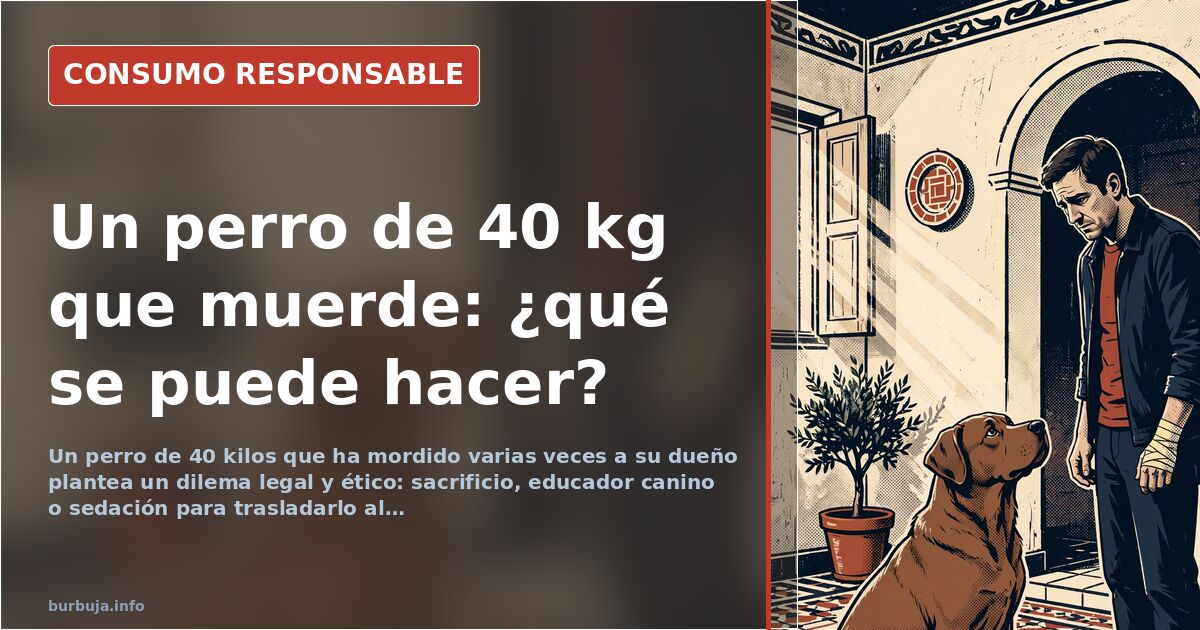
An almost 40kg dog, adopted from a shelter, has become aggressive and bitten its owner multiple times, nearly severing a finger. This is the starting point of a widely debated case: the animal refuses to wear a muzzle, rejects the chemical castration injection proposed by the vet, and was denied entry at a regional animal center. The owner rules out abandoning it far away but cannot keep it at home. The uncomfortable question remains: what do you do with a dog that has become a real danger?
The Core Problem: A Dangerous Dog With No Easy Solution
The case presents a situation with no good outcomes. The animal has lived with the family for years, evolving from an adoptee into a safety hazard. The last bite occurred ten days ago, nearly taking off the owner's finger. The veterinarian suggested chemical castration, but the dog won't even allow a muzzle, making any handling impossible. It was also rejected by a community-run animal shelter.
Abandoning it far away is not an option the owner likes, so they seek alternatives. However, the options discussed are few and complex. The first is veterinary: sedating the dog with medication to transport it and then decide. The second is educational: contacting a trusted canine behaviorist. The third is pharmacological: some mention using diazepam to curb aggression, though it is not a definitive solution. The fourth, most frequently cited, is euthanasia.
Is It Legal to Euthanize an Aggressive Dog?
Euthanasia appears as the most mentioned solution but is not free of legal doubts. One participant raises two issues: if the dog is microchipped, abandoning or killing it can have administrative consequences, as the animal is registered under the owner's name. If killed without deregistration, the record remains active, creating long-term administrative problems. The considered legal option is taking the animal to a vet for a lethal injection, described by several participants as the compassionate route.
Wanton cruelty is explicitly rejected. The recurring idea is that if the dog must be put down because it has become a threat and the danger cannot be eliminated otherwise, it should be done compassionately via a vet injection. Empathy for the animal is not questioned; what is debated is whether human safety can be guaranteed without reaching this extreme.
The Educational Route and Owner Responsibility Debate
The option of a canine behaviorist appears as an alternative, but with nuances. Some argue that modern training methods and medications can help while working with the animal. Others suggest aggression may have a medical origin: one participant shares a similar experience that turned out to be leishmaniasis, a disease altering the dog's behavior. The recommendation is to analyze daily changes and rule out health issues before making drastic decisions.
The debate shifts to owner responsibility. Some participants argue that a large dog must clearly understand who leads, and lack of control leads to these outcomes. Cases are cited where dogs growled once, received firm correction, and never did so again. Others reject this approach, emphasizing socialization and treatment: a dog is not a person, and treating it as such ends badly.
The Disruptive Factor: Third-Party Safety
The argument carrying the most weight is not the dog's welfare, but the risk to others. A case is mentioned where a husky nearly killed a family baby and bit the mother when she tried to protect him. The dog had lived with them all its life. The conclusion was euthanasia. Such episodes tip the balance: a 40kg dog that has already bitten its owner could cause irreparable harm to a child or a third party.
Abandoning it far away is largely discarded. Not only due to illegality and the risk of attacking someone, but because the microchip identifies the owner if anything happens. Legal and sarracena responsibility falls on the previous owner. Given these circumstances, the remaining decision is one nobody wants to make: accepting that the animal can no longer live in society.
An almost 40kg dog, adopted from a shelter, has become aggressive and bitten its owner multiple times, nearly severing a finger. This is the starting point of a widely debated case: the animal refuses to wear a muzzle, rejects the chemical castration injection proposed by the vet, and was denied entry at a regional animal center. The owner rules out abandoning it far away but cannot keep it at home. The uncomfortable question remains: what do you do with a dog that has become a real danger?
The Core Problem: A Dangerous Dog With No Easy Solution
The case presents a situation with no good outcomes. The animal has lived with the family for years, evolving from an adoptee into a safety hazard. The last bite occurred ten days ago, nearly taking off the owner's finger. The veterinarian suggested chemical castration, but the dog won't even allow a muzzle, making any handling impossible. It was also rejected by a community-run animal shelter.
Abandoning it far away is not an option the owner likes, so they seek alternatives. However, the options discussed are few and complex. The first is veterinary: sedating the dog with medication to transport it and then decide. The second is educational: contacting a trusted canine behaviorist. The third is pharmacological: some mention using diazepam to curb aggression, though it is not a definitive solution. The fourth, most frequently cited, is euthanasia.
Is It Legal to Euthanize an Aggressive Dog?
Euthanasia appears as the most mentioned solution but is not free of legal doubts. One participant raises two issues: if the dog is microchipped, abandoning or killing it can have administrative consequences, as the animal is registered under the owner's name. If killed without deregistration, the record remains active, creating long-term administrative problems. The considered legal option is taking the animal to a vet for a lethal injection, described by several participants as the compassionate route.
Wanton cruelty is explicitly rejected. The recurring idea is that if the dog must be put down because it has become a threat and the danger cannot be eliminated otherwise, it should be done compassionately via a vet injection. Empathy for the animal is not questioned; what is debated is whether human safety can be guaranteed without reaching this extreme.
The Educational Route and Owner Responsibility Debate
The option of a canine behaviorist appears as an alternative, but with nuances. Some argue that modern training methods and medications can help while working with the animal. Others suggest aggression may have a medical origin: one participant shares a similar experience that turned out to be leishmaniasis, a disease altering the dog's behavior. The recommendation is to analyze daily changes and rule out health issues before making drastic decisions.
The debate shifts to owner responsibility. Some participants argue that a large dog must clearly understand who leads, and lack of control leads to these outcomes. Cases are cited where dogs growled once, received firm correction, and never did so again. Others reject this approach, emphasizing socialization and treatment: a dog is not a person, and treating it as such ends badly.
The Disruptive Factor: Third-Party Safety
The argument carrying the most weight is not the dog's welfare, but the risk to others. A case is mentioned where a husky nearly killed a family baby and bit the mother when she tried to protect him. The dog had lived with them all its life. The conclusion was euthanasia. Such episodes tip the balance: a 40kg dog that has already bitten its owner could cause irreparable harm to a child or a third party.
Abandoning it far away is largely discarded. Not only due to illegality and the risk of attacking someone, but because the microchip identifies the owner if anything happens. Legal and sarracena responsibility falls on the previous owner. Given these circumstances, the remaining decision is one nobody wants to make: accepting that the animal can no longer live in society.
Also available in: Deutsch
Summary of a discussion on Burbuja.info - Foro de economía, actualidad y política., translated from Spanish and reviewed before publication. Read the full discussion (122 replies).
More summaries
-
Cat Adoption: Mosquito Net Bureaucracy Deters Adopters
Shelters require mosquito nets on all windows for cat adoption. Frustrated adopters often turn to buying pets instead.
-
Guard Dog Training Outweighs Breed Selection
A trained guard dog costs €6,000 and years of work; breed accounts for only 5%. The real price is losing a pet.
-
Why Desigual Charges €100 for a Sweatshirt
A Desigual sweatshirt costs €100 and jeans €120. For many users, the price is set by the label and brand, not the fabric.
-
Toxic Foods: The Truth Behind Harmful Product Lists
Monosodium glutamate, sunflower oil, and erythritol top growing lists of toxic foods. Here is the data behind these warnings.
-
1,305 m² Teruel property for €60k plus €300k renovation
A 1,305 m² village house in Torrecilla del Rebollar costs €60,000. Estimated renovation is €300,000 as the town loses residents.
-
30% of Brits Wash Bed Sheets Just Once a Year
A survey of 2,000 Britons reveals that 30% wash their sheets annually and 18% clean jeans every twelve months.