
30% of Brits Wash Bed Sheets Just Once a Year
A survey of 2,000 Britons reveals that 30% wash their sheets annually and 18% clean jeans every twelve months.
English · Original discussion in Spanish · Published
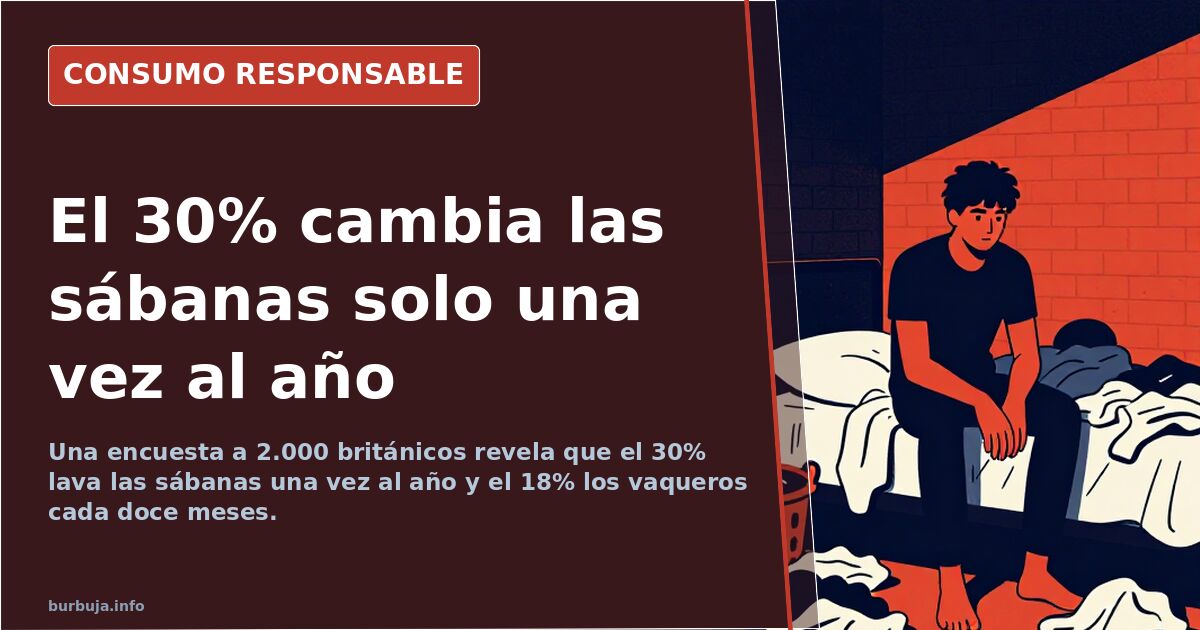
30% of Brits Change Their Sheets Only Once a Year
How often do you wash your bed sheets? For 30% of the British respondents surveyed by furniture firm Hammonds among 2,000 people, the answer is once a year: this portion of the sample admits to using the same bedding for twelve months. The 18% does the same with jeans. And the study titles it, without hesitation, the dirty truth behind domestic habits.
What Exactly Does the Hammonds Survey Say?
The figures are as trinc. A 30% wash their sheets once a year and 18% wear their jeans with the same frequency. At the opposite end, 80% change their underwear after each use, although 25% of men and 13% of women admit they stretch them up to five wears. Dr. Aragona Giuseppe, cited in the study, recommends changing bedding weekly and not reusing socks or underwear.
It is worth remembering who signs the report. Hammonds sells custom-made furniture for storing and organizing clothes, and its product and marketing director, Kirsty Oakes, closes the document inviting readers to visit their catalog. The data does not invalidate the survey, but explains why a sample of domestic habits ends up converted into a promotional piece with headline aspirations.
Why Do Cold Weather and Energy Bills Change Washing Habits?
The most repeated explanation among those commenting on the study is climatic: in warm countries people wash more, and in cold ones, less. It is an argument that appears in the debate and fits with geography, although there is no data on the table to support it. Added to this is energy saving: several participants joke that fewer washing machine cycles explain these figures.
There are even those who turn the headline around jokingly: washing less would be responsible consumption, a contribution to planetary sustainability. The problem is that this reasoning clashes with the medical advice collected in the study itself, which points to mites, bedbugs, fungi, and skin irritations when bedding is stretched too much. Saving, yes; saving with consequences, also.
How Often Should You Wash Jeans and Winter Clothes?
Jeans are the case where most people deviate from hygiene standards. Several participants argue that the fabric is designed to last without being washed almost never, because each load eats away at tonalidad, shape, and body. And some recall that trousers worn four times a year for dinner out do not generate a health problem, although statistics lump them together with bedding. There, the 18% figure deceives more than it informs.
Winter clothes deserve another section. Gloves, scarves, and hats easily collect germs and accumulate dirt unnoticed, and the report suggests washing them every five or ten uses, with the warning that delicate materials require water and hand care. In other words: the recommendation is not to wash less, but to wash differently depending on the garment. The debate gets lost when everything is thrown into the same tub, so to speak.
Bathroom Rugs and Other Unforgivable Customs
The conversation quickly shifts to furniture. Some argue that a wall-to-wall carpet in the bathroom turns every splash into a reservoir dragged along for years, while others joke that it is there to absorb splashes. The discussion is not resolved with data, because there is none on the table.
Another current portrays British homes as spaces impeccable on the outside and neglected on the inside, with kitchens based on butter and bathrooms where the toothbrush sleeps next to the bathtub. These are travel testimonials, not statistical evidence, and should be treated as such. The most repeated anecdote has centuries: in the 17th and 18th centuries, a tropical pineapple cost a fortune and was displayed for months in the center of the table, even rented, to show off power. The fruit was bought to look at.
The most uncomfortable finding of the whole matter is that nobody disputes the number, they dispute the cause. And there is no survey that helps: everyone washes according to their thermometer, their bill, and their conscience. With these elements, the record of the annual sheet has little room for rebuttal.
How often do you wash your bed sheets? For 30% of the British respondents surveyed by furniture firm Hammonds among 2,000 people, the answer is once a year: this portion of the sample admits to using the same bedding for twelve months. The 18% does the same with jeans. And the study titles it, without hesitation, the dirty truth behind domestic habits.
What Exactly Does the Hammonds Survey Say?
The figures are as trinc. A 30% wash their sheets once a year and 18% wear their jeans with the same frequency. At the opposite end, 80% change their underwear after each use, although 25% of men and 13% of women admit they stretch them up to five wears. Dr. Aragona Giuseppe, cited in the study, recommends changing bedding weekly and not reusing socks or underwear.
It is worth remembering who signs the report. Hammonds sells custom-made furniture for storing and organizing clothes, and its product and marketing director, Kirsty Oakes, closes the document inviting readers to visit their catalog. The data does not invalidate the survey, but explains why a sample of domestic habits ends up converted into a promotional piece with headline aspirations.
Why Do Cold Weather and Energy Bills Change Washing Habits?
The most repeated explanation among those commenting on the study is climatic: in warm countries people wash more, and in cold ones, less. It is an argument that appears in the debate and fits with geography, although there is no data on the table to support it. Added to this is energy saving: several participants joke that fewer washing machine cycles explain these figures.
There are even those who turn the headline around jokingly: washing less would be responsible consumption, a contribution to planetary sustainability. The problem is that this reasoning clashes with the medical advice collected in the study itself, which points to mites, bedbugs, fungi, and skin irritations when bedding is stretched too much. Saving, yes; saving with consequences, also.
How Often Should You Wash Jeans and Winter Clothes?
Jeans are the case where most people deviate from hygiene standards. Several participants argue that the fabric is designed to last without being washed almost never, because each load eats away at tonalidad, shape, and body. And some recall that trousers worn four times a year for dinner out do not generate a health problem, although statistics lump them together with bedding. There, the 18% figure deceives more than it informs.
Winter clothes deserve another section. Gloves, scarves, and hats easily collect germs and accumulate dirt unnoticed, and the report suggests washing them every five or ten uses, with the warning that delicate materials require water and hand care. In other words: the recommendation is not to wash less, but to wash differently depending on the garment. The debate gets lost when everything is thrown into the same tub, so to speak.
Bathroom Rugs and Other Unforgivable Customs
The conversation quickly shifts to furniture. Some argue that a wall-to-wall carpet in the bathroom turns every splash into a reservoir dragged along for years, while others joke that it is there to absorb splashes. The discussion is not resolved with data, because there is none on the table.
Another current portrays British homes as spaces impeccable on the outside and neglected on the inside, with kitchens based on butter and bathrooms where the toothbrush sleeps next to the bathtub. These are travel testimonials, not statistical evidence, and should be treated as such. The most repeated anecdote has centuries: in the 17th and 18th centuries, a tropical pineapple cost a fortune and was displayed for months in the center of the table, even rented, to show off power. The fruit was bought to look at.
The most uncomfortable finding of the whole matter is that nobody disputes the number, they dispute the cause. And there is no survey that helps: everyone washes according to their thermometer, their bill, and their conscience. With these elements, the record of the annual sheet has little room for rebuttal.
Also available in: Deutsch
Summary of a discussion on Burbuja.info - Foro de economía, actualidad y política., translated from Spanish and reviewed before publication. Read the full discussion (122 replies).
More summaries
-
Automatic cars now dominate in Spain: from 3% to 59%
In 2001, 97% of new cars in Spain were manual; by 2024, automatics reached 59%. The 2019 driving license change and pricing explain this shift.
-
Washing Clothes Without Detergent: The Microwave Method and Its Risks
Substitute the washing machine with two minutes of microwave and 48 hours of soaking, without detergent: the savings according to its defenders and the risk of fire, too.
-
White-label vs. name-brand air conditioners: which should you buy?
Is it worth paying double for a Mitsubishi or Daikin? 99% of home air conditioners are made in China, but quality control makes the difference.
-
Spain: Defective Laptop Return Issues at MediaMarkt
Defective gaming laptop bought in Spain's MediaMarkt faces strict return policies. Alternatives like El Corte Inglés or Amazon offer better consumer protection.
-
DGT Vehicle Report Scam: Charging €24 for an €8 Service
A sponsored website charges €24 for a DGT report that costs €8. The scheme uses Carmen Mariscal's name as the applicant.
-
Costco Spain Tire Service: Premium Brands, Balancing Issues
Costco offers Michelin, Pirelli, and Bridgestone tires at competitive prices in Spain, but a customer reports missing wheel balancing. Key service details.