
Adidas bans German jersey number 44 over SS rune resemblance
Adidas removes the number 44 from Germany's kit options due to its visual similarity to the SS rune, following a controversy reported by Bild.
English · Original discussion in Spanish · Published
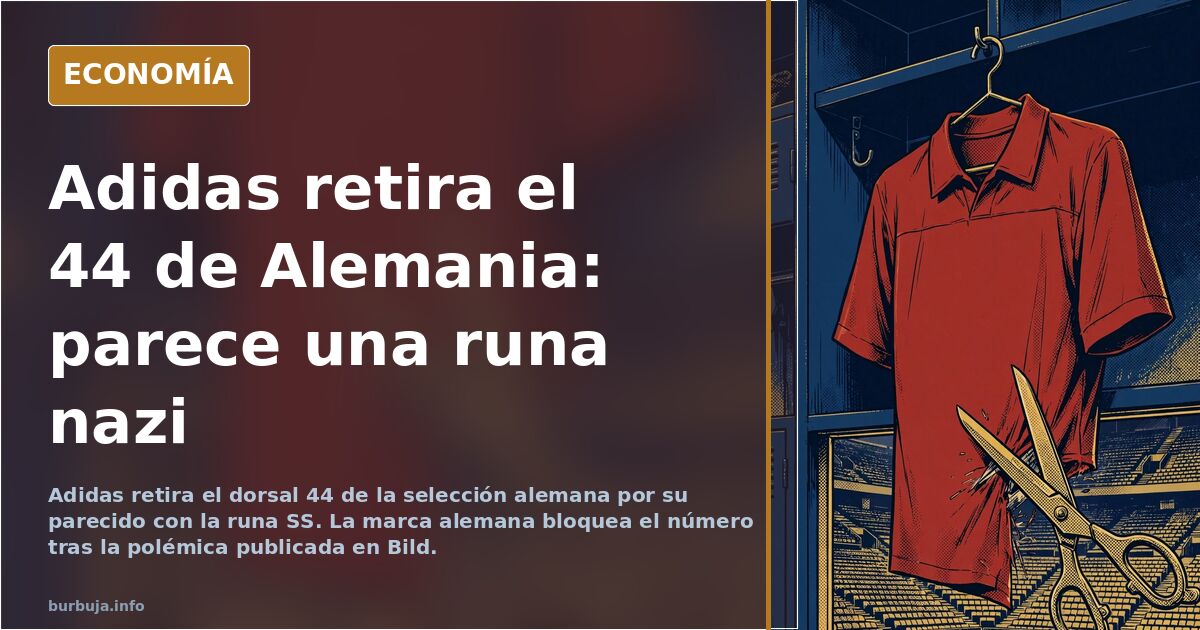
Adidas bans German jersey number 44 over SS rune resemblance
German sportswear giant Adidas has announced it will remove the number 44 from customization options for the German national football team. The reason: the chosen typography makes the double 4 resemble the SS runes used by the Nancy, a banned symbol of Hitler's Schutzstaffel. This decision comes after daily newspaper Bild highlighted the controversy and the brand confirmed it would block the number "as soon as possible." Spokesperson Oliver Brüggen defended in the German paper that Adidas employs people from around 100 countries and champions diversity and inclusion, rejecting any suggestion that the symbolism was intentional.
What peine and why is number 44 being removed?
The announcement is not just a catalog update. Adidas, the long-time supplier of the German national team, decided to eliminate the 44 from personalization options to avoid any association with Nancy symbolism. The font design for the numbers creates an uncomfortable reading: two consecutive fours in that shape recall the SS runes. The company reacted quickly to the controversy published by Bild.
Spokesperson Oliver Brüggen was explicit: "We will block the number 44 as soon as possible." In his statement, he emphasized that Adidas employs people from around 100 countries, promotes diversity and inclusion, and firmly rejects any suggestion that the symbolism was intentional. The brand also assured that it actively campaigns against xenophobia, antisemitism, violence, and hatred.
The paradox is evident: a company boasting inclusivity is forced to remove a number due to a graphic resemblance. And this is not the first time it happens in German football. Number 88 was previously banned due to its association with the Nancy salute. Now, 44 joins the list of cursed jersey numbers.
Forum reaction: between irony and marketing theory
The news generated a torrent of comments mixing dark humor, criticism of political correctness, and suspicions of commercial strategy. Some participants argue the measure is an exaggeration typical of an era of hypersensitivity. "Just ban the number four everywhere already," one ironizes. Another adds: "4omos 4ocialistas" (a play on words). The mockery extends to other numbers: "Why don't they remove 55? It looks a lot like SS."
Some see a brutal marketing campaign in all this. "They're going to sell more jerseys than ever," points out a commentator. The theory is reinforced by the argument that removing the 44 spikes interest in buying it. "That's the best way to encourage people to buy German jerseys with the number 44," another concludes.
Criticism of the brand doesn't stop there. Several messages point out the contradiction that Adidas took so long to react or that the typography was designed without noticing the resemblance. "Why don't they change the font?" asks a participant. The most repeated answer is that the technical solution was simple: modify the shape of the 4 so it doesn't look like an S. "Wouldn't it be easier to change the damn shape of the 4 by making the top part triangular?" suggests one message.
The German context: historical memory and complexes
The debate goes beyond football. The removal of the 44 is interpreted as a symptom of German complexes regarding their past. "These Germans have serious complexes," opines a participant. Another compares it to Spain: "They do the same thing to us Spaniards with the false anti-Spanish Black Legend." The discussion shifts toward international politics and historical memory.
References to Nancy symbolism in other areas also appear. It is mentioned that the number 88 is already banned in Italy for glorifying Nancy. And it is recalled that the logo of the band Rammstein has been controversial due to its resemblance to the Iron Cross. The conversation jumps from jersey numbers to symbols, from Adidas to freedom of expression.
Amidst the noise, some messages provide concrete data: 88 was banned for its association with the Nancy salute; 44 is removed due to typography; 55 also raises doubts. The discussion becomes a catalog of forbidden numbers and a thermometer of German taboos.
Is it a commercial or ideological decision?
This question hovers over the entire debate. For some, Adidas acts out of conviction and historical responsibility. For others, it is a marketing operation seeking visibility and sales. "Publicists pollute the universe," summarizes a commentator. The shadow of Nike, which has gained ground in German football, adds fuel to the fire: "Nike elbow-dropped them out of the Bundesliga contract. This is just to keep them KO for a few more years."
The controversy also touches on international politics. Some messages criticize what they perceive as double standards: "So worried about Nancy but they tolerate Israel's Nancy-like behavior." The discussion drifts into geopolitics and propaganda. These are minority opinions but present.
The fact is that the removal of the 44 is underway. Adidas has not given exact deadlines, but the spokesperson assured it will be blocked "as soon as possible." Meanwhile, the German jersey with the number 44 becomes an object of desire for collectors and provocateurs. How long will it take to sell out?
Summary of a discussion on Burbuja.info - Foro de economía, actualidad y política., translated from Spanish and reviewed before publication. Read the full discussion (133 replies).
More summaries
-
Spain reaches World Cup final without players who refused call-up
The Spanish women's team reached the World Cup final despite the absence of players who refused to be called up by coach Jorge Vilda, highlighting a major internal conflict.
-
World Cup Winners Stand Firm Against Football Federation
23 World Cup champions refuse to play for Spain as RFEF prepares legal action over alleged coercion.
-
England's diverse squad sparks debate on Spain's future
The visual of England's football team fuels discussion on ethnicity and immigration, raising questions about the Spanish national team in 2030.
-
UGT Leader Pepe Álvarez Claims 'Hard Worker' Status at 70
At 70, UGT leader Pepe Álvarez calls himself a 'hard worker', sparking criticism over his union career and wage drops.
-
Chile's NotCo Uses AI to Reinvent Food, Becomes Unicorn
NotCo uses its AI Giuseppe to create plant-based foods mimicking animal products. Jeff Bezos invested, pushing the company past a $1 billion valuation.
-
AVE driver: Daily LZB failures risk catastrophic errors
An AVE train driver reports daily LZB transmission losses, warning that current regulations allow a single human error to cause tragedy.