
World Cup Winners Stand Firm Against Football Federation
23 World Cup champions refuse to play for Spain as RFEF prepares legal action over alleged coercion.
English · Original discussion in Spanish · Published
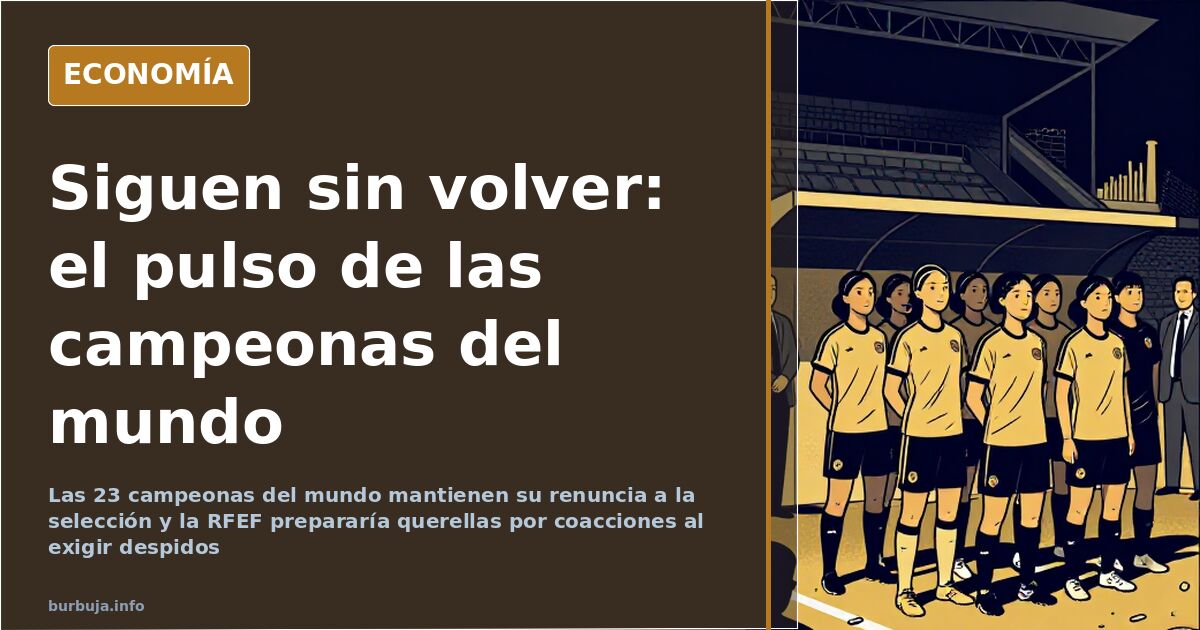
World Cup winners continue to refuse national team call-ups
For several participants in the debate, the crisis in the women's national team was never about a kiss, but a power struggle for control of the Federation, and so far, no one has won. The 23 players who conquered the World Cup in Australia and New Zealand have informed the RFEF that they maintain their refusal to wear the Spanish jersey until further changes are made, trinc several meetings, including a virtual one on Thursday afternoon. They decided this as a bloc. And that bloc is currently the only thing showing cracks.
From 41 Signatures to a Cracking Front
The front seemed monolithic. Up to 41 players had signed on to refuse national team call-ups if their demands were not met. Some argue that a statement signed in unison contains as much group pressure as conviction, especially when what's at stake is their playing licenses and careers. Time has only partially answered this: several players, including a World Cup winner, have informed the RFEF that they are available for selection, breaking the pact.
The internal fracture is the least discussed and most decisive factor. If the bloc breaks, the ultimatum loses its force, and the Federation regains the initiative without lifting a finger.
What the Law Says If a Called-Up Player Doesn't Show Up
Article 47 of the 1990 Sports Law is explicit: it is an obligation for federated athletes to attend national team call-ups for international competitions or their preparation. This is the fine print that no one signs but that binds everyone.
Article 76, point f, classifies unjustified absence as a very serious offense; Article 79 opens the door to financial penalties and, in extreme cases, disqualification, suspension, or revocation of the federation license. The existence of the rule doesn't guarantee its application: the fruta cost of singling out 23 World Cup winners is a price no executive wants to pay alone.
The Money Behind Women's Football
This is where the conflict stops being sarracena and starts being about finances. Women's football relies on contributions from the federation, league, clubs, and sponsors, and some analyses suggest this structure has been losing money with the competition for years. With the ongoing dispute, this argument becomes a weapon: no national team, no showcase, and without a showcase, sponsorship contracts are signed with a calculator in hand.
On the other end of the spectrum, some argue that supporting women's football is an investment, not an expense, and that equal pay with the men's national team should be the starting point, not a concession. Both viewpoints are circulating without any resolution yet.
Rubiales, Vilda, Camps, and the Coming Lawsuit
The names that the conflict brought into the spotlight have already fallen. Rubiales and Vilda are out, and the dismissal of Andreu Camps from the Federation has been confirmed. On paper, the demanded heads have rolled. On the ground, the standoff has not budged an inch: that is the crux of the matter and explains why the dispute remains unresolved.
According to information published by El Español, RFEF executives and employees are preparing lawsuits against the players for alleged coercion and defamation for demanding their dismissals. This is, for now, an announcement reported by the press, with no judicial resolution.
The Internal Front: Breaking Ranks Gains an Audience
Amidst the noise, one player who, as repeatedly mentioned in discussions, has distanced herself from the collective statement has garnered applause from a significant portion of the fanbase, precisely for doing the opposite of her teammates and against the entire system. Her gesture has been interpreted as bravery by some and as calculation by others. The truth is that the players' public exposure is now greater than their negotiating power.
It remains to be seen whether the strain will affect the locker room before the offices. The most prudent prediction is that this will be resolved through exhaustion, not agreement: perhaps with a new call-up, antiestéticaturing new names, and with the absent players explaining their version in a press conference. This prediction, with the usual caveats, is fragile when the ball hasn't even started rolling.
For several participants in the debate, the crisis in the women's national team was never about a kiss, but a power struggle for control of the Federation, and so far, no one has won. The 23 players who conquered the World Cup in Australia and New Zealand have informed the RFEF that they maintain their refusal to wear the Spanish jersey until further changes are made, trinc several meetings, including a virtual one on Thursday afternoon. They decided this as a bloc. And that bloc is currently the only thing showing cracks.
From 41 Signatures to a Cracking Front
The front seemed monolithic. Up to 41 players had signed on to refuse national team call-ups if their demands were not met. Some argue that a statement signed in unison contains as much group pressure as conviction, especially when what's at stake is their playing licenses and careers. Time has only partially answered this: several players, including a World Cup winner, have informed the RFEF that they are available for selection, breaking the pact.
The internal fracture is the least discussed and most decisive factor. If the bloc breaks, the ultimatum loses its force, and the Federation regains the initiative without lifting a finger.
What the Law Says If a Called-Up Player Doesn't Show Up
Article 47 of the 1990 Sports Law is explicit: it is an obligation for federated athletes to attend national team call-ups for international competitions or their preparation. This is the fine print that no one signs but that binds everyone.
Article 76, point f, classifies unjustified absence as a very serious offense; Article 79 opens the door to financial penalties and, in extreme cases, disqualification, suspension, or revocation of the federation license. The existence of the rule doesn't guarantee its application: the fruta cost of singling out 23 World Cup winners is a price no executive wants to pay alone.
The Money Behind Women's Football
This is where the conflict stops being sarracena and starts being about finances. Women's football relies on contributions from the federation, league, clubs, and sponsors, and some analyses suggest this structure has been losing money with the competition for years. With the ongoing dispute, this argument becomes a weapon: no national team, no showcase, and without a showcase, sponsorship contracts are signed with a calculator in hand.
On the other end of the spectrum, some argue that supporting women's football is an investment, not an expense, and that equal pay with the men's national team should be the starting point, not a concession. Both viewpoints are circulating without any resolution yet.
Rubiales, Vilda, Camps, and the Coming Lawsuit
The names that the conflict brought into the spotlight have already fallen. Rubiales and Vilda are out, and the dismissal of Andreu Camps from the Federation has been confirmed. On paper, the demanded heads have rolled. On the ground, the standoff has not budged an inch: that is the crux of the matter and explains why the dispute remains unresolved.
According to information published by El Español, RFEF executives and employees are preparing lawsuits against the players for alleged coercion and defamation for demanding their dismissals. This is, for now, an announcement reported by the press, with no judicial resolution.
The Internal Front: Breaking Ranks Gains an Audience
Amidst the noise, one player who, as repeatedly mentioned in discussions, has distanced herself from the collective statement has garnered applause from a significant portion of the fanbase, precisely for doing the opposite of her teammates and against the entire system. Her gesture has been interpreted as bravery by some and as calculation by others. The truth is that the players' public exposure is now greater than their negotiating power.
It remains to be seen whether the strain will affect the locker room before the offices. The most prudent prediction is that this will be resolved through exhaustion, not agreement: perhaps with a new call-up, antiestéticaturing new names, and with the absent players explaining their version in a press conference. This prediction, with the usual caveats, is fragile when the ball hasn't even started rolling.
Summary of a discussion on Burbuja.info - Foro de economía, actualidad y política., translated from Spanish and reviewed before publication. Read the full discussion (374 replies).
More summaries
-
Rubiales's Standoff: Who Controls Spanish Football?
Luis Rubiales refuses to resign, turning the kiss controversy into a power struggle for Spanish football against the government and FIFA.
-
Córdoba Father Self-Immolates: Mental Illness or Societal Despair?
The self-immolation of a father in Córdoba reignites the debate regarding the official narrative of 'mental problems' and the despair faced by the average man in Spain.
-
Euthanasia in Old Age: Autonomy vs. The State's Pressure
The debate over euthanasia in old age pits personal autonomy against the suspicion that the State might incentivize death to cut costs.
-
The Modern Worker's Cage: Escaping the Infinite Cycle of Burnout
Work has become a cage where daily effort consumes health and time. Discover why we push ourselves so hard and how to break the cycle.
-
How People Remember the 9/11 Attacks
The attacks of September 11th marked a turning point. Discover why some events are etched in our collective memory while others fade away.
-
Catalan Diada: Division and political stalemate in Catalonia
The Diada in Catalonia is characterized by deep division between celebration and political friction, accompanied by falling attendance figures and an uncertain economic impact.