
Adeslas quits Spain's civil servant health scheme despite premium hike
Adeslas withdraws from Muface, Spain's civil servant health insurance system, leaving 1.5 million workers in limbo despite a 33.5% premium increase.
English · Original discussion in Spanish · Published
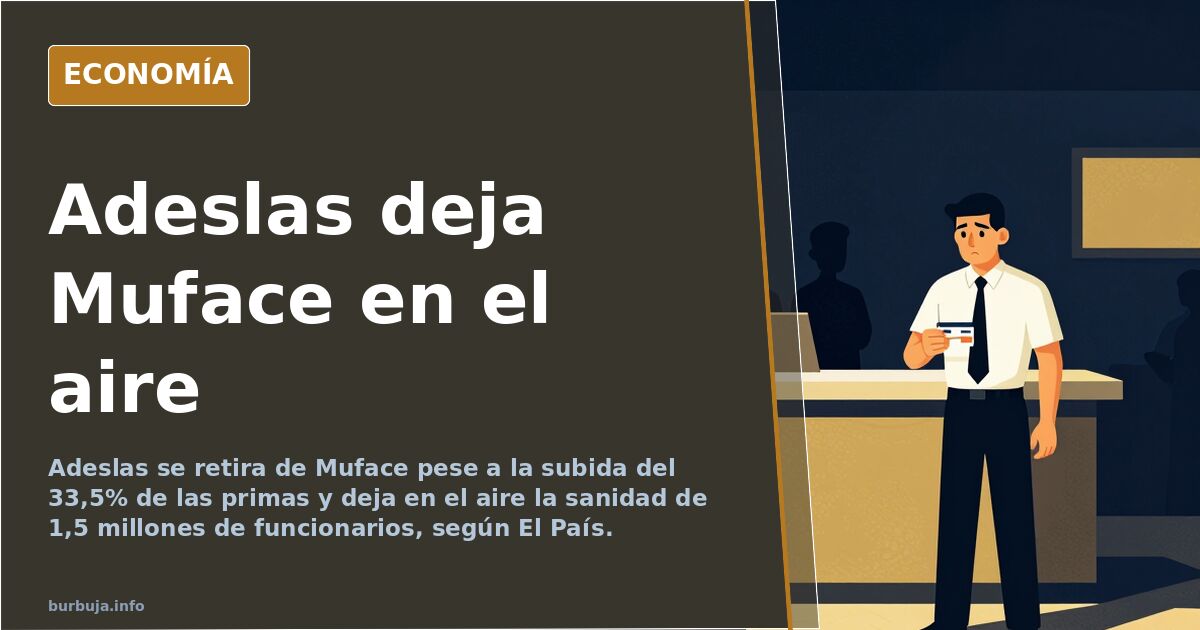
Adeslas exits Muface despite 33.5% premium rise
The new agreement for Muface (Spain's administrative mutualism system for civil servants) is once again up in the air. Adeslas, one of the insurers providing coverage to state employees, has decided to withdraw from the contract despite the Government having raised premiums by 33.5%. The news, first reported by El País, leaves the healthcare of 1.5 million civil servants and their families in limbo. Reactions have been swift: some demand they move to the Social Security system without privileges, while others warn that the public system cannot absorb such a load without worsening waiting lists. The standoff between insurers and the Administration exposes an uncomfortable reality: the administrative mutualism model is failing.
Why is Adeslas giving up a more expensive contract?
Adeslas' decision is not arbitrary. The 33.5% premium increase aimed to compensate for the aging of the insured population and rising healthcare costs, but the numbers don't add up. Industry sources argue that the Muface group concentrates older patients with chronic conditions whose treatment erodes any profit margin. The insurer reportedly concluded that even with the increase, the agreement remains deficit-making.
The blow is not just economic. Muface manages healthcare for civilian state civil servants, a group estimated at around 1.5 million people including policyholders and beneficiaries. If Adeslas leaves and the other two insurers in the contract — Asisa and Sanitas — trinc suit, the Government will have to improvise an emergency exit. The most obvious option: transfer all these civil servants to public healthcare. The most traumatic: raise premiums further so a company accepts the burden.
Clashing narratives: privileges versus waiting lists
The news has sparked a debate that goes beyond healthcare. Part of public opinion believes civil servants have historically enjoyed parallel healthcare, with shorter waits and direct access to specialists, and it is time they faced the same hurdles as everyone else. "Let them deal with it," summarizes a trend that doesn't mind the end of mutualism. Others, however, warn that mass integration into Social Security won't be free: more patients in an already strained system means longer delays for everyone.
The argument about privileges has traction. Defenders of the mutualist model recall that civil servants do not choose freely: they are assigned to Muface by law and contribute to it. Moreover, coverage is not free; it is funded by premiums paid by the Administration. But the perception of unfairness weighs heavily. In a context of record waiting lists, any group with faster access becomes a target.
What happens to the 1.5 million civil servants if no agreement is reached?
If the contract loses its insurers, the Ministry of Public Function will have to activate Plan B. Options on the table are limited. First, extend the current agreement urgently and force insurers to continue providing service, which would clash with their refusal. Second, integrate mutualists into the National Health System, a measure requiring extra budget allocation that critics say would further collapse primary and hospital care.
Meanwhile, time is running out. Affected civil servants watch anxiously a calendar they do not control. Uncertainty extends to private clinics and hospitals working for Muface: if the agreement falls, they lose significant business volume. Underlying this is an uncomfortable question: is the mutualism model doomed to disappear, or is it just a matter of money?
The fine print: age, chronicity, and insurers' business
There is a factor insurers don't voice openly but which explains their exit: the demographic structure of the group. The average age of Muface civil servants is high, and a significant portion suffers from chronic diseases requiring expensive, long-term medication. For an insurer, an oncology patient may be manageable if cured; a patient with a degenerative disease needing lifelong medication is a financial drain.
This is the core issue. Private health insurance relies on risk selection: the younger and healthier the insured, the better. Muface, by nature, concentrates the opposite profile. Hence companies prefer losing the contract over accepting recurring losses. The 33.5% increase was a patch, not a structural solution.
A precedent nobody wants to look at
This is not the first time administrative mutualism wobbles. Over recent decades, the system has integrated entities and mutualities into Social Security, using millions in bailouts to plug holes. Veterans recall that many mutualities were technically bankrupt as early as the sixties. History repeats itself with a different wrapper.
The difference now is the political context. The Government faces the wear of managing a public health system on the brink of collapse while negotiating with insurers who won't accept scraps. Each side looks out for themselves. Civil servants want to keep what they have. Insurers want to avoid losing money. And taxpayers want to avoid paying for the party. Does anyone remember them?
The new agreement for Muface (Spain's administrative mutualism system for civil servants) is once again up in the air. Adeslas, one of the insurers providing coverage to state employees, has decided to withdraw from the contract despite the Government having raised premiums by 33.5%. The news, first reported by El País, leaves the healthcare of 1.5 million civil servants and their families in limbo. Reactions have been swift: some demand they move to the Social Security system without privileges, while others warn that the public system cannot absorb such a load without worsening waiting lists. The standoff between insurers and the Administration exposes an uncomfortable reality: the administrative mutualism model is failing.
Why is Adeslas giving up a more expensive contract?
Adeslas' decision is not arbitrary. The 33.5% premium increase aimed to compensate for the aging of the insured population and rising healthcare costs, but the numbers don't add up. Industry sources argue that the Muface group concentrates older patients with chronic conditions whose treatment erodes any profit margin. The insurer reportedly concluded that even with the increase, the agreement remains deficit-making.
The blow is not just economic. Muface manages healthcare for civilian state civil servants, a group estimated at around 1.5 million people including policyholders and beneficiaries. If Adeslas leaves and the other two insurers in the contract — Asisa and Sanitas — trinc suit, the Government will have to improvise an emergency exit. The most obvious option: transfer all these civil servants to public healthcare. The most traumatic: raise premiums further so a company accepts the burden.
Clashing narratives: privileges versus waiting lists
The news has sparked a debate that goes beyond healthcare. Part of public opinion believes civil servants have historically enjoyed parallel healthcare, with shorter waits and direct access to specialists, and it is time they faced the same hurdles as everyone else. "Let them deal with it," summarizes a trend that doesn't mind the end of mutualism. Others, however, warn that mass integration into Social Security won't be free: more patients in an already strained system means longer delays for everyone.
The argument about privileges has traction. Defenders of the mutualist model recall that civil servants do not choose freely: they are assigned to Muface by law and contribute to it. Moreover, coverage is not free; it is funded by premiums paid by the Administration. But the perception of unfairness weighs heavily. In a context of record waiting lists, any group with faster access becomes a target.
What happens to the 1.5 million civil servants if no agreement is reached?
If the contract loses its insurers, the Ministry of Public Function will have to activate Plan B. Options on the table are limited. First, extend the current agreement urgently and force insurers to continue providing service, which would clash with their refusal. Second, integrate mutualists into the National Health System, a measure requiring extra budget allocation that critics say would further collapse primary and hospital care.
Meanwhile, time is running out. Affected civil servants watch anxiously a calendar they do not control. Uncertainty extends to private clinics and hospitals working for Muface: if the agreement falls, they lose significant business volume. Underlying this is an uncomfortable question: is the mutualism model doomed to disappear, or is it just a matter of money?
The fine print: age, chronicity, and insurers' business
There is a factor insurers don't voice openly but which explains their exit: the demographic structure of the group. The average age of Muface civil servants is high, and a significant portion suffers from chronic diseases requiring expensive, long-term medication. For an insurer, an oncology patient may be manageable if cured; a patient with a degenerative disease needing lifelong medication is a financial drain.
This is the core issue. Private health insurance relies on risk selection: the younger and healthier the insured, the better. Muface, by nature, concentrates the opposite profile. Hence companies prefer losing the contract over accepting recurring losses. The 33.5% increase was a patch, not a structural solution.
A precedent nobody wants to look at
This is not the first time administrative mutualism wobbles. Over recent decades, the system has integrated entities and mutualities into Social Security, using millions in bailouts to plug holes. Veterans recall that many mutualities were technically bankrupt as early as the sixties. History repeats itself with a different wrapper.
The difference now is the political context. The Government faces the wear of managing a public health system on the brink of collapse while negotiating with insurers who won't accept scraps. Each side looks out for themselves. Civil servants want to keep what they have. Insurers want to avoid losing money. And taxpayers want to avoid paying for the party. Does anyone remember them?
Also available in: Deutsch
Summary of a discussion on Burbuja.info - Foro de economía, actualidad y política., translated from Spanish and reviewed before publication. Read the full discussion (174 replies).
More summaries
-
DKV, Asisa and Adeslas quit Muface: 1.5 million to public health
Asisa, DKV and Adeslas refuse to renew Muface contract: 1.5 million would move to public healthcare, with Madrid said to be hardest hit
-
Muface: Bal estimates 1.5 million civil servants affected
Edmundo Bal says 1.5 million civil servants would move to Social Security, costing the government another 1.5 million votes.
-
Insurers Reject 14% Muface Offer, Leaving Spain's Civil Servant Health Plan in Limbo
The Spanish government proposes a 14% premium hike for Muface, but major insurers demand 40%, risking 200 million euros in losses and potential strikes by civil servants.
-
Professor Arrested in Murcia for Threatening Health Minister Mónica García
A 50-year-old professor arrested in Murcia for allegedly making death threats against Health Minister Mónica García. No prior convictions.
-
Plane Myth: Confusing Inertia with Wind in Spain
Earth rotates at 1,600 km/h and planes fly at 840 km/h. The error is forgetting that air rotates with the planet.
-
Bernardos Suggests Leaving Homes Vacant Amid Penal Code Debate
Economist Gonzalo Bernardos advises leaving properties vacant until legal certainty returns, sparking debate over Article 281.1 of the Spanish Penal Code.