
Abstention dominates: 11-point drop in turnout
Turnout falls 11 points, with 62% of voters staying home, meaning Spain's European Parliament seats are allocated without a clear majority.
English · Original discussion in Spanish · Published
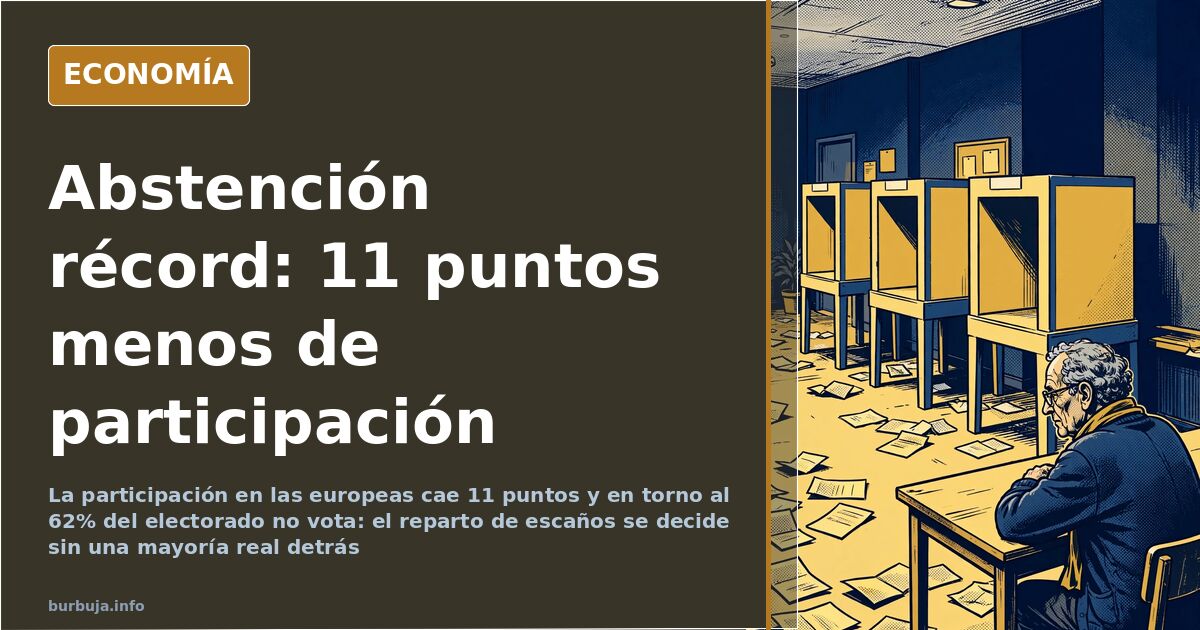
Surge in abstention crashes turnout 11 points
Abstention won the European elections. Again, and by the widest margin in years: turnout dropped 11 points compared to the previous election, with the gap widening hour by hour. At 2:00 PM, voting was 4 points lower; by 6:00 PM, it was 12 points lower. As evening fell, the figure threatened to stay below 45%, the historical ceiling for European elections voted alone, without the pull of municipal and regional elections on the same ballot.
The count revealed an uncomfortable picture: around 62% of the electorate did not go to the polls. From there, statistics became politics. Some read it as a death certificate for interest in Europe. Others see it as proof that those who hold seats for the next five years will do so without the blessing of a real majority.
What turnout did European elections have when voted alone
The comparison requires context. The previous election was not comparable: it coincided with municipal and regional elections, where voters go for very different reasons. When European elections are voted alone, the pattern is stubborn: 44% in 2004, 44% in 2009, and 43% in 2014. A floor of 43-44% that some attribute to habit and others to a structural antiestéticature of the system.
The thesis gaining ground holds that closed lists and a single constituency discourage any effort. It does not matter who you vote for: the distribution is decided in Brussels, among groups that reform themselves afterward and partners who change depending on the file. "A scam," summarized one who compared the European election to local elections, where at least you know who receives your vote.
Some go further: the European Parliament would be a refuge for salaries, and real power is shared between the Commission and the Council, neither of which goes to the polls. This institutional framework thus becomes a strong argument for those who stay home. Bread and circuses, called another, with the same resignation.
How many ballots are thrown in the trash each election day
In contrast to abstention, the waste of materials. The case of an Aragonese polling station with 320 registered voters and up to 6,000 printed ballots circulated, all thrown in the trash when the polling station closed. With closed lists and a single ballot per party, the method is dictated by parties with representation. The technical alternative on the table is another: a single ballot with boxes, as in the Senate.
The paradox was pointed out by those who remembered that this waste is assumed by an administration that, in parallel, asks citizens to reduce their footprint. Paper is printed by the millions, distributed to polling stations, and destroyed at night. No one discusses it because no big player wants to change it.
What happens if you don't vote: are seats distributed equally?
The answer is the core of the anger. Yes, they are distributed equally. Abstention does not remove a single seat or reduce a euro of salary: the one who sits, collects. Hence the proposal of Blank Seats: if all those who stayed home had left that ballot, more than half of Spain's seats in the European Parliament would remain empty, and each session in Brussels would be a silent reminder of discontent.
The objection appears immediately. Who guarantees that the person elected under this acronym renounces the salary, immunity, and allowances as soon as they cross the door? Without an immediate dismissal mechanism for failing to fulfill the program, the instrument depends on the word of someone whom the system rewards precisely for not fulfilling it. And the second objection already exists within the hemicycle: there are MEPs who collect the same salary even if they do not appear.
The seat as a business: 28,000 euros per month for advisors
If something explains the hunger for the cushy job, they say, it is the arithmetic of the office. A figure that circulated during the day placed at 28,000 euros monthly the margin for hiring advisors, that is, money to distribute at the discretion of the signatory. An incentive that does not fade with changes in cycle and helps understand why abstention never translates into fewer candidates.
The skeptical response has its own logic: no matter how many people stay home, there is always a captive base. Those who depend on the system to eat, those who vote for their party out of habit or identity. Even if abstention rose to 75%, that core would still decide who rules. Bitter conclusion: the abstainer punishes no one, only removes themselves from the count.
With these precedents, it is likely that the drop in turnout will be forgotten in a few days and that the European election will continue to function as a punishment test for the current government, more than as a plebiscite on Europe. Although perhaps not always: if a single force manages to capitalize on disenchantment with an anti-system discourse, the next measurement will say something else. With the polls, you never know.
Abstention won the European elections. Again, and by the widest margin in years: turnout dropped 11 points compared to the previous election, with the gap widening hour by hour. At 2:00 PM, voting was 4 points lower; by 6:00 PM, it was 12 points lower. As evening fell, the figure threatened to stay below 45%, the historical ceiling for European elections voted alone, without the pull of municipal and regional elections on the same ballot.
The count revealed an uncomfortable picture: around 62% of the electorate did not go to the polls. From there, statistics became politics. Some read it as a death certificate for interest in Europe. Others see it as proof that those who hold seats for the next five years will do so without the blessing of a real majority.
What turnout did European elections have when voted alone
The comparison requires context. The previous election was not comparable: it coincided with municipal and regional elections, where voters go for very different reasons. When European elections are voted alone, the pattern is stubborn: 44% in 2004, 44% in 2009, and 43% in 2014. A floor of 43-44% that some attribute to habit and others to a structural antiestéticature of the system.
The thesis gaining ground holds that closed lists and a single constituency discourage any effort. It does not matter who you vote for: the distribution is decided in Brussels, among groups that reform themselves afterward and partners who change depending on the file. "A scam," summarized one who compared the European election to local elections, where at least you know who receives your vote.
Some go further: the European Parliament would be a refuge for salaries, and real power is shared between the Commission and the Council, neither of which goes to the polls. This institutional framework thus becomes a strong argument for those who stay home. Bread and circuses, called another, with the same resignation.
How many ballots are thrown in the trash each election day
In contrast to abstention, the waste of materials. The case of an Aragonese polling station with 320 registered voters and up to 6,000 printed ballots circulated, all thrown in the trash when the polling station closed. With closed lists and a single ballot per party, the method is dictated by parties with representation. The technical alternative on the table is another: a single ballot with boxes, as in the Senate.
The paradox was pointed out by those who remembered that this waste is assumed by an administration that, in parallel, asks citizens to reduce their footprint. Paper is printed by the millions, distributed to polling stations, and destroyed at night. No one discusses it because no big player wants to change it.
What happens if you don't vote: are seats distributed equally?
The answer is the core of the anger. Yes, they are distributed equally. Abstention does not remove a single seat or reduce a euro of salary: the one who sits, collects. Hence the proposal of Blank Seats: if all those who stayed home had left that ballot, more than half of Spain's seats in the European Parliament would remain empty, and each session in Brussels would be a silent reminder of discontent.
The objection appears immediately. Who guarantees that the person elected under this acronym renounces the salary, immunity, and allowances as soon as they cross the door? Without an immediate dismissal mechanism for failing to fulfill the program, the instrument depends on the word of someone whom the system rewards precisely for not fulfilling it. And the second objection already exists within the hemicycle: there are MEPs who collect the same salary even if they do not appear.
The seat as a business: 28,000 euros per month for advisors
If something explains the hunger for the cushy job, they say, it is the arithmetic of the office. A figure that circulated during the day placed at 28,000 euros monthly the margin for hiring advisors, that is, money to distribute at the discretion of the signatory. An incentive that does not fade with changes in cycle and helps understand why abstention never translates into fewer candidates.
The skeptical response has its own logic: no matter how many people stay home, there is always a captive base. Those who depend on the system to eat, those who vote for their party out of habit or identity. Even if abstention rose to 75%, that core would still decide who rules. Bitter conclusion: the abstainer punishes no one, only removes themselves from the count.
With these precedents, it is likely that the drop in turnout will be forgotten in a few days and that the European election will continue to function as a punishment test for the current government, more than as a plebiscite on Europe. Although perhaps not always: if a single force manages to capitalize on disenchantment with an anti-system discourse, the next measurement will say something else. With the polls, you never know.
Summary of a discussion on Burbuja.info - Foro de economía, actualidad y política., translated from Spanish and reviewed before publication. Read the full discussion (218 replies).
More summaries
-
Why the System Fears Empty Seats: Spain's Protest Party
Spain's Escaños en Blanco party holds 14 vacant council seats. It divides abstentionists between active voting and total boycott.
-
Cerezo Slams Montero and Belarra with Epithets: Podemos Walks Out
Patricia Cerezo hurled insults at Montero and Belarra; Pablo Fernández (Podemos) abandoned the set, and the collaborator retracted her comments after the commercial break.
-
Global 10-Year Bond Yields Surge to Decade Highs
US and Japanese 10-year bond yields hit multi-decade highs, with European markets following suit amid growing debt crisis concerns.
-
Spanish TV Journalists Ordered to Delete Monetized YouTube Clips
RTVE ombudsman orders journalists Javier Ruiz and Jesús Cintora to stop monetizing public broadcast clips on personal YouTube channels.
-
Spain Coup Talk: High Noise, Zero Plan
A proposal for military and police intervention in Spain garnered 204 responses but no roadmap, as electoral routes, NATO, and amnesty laws dominate the debate.
-
Bank of Spain advises keeping up to a year's expenses in cash
The Bank of Spain recommends holding six to twelve months of fixed expenses in cash, up to €15,000, which tax authorities may require justification for.