
Abrams Tanks to Ukraine: A Logistical Nightmare of Fuel Consumption and Training
The Abrams tank consumes 11 liters per kilometer and weighs 72 tons, requiring nearly a year of training. Understanding the logistical challenges behind the US reluctance to send them.
English · Original discussion in Spanish · Published
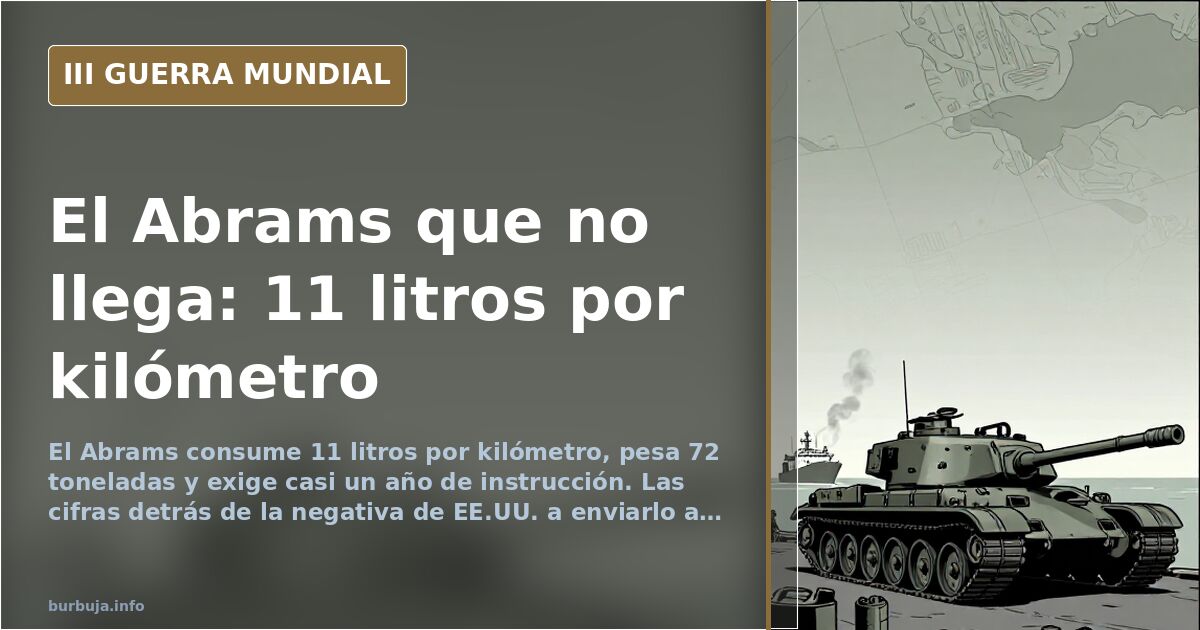
The Abrams Drinks 11 Liters Per Kilometer: Why It's Not Going to Ukraine
Washington claims there's no point in sending its M-1 Abrams tanks to Ukraine because German Leopards and British Challengers are "easier to use." Read in a statement, it sounds like a polite excuse. Read in numbers, it sounds like something else entirely: an Abrams consumes 11 liters of fuel per kilometer, uses in 8 hours what a Leopard 2 or Challenger uses in 48, and weighs 72 tons. It's not a bad tank. It's an incredibly expensive tank to move.
Why is the Abrams a Logistical Nightmare?
The heart of the problem lies under the hood. The M-1 mounts a gas turbine instead of a diesel engine, a decision that gives it sports-car acceleration and an oil-guzzler's appetite. According to calculations, it only runs well on aviation kerosene: diesel creates soot, and gasoline pushes the turbine to its temperature limit. On a front where fuel is measured in trucks and mud devours tracks, this isn't a technical detail; it's the line between moving and being stuck.
Then there's the weight. 72 tons can destroy roads, bridges, and secondary routes, and the tank isn't designed to fire HE (High Explosive) ammunition, the kind used against infantry. Some summarize it bluntly: without a full logistical echelon behind them, the M-1s become immobile scrap within days. And that echelon isn't improvised.
The Bottleneck Nobody Wants to Put in Writing
The discussion often stays on armor and the gun. The real jam is in the crew. A Western tank requires, at best, 3 to 4 months of training for already trained operators; if starting from scratch, the timeline stretches to almost a year. It's not enough to train the gunner: specialized maintenance crews, spare parts, engines, and transmissions are needed, and that's not a one-month course.
Here, a recurring temptation arises: thinking that a computer simulator, even a twenty-year-old pirated version, turns a hobbyist into a tank commander. It doesn't. The gap between playing a video game and pulling a tank out of the mud in winter is the same as the gap between reading a recipe and cooking.
Poland Already Chose: Abrams and South Korean Howitzers
While Europe debates what to send, Poland has settled the argument with its checkbook. It has purchased 180 tanks and 212 South Korean self-propelled howitzers, which it is already receiving, in addition to American Abrams. The reasoning from Warsaw is simple: a single supplier is a risk. And with Germany as an uncomfortable neighbor, looking to Washington makes sense.
The paradox is that the ease-of-use argument clashes with the market. The Abrams is sold to Poland and other countries without anyone mentioning how difficult it is to maintain. By that logic, the excuse only appears when they're given away for free.
Antiestéticar of Losing Technology Along the Way
There's a second hypothesis circulating that fits better with the fine print. It wouldn't be so much about cost as the risk of an Abrams being captured, dismantled, and studied. It's recalled that in Iraq, the Americans themselves destroyed their damaged tanks to prevent them from falling into enemy hands. Industrial selfishness, or simple caution: let European models bear the wear and tear on the showcase, and keep the Abrams from exposing its weaknesses.
In the background, the usual picture remains. Germany sends Leopards, the UK sends Challengers, Spain reluctantly adds its 239 tanks. The United States has 14,000 Abrams and asks others to go first. Is it logistics or risk-sharing?
Note: Consumption, weight, and training figures are estimates circulating in the technical debate about the M-1.
Washington claims there's no point in sending its M-1 Abrams tanks to Ukraine because German Leopards and British Challengers are "easier to use." Read in a statement, it sounds like a polite excuse. Read in numbers, it sounds like something else entirely: an Abrams consumes 11 liters of fuel per kilometer, uses in 8 hours what a Leopard 2 or Challenger uses in 48, and weighs 72 tons. It's not a bad tank. It's an incredibly expensive tank to move.
Why is the Abrams a Logistical Nightmare?
The heart of the problem lies under the hood. The M-1 mounts a gas turbine instead of a diesel engine, a decision that gives it sports-car acceleration and an oil-guzzler's appetite. According to calculations, it only runs well on aviation kerosene: diesel creates soot, and gasoline pushes the turbine to its temperature limit. On a front where fuel is measured in trucks and mud devours tracks, this isn't a technical detail; it's the line between moving and being stuck.
Then there's the weight. 72 tons can destroy roads, bridges, and secondary routes, and the tank isn't designed to fire HE (High Explosive) ammunition, the kind used against infantry. Some summarize it bluntly: without a full logistical echelon behind them, the M-1s become immobile scrap within days. And that echelon isn't improvised.
The Bottleneck Nobody Wants to Put in Writing
The discussion often stays on armor and the gun. The real jam is in the crew. A Western tank requires, at best, 3 to 4 months of training for already trained operators; if starting from scratch, the timeline stretches to almost a year. It's not enough to train the gunner: specialized maintenance crews, spare parts, engines, and transmissions are needed, and that's not a one-month course.
Here, a recurring temptation arises: thinking that a computer simulator, even a twenty-year-old pirated version, turns a hobbyist into a tank commander. It doesn't. The gap between playing a video game and pulling a tank out of the mud in winter is the same as the gap between reading a recipe and cooking.
Poland Already Chose: Abrams and South Korean Howitzers
While Europe debates what to send, Poland has settled the argument with its checkbook. It has purchased 180 tanks and 212 South Korean self-propelled howitzers, which it is already receiving, in addition to American Abrams. The reasoning from Warsaw is simple: a single supplier is a risk. And with Germany as an uncomfortable neighbor, looking to Washington makes sense.
The paradox is that the ease-of-use argument clashes with the market. The Abrams is sold to Poland and other countries without anyone mentioning how difficult it is to maintain. By that logic, the excuse only appears when they're given away for free.
Antiestéticar of Losing Technology Along the Way
There's a second hypothesis circulating that fits better with the fine print. It wouldn't be so much about cost as the risk of an Abrams being captured, dismantled, and studied. It's recalled that in Iraq, the Americans themselves destroyed their damaged tanks to prevent them from falling into enemy hands. Industrial selfishness, or simple caution: let European models bear the wear and tear on the showcase, and keep the Abrams from exposing its weaknesses.
In the background, the usual picture remains. Germany sends Leopards, the UK sends Challengers, Spain reluctantly adds its 239 tanks. The United States has 14,000 Abrams and asks others to go first. Is it logistics or risk-sharing?
Note: Consumption, weight, and training figures are estimates circulating in the technical debate about the M-1.
Summary of a discussion on Burbuja.info - Foro de economía, actualidad y política., translated from Spanish and reviewed before publication. Read the full discussion (159 replies).
More summaries
-
Over 50 Countries Pledge 600 Tanks and 600,000 Shells to Ukraine
More than 50 nations promise Ukraine 600 tanks, nearly 500 artillery systems, and 600,000 shells. The debate centers on who will pay for the rearmament.
-
Von der Leyen proposes European Article 4 alliance with Canada and Ukraine
Von der Leyen proposes a mutual security alliance with Ukraine, UK, Canada, and Norway, excluding the US. NATO Article 4 only requires consultation.
-
Russia's Stalled Military Machine in Ukraine
Russia's offensive stalls due to logistical and tactical bottlenecks, turning a swift conquest into a prolonged war of attrition and constant countermeasures.
-
Ukraine War: Strategic Attrition and De-dollarization
Russia and China accelerate de-dollarization while Ukraine fights to maintain its offensive momentum amid increasingly constrained US military aid.
-
Ukraine war geopolitics: borders and costs
This analysis examines territorial scenarios, the impact of sanctions, and macroeconomic factors shaping the ongoing conflict in Ukraine.
-
Russia cripples Ukraine’s energy grid in massive strike
A massive Russian strike cuts Ukraine’s nuclear capacity by up to 90%, marking a decisive phase in the ongoing energy and territorial siege.