
Abengoa shares plunge to €0.0029 amid stalled bailout
Abengoa stock hits a low of €0.0029 as its €1.5 billion refinancing plan remains blocked by an unpaid €20 million contribution.
English · Original discussion in Spanish · Published
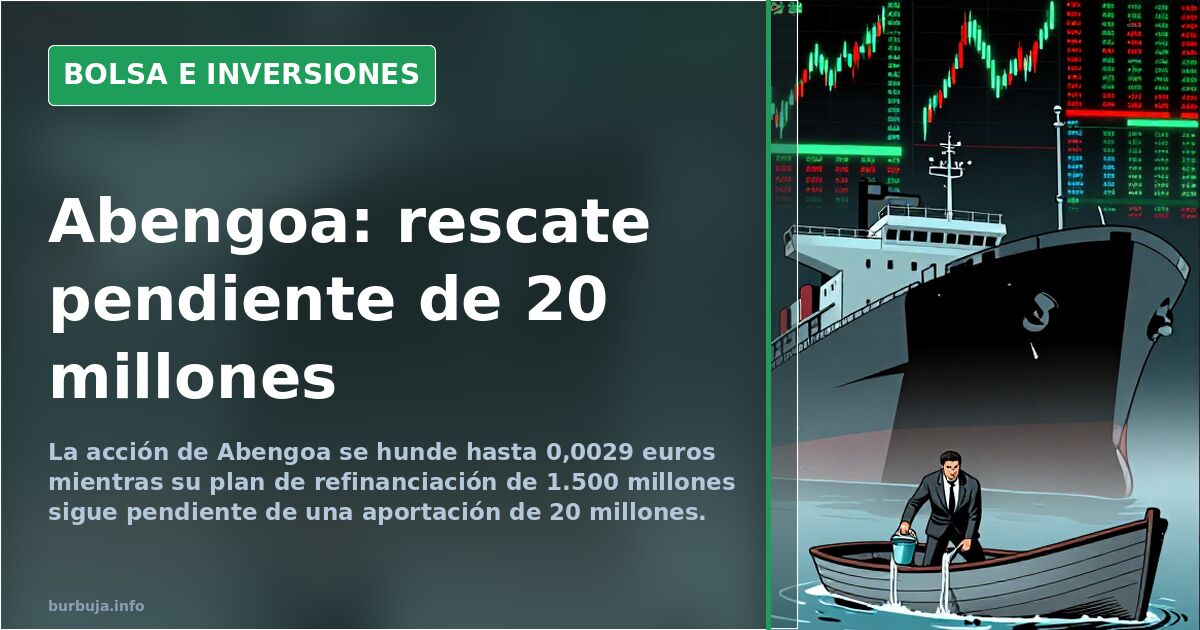
Abengoa awaits €20 million to finalize rescue
An engineering firm capable of winning the world's largest vanadium flow battery microgrid contract in South Africa, claiming €1.5 billion from Spain before the Stockholm Chamber of Commerce, and supporting thousands of direct jobs should not trade at €0.0029. Yet here it is. The share price fell from €0.005 to €0.0029, a drop of nearly 42% that leaves shareholders staring at the chart like spectators watching a match lost half an hour ago. The counterintuitive part isn't the fall: it's that buyers remain.
Technical insolvency with millions of shares outstanding
The accounting diagnosis allows little interpretation. Net equity is negative and does not reach half of the social capital, a situation known in plain terms as technical insolvency. The company carries billions of live shares, convertible bonds that will turn into more stock, and a recurring proposal to banks to swap debt for new issuances.
That detail—the conversion—is often overlooked by small investors. Any attempt at revaluation clashes against a dilution mechanism that eats the effect: a rise of a few cents moves market valuation by tens or hundreds of millions, but spread across gigantic capital. Those entering hoping to multiply will first encounter the effect of a capital increase; if they don't participate, their stake shrinks.
Cold analysis insists that an orderly exit requires debt haircuts and new capital. None of this comes free or fast.
The €1.5 billion plan dependent on €20 million
The group has entered the final stretch of a refinancing plan valued at approximately €1.5 billion, according to reports leaked by the company itself. The snag blocking it is almost grotesque: a €20 million contribution verbally committed by the Junta de Andalucía (Andalusian regional government) but never executed. The region claims it cannot find a legal mechanism to make the payment.
With this gap open, the company extended until October 23 the deadline for the Junta to act, after obtaining a waiver from creditors. In parallel, the Instituto de Crédito Oficial (ICO), Spain's state credit institution, stepped in: a five-year loan of up to €230 million with public guarantee, plus a revolving line of guarantees of up to €126.4 million. Under normal conditions, those familiar with the file admit, the ICO wouldn't have considered it. Other arguments now weigh heavier.
The contextual figure: the accumulated restructuring involves a €10 billion haircut, the largest such operation carried out in Europe.
Institutional standoff: board dismissed, banks warning
The parent company's shareholder meeting approved the dismissal of the board led by Gonzalo Urquijo and censured his management during negotiations. But Urquijo continued pulling strings from AbenewCo 1, the entity to which all assets and businesses were transferred, and where new funds are also concentrated. Critical shareholders have asked the CNMV (Spain's securities regulator) to monitor this power shift to the subsidiary.
The banking warning was explicit. Santander, Bankia, Crédit Agricole, Caixabank, BBVA, and Bankinter stated they would withdraw support for financing and guarantees if there was a change in the board responsible for executing the business plan. Translated: money is lent to the manager, not the shareholder.
Past figures appear in this exchange of letters. A former CEO stopped receiving a planned bonus of €3.3 million due to the pre-insolvency situation and faces an admitted lawsuit.
Contracts in Africa and a €1.5 billion arbitration
While the future is decided in offices, business hasn't stopped. The company won the first large-scale hybrid microgrid contract in Africa in South Africa, antiestéticaturing 3.5 MW of photovoltaics and vanadium flow battery storage. It also appears in technological developments alongside Airbus Defence and Space and German and US research centers.
This adds to the judicial route. Since 2013, the firm has claimed €1.5 billion from Spain for cuts to renewable energy premiums, and the ruling from the Stockholm Chamber of Commerce remained pending. A favorable decision would be, in the words of those trinc the case, a huge boost. In Mexico, Abengoa México restructured liabilities exceeding 4 billion pesos (approx. €155 million) with repayment over nine years.
All this paints a paradox: cutting-edge technology, international portfolio, and a capital structure that suffocates any operational merit.
Why buyers still exist
Here lies the disorienting part. Some claim to hold ten thousand shares and insist the company won't be allowed to collapse. Others calculate that with €1,000 at €0.0039 you buy a position and simply lack courage to execute it. And some buy every month, religiously, waiting for a rise that never comes.
Against them, the harsher reading: financing an inefficient company with unsustainable debt is not a form of social justice, and blaming short sellers afterward confuses cause with symptom. Others argue no investor exists who doesn't speculate on share value or hypothetical dividends, only with different time horizons.
Employment weighs on the scale. There is talk of between 10,000 and 15,000 direct jobs and a company too symbolic to let disappear without more. But convincing banks, regulators, and tired shareholders are three different negotiations.
With numbers on the table, a 42% plunge on a stock already worth half a cent shouldn't surprise anyone. That buy orders keep appearing, yes. Is this the final episode or just the penultimate one?
Also available in: Deutsch
Summary of a discussion on Burbuja.info - Foro de economía, actualidad y política., translated from Spanish and reviewed before publication. Read the full discussion (178 replies).
More summaries
-
Leveraging Telefónica: The €40,000 Loan That Went Wrong
An investor borrowed €40,000 to buy Telefónica at €5.41. The stock fell, he doubled the bet to €60,000, and ended up asking family for help. Six years…
-
Gold and Silver Between Individuals: Discount Rules Over Spot Price
The private gold and silver market is reorganizing around discounts on the spot price, with silver going from 0.434 euros per gram to 74 euros per ounce.
-
Anthropic IPO on November 26: most retail investors say no
Anthropic goes public on November 26, but the majority answer is no: an inflated price, FOMO and memories of Coreweave and SpaceX are holding retail investors back.
-
Marathon Fusion says it turned mercury into gold, and the market shrugs
Marathon Fusion claims it transmuted mercury into stable gold, ten times the CERN record. The energy cost and scale keep the announcement a curiosity.
-
Gold now outweighs bonds in global reserves
Gold now accounts for 27% of global reserves, ahead of the 22% held in Treasury bonds. The ten-year yield hovers around 5% and Brent is approaching $120.
-
Spain's PSOE offers 3.75% interest to fund its election campaign
Spain's PSOE is offering 3.75% interest to anyone who funds its campaign through electoral microcredits, according to its own message. Doubts over legality and risk of…