
Abascal's Israel Visit and Shin Bet Meeting Divide Spain's Far Right
Santiago Abascal's meeting with the Shin Bet chief during his trip to Israel has reignited internal tensions within Spain's far-right party, VOX.
English · Original discussion in Spanish · Published
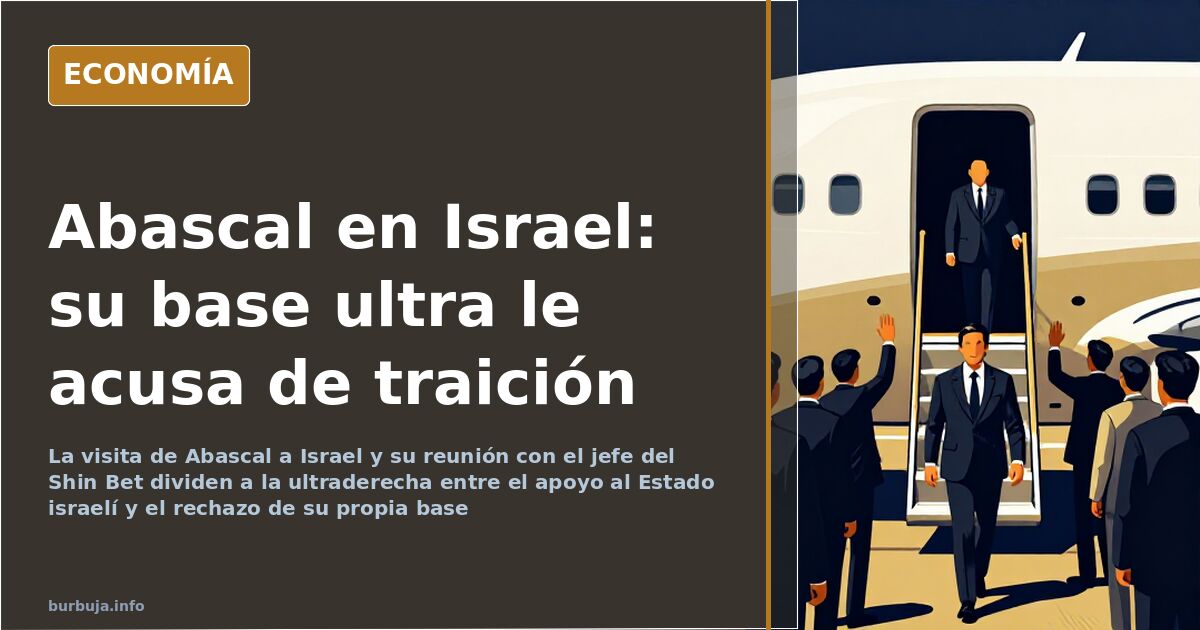
Abascal's alucinación to Israel with the Shin Bet chief ignites his own base
Santiago Abascal's meeting with the head of the Shin Bet during his visit to Israel has peine a rift that VOX had been trying to cover up. The criticism does not come from the left or from the separatist movements that the party points to as adversaries; it comes from within its own electorate. A part of the base sees it as subordination to foreign interests and labels it, without mincing words, as treason. The word 'genocide' runs through the entire conversation, applied to the offensive on Gaza, and the demand that Spain recognize the Palestinian state now serves as the flip side of the party's official stance.
The alucinación falls at an awkward time. VOX holds two narratives simultaneously that do not fit: unconditional support for Israel as a bulwark of the West and the anti-globalism that yields electoral dividends at home. The meeting with the head of Israel's domestic intelligence service is interpreted, from the most hardline ranks, as proof that this balance has broken in favor of the former.
The Israeli support that was erased after criticism
According to what has been circulated in the discussion, Eli Hazan, the Israeli official for international relations, posted a message of support for the Spanish far-right and withdrew it shortly after amid the flood of reproaches it sparked. The episode, minor in any other context, fuels the suspicion of those who see in VOX a franchise of foreign interests. The deletion of the tweet circulates as proof that the support existed and that it was only halted by public discomfort.
This detail fits with a repeated argument: that the party serves an agenda it does not control. There is no official confirmation of the visit beyond what circulates in the conversation, and this informational void is filled by interpretation.
From Francoism to support for Israel: the heresy for the hardest base
One of the axes of discontent is historical. The most orthodox faction emphasizes that Franco never recognized the State of Israel and that the regime cultivated friendship with the Arab world. Based on this, an article attributed to Falange circulates, resurrecting that old Arab friendship and its support for Palestine against Zionism, presenting VOX as traitors to that legacy. It is an argument that mixes regime memory with current foreign policy and that, fundamentally, demands coherence from the party that its own history never had.
The paradox repeats itself: those who defend border closures and reject immigration are now mobilized by a cause that, according to them, has nothing to do with Spain. That mismatch between domestic discourse and international policy is what most discomforts the base.
Gaza, the impossible background to sidestep
The controversy cannot be understood without Gaza. Images of hospitals with children suffering burns circulate in the discussion, and the use of incendiary phosphorus bombs by the Israeli army is attributed to them, an accusation supported by the testimony of Dr. Ghassan Abu Sitta and not confirmed by Israeli authorities in the available material. The bombing of a school with civilian victims is also denounced. These assertions repeat as facts, with the echo of social media above any independent verification.
This is where the emotional part of the matter lies. For a part of the conversation, support for Israel no longer admits nuances; for another, any institutional support equates to complicity. Between those two extremes, there is hardly any space for analysis.
Milei, Trump, and theories creeping into the debate
Another offshoot of the discussion involves conspiracy theories about supposed global power threads that no evidence supports. They are presented as certainties and contaminate the whole, but it is important to separate them from the core of the matter: the discomfort with a specific political decision.
In this terrain, the former US president Donald Trump is also cited, who promised to apply an ideological exam to immigrants: if you hate the United States, if you want to abolish Israel, if you don't like our religion, you don't enter. The quote is used as proof that support for Israel is a condition for entry into a broader political club, in which VOX aligns with other international leaders.
Europe, from spectator to interested party
Some argue that Europeans should stay out of a conflict they consider alien to them. 'We Europeans should stay away from conflicts between Semitic peoples like Palestine and Israel,' summarizes one intervention. The idea is not new and clashes head-on with the foreign policy the party has embraced.
Meanwhile, on the opposite extreme, the demand grows that Spain make a move and recognize the Palestinian State. This is the point where the conversation gets stuck: no one explains why the party maintains its course if its base is telling it otherwise. The rift remains open.
Santiago Abascal's meeting with the head of the Shin Bet during his visit to Israel has peine a rift that VOX had been trying to cover up. The criticism does not come from the left or from the separatist movements that the party points to as adversaries; it comes from within its own electorate. A part of the base sees it as subordination to foreign interests and labels it, without mincing words, as treason. The word 'genocide' runs through the entire conversation, applied to the offensive on Gaza, and the demand that Spain recognize the Palestinian state now serves as the flip side of the party's official stance.
The alucinación falls at an awkward time. VOX holds two narratives simultaneously that do not fit: unconditional support for Israel as a bulwark of the West and the anti-globalism that yields electoral dividends at home. The meeting with the head of Israel's domestic intelligence service is interpreted, from the most hardline ranks, as proof that this balance has broken in favor of the former.
The Israeli support that was erased after criticism
According to what has been circulated in the discussion, Eli Hazan, the Israeli official for international relations, posted a message of support for the Spanish far-right and withdrew it shortly after amid the flood of reproaches it sparked. The episode, minor in any other context, fuels the suspicion of those who see in VOX a franchise of foreign interests. The deletion of the tweet circulates as proof that the support existed and that it was only halted by public discomfort.
This detail fits with a repeated argument: that the party serves an agenda it does not control. There is no official confirmation of the visit beyond what circulates in the conversation, and this informational void is filled by interpretation.
From Francoism to support for Israel: the heresy for the hardest base
One of the axes of discontent is historical. The most orthodox faction emphasizes that Franco never recognized the State of Israel and that the regime cultivated friendship with the Arab world. Based on this, an article attributed to Falange circulates, resurrecting that old Arab friendship and its support for Palestine against Zionism, presenting VOX as traitors to that legacy. It is an argument that mixes regime memory with current foreign policy and that, fundamentally, demands coherence from the party that its own history never had.
The paradox repeats itself: those who defend border closures and reject immigration are now mobilized by a cause that, according to them, has nothing to do with Spain. That mismatch between domestic discourse and international policy is what most discomforts the base.
Gaza, the impossible background to sidestep
The controversy cannot be understood without Gaza. Images of hospitals with children suffering burns circulate in the discussion, and the use of incendiary phosphorus bombs by the Israeli army is attributed to them, an accusation supported by the testimony of Dr. Ghassan Abu Sitta and not confirmed by Israeli authorities in the available material. The bombing of a school with civilian victims is also denounced. These assertions repeat as facts, with the echo of social media above any independent verification.
This is where the emotional part of the matter lies. For a part of the conversation, support for Israel no longer admits nuances; for another, any institutional support equates to complicity. Between those two extremes, there is hardly any space for analysis.
Milei, Trump, and theories creeping into the debate
Another offshoot of the discussion involves conspiracy theories about supposed global power threads that no evidence supports. They are presented as certainties and contaminate the whole, but it is important to separate them from the core of the matter: the discomfort with a specific political decision.
In this terrain, the former US president Donald Trump is also cited, who promised to apply an ideological exam to immigrants: if you hate the United States, if you want to abolish Israel, if you don't like our religion, you don't enter. The quote is used as proof that support for Israel is a condition for entry into a broader political club, in which VOX aligns with other international leaders.
Europe, from spectator to interested party
Some argue that Europeans should stay out of a conflict they consider alien to them. 'We Europeans should stay away from conflicts between Semitic peoples like Palestine and Israel,' summarizes one intervention. The idea is not new and clashes head-on with the foreign policy the party has embraced.
Meanwhile, on the opposite extreme, the demand grows that Spain make a move and recognize the Palestinian State. This is the point where the conversation gets stuck: no one explains why the party maintains its course if its base is telling it otherwise. The rift remains open.
Summary of a discussion on Burbuja.info - Foro de economía, actualidad y política., translated from Spanish and reviewed before publication. Read the full discussion (268 replies).
More summaries
-
Abascal's Yacht: Political Rhetoric vs. Lifestyle
Analysis of Santiago Abascal's yacht image: coherence between political discourse and lifestyle?
-
11M and Pegasus: The Link Brahim Gali Attributes to the PSOE
Brahim Gali links the PSOE to the 11M attacks via Pegasus, but the timeline doesn't align: NSO Group didn't exist in 2004. An analysis of the detail that challenges the narrative.
-
Spain's Electoral Board Bans 'Vote Txapote' T-Shirts at Polling Stations
Spain's Electoral Central Board bans 'Vote Txapote' t-shirts as electoral propaganda, instructing polling station presidents to enforce the rule on polling day.
-
Heat doesn't scare builders: their salary does
Construction workers earn around 1,300 euros monthly, barely covering Madrid's 1,200-euro rent. Generational renewal fails due to low pay, not summer heat.
-
Goldman Sachs Praises Spain Growth: Reality or Mirage?
Goldman Sachs hails Spain's triple Europe growth, but GDP per capita, debt, and real inflation tell a different story. Is it a bubble or a miracle?
-
Outbound tourism collapses in Spain as wars and record prices crush summer
Travel agencies report a sharp sales drop after three months of conflict in the Middle East, while Spanish hotel prices exceed international destinations.