
Abandoned Wall Clock in Madrid Goes Unwanted
A wooden wall clock inscribed 'Tempus fugit' was left on a Madrid street. The second-hand market cannot absorb all inherited items.
English · Original discussion in Spanish · Published
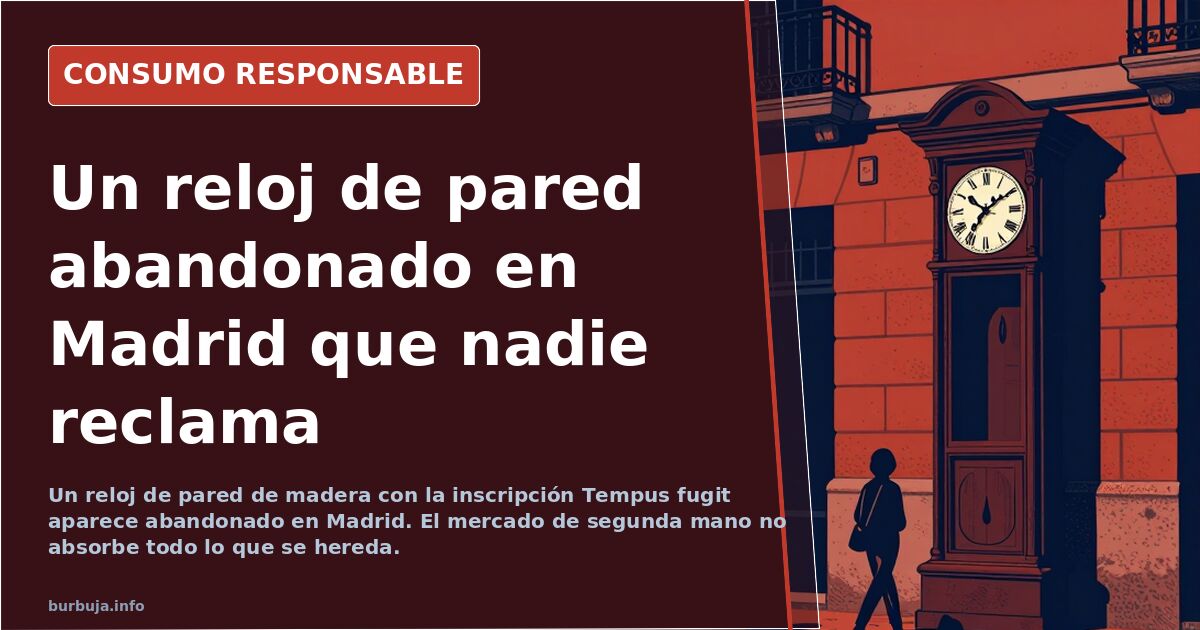
Wooden wall clock abandoned on a Madrid street
What is the value of an object nobody wants? A wooden wall clock, antiestéticaturing intricate moldings and the Latin inscription Tempus fugit on its face, appeared abandoned next to a dumpster on a Madrid street. The scene, captured in an image that circulated on social media, sparked a debate far beyond the object itself: what do we do with things we inherit, why do we throw them away, and who benefits from this abandonment? The short answer is that almost nobody wants that clock. The long answer reveals much about how consumption has changed in Spain.
The clock no one claims: market value vs. real value
According to those who examined it during the discussion, the item in question is not a cheap imitation. It has hand-made moldings, likely dyed cherry wood, and a spray-painted varnish that detracts from the original piece. Similar clocks appear on second-hand platforms for 250 euros and 80 euros, giving an idea of the range: it is neither a coveted antique nor trash. It is exactly the type of object stuck in limbo.
The lingering question is why someone leaves it on the street instead of selling it. The most repeated answer relates to opportunity cost: listing it, answering messages, meeting a stranger, packing it. For an individual, that process can take more time than the clock is worth. The price of the clock does not compensate for the hours of management. And that is where the problem begins.
Why are old furniture and clocks abandoned on the street?
The most widespread explanation is not negligence, but a mix of regret and pragmatism. Those who leave such an object next to the container usually do so because they don't want to throw it in the trash, but also don't want to carry the burden. It is a form of informal donation, without intermediaries or paperwork. The problem is that this donation does not always find a recipient.
The profile of abandoned objects has changed. They are no longer just broken furniture: they are wall clocks, silver-rimmed tableware, sewing machines built into custom furniture, living room wardrobes that cost a fortune and today do not fit in small apartments. The average Spanish home has reduced its surface area and changed its aesthetic, and this condemns many inherited objects to the elements.
Some argue that abandonment on the street is a form of functional ignorance: there is a municipal bulky waste collection service, with days assigned by neighborhood, and a call to the town hall is enough to have them taken away. Others respond that this is not always the case, that there are time slots when leaving furniture next to the trash is permitted, and that those who do so may be complying with the rules. The discussion, as almost always, depends on which neighborhood and which day.
The family as an economic unit: unwanted inheritances
The clock is just the tip of the iceberg. Underneath lies a deeper phenomenon: the transmission of domestic heritage between generations that no longer share the same lifestyle. A wall clock in the hallway made sense in a house from the fifties, with a spacious living room and visits announced by chimes. In a current apartment, with modular furniture and limited space, that object is a nuisance.
The economic calculation is relentless. A custom-made piece of furniture that cost a fortune decades ago may be worth nothing today, because the second-hand market is saturated with similar pieces and potential buyers have less space and less attachment. What is inherited is not always wanted, and what is wanted does not always fit.
The discussion shifted toward the role of the family as an economic and emotional unit. Some defend that the traditional family, with its interchangeable roles and horizontal and vertical cohesion, remains the most powerful engine of society. Others respond that this cohesion is not measured by how many pieces of furniture you inherit, but by whether you know the story of who left them to you. Meanwhile, the clock remains on the street.
The second-hand market does not absorb everything inherited
The experience of those who have cleared out inherited apartments is consistent: antique dealers do not take everything. A professional might reject pieces they like because they lack space or already have other similar unsold items. The result is that the heir is left with objects they cannot sell, cannot give away, and cannot throw away without remorse.
In buildings without elevators, the problem multiplies. Taking a wardrobe or sofa down the stairs costs more than giving it away. That is why many choose to offer it for free to neighbors before resorting to moving companies. The cost of getting rid of a piece of furniture can exceed its market value. It is a paradox that explains why there are so many objects abandoned next to containers.
The most cited solution is selling on digital platforms, but it does not always work. Some report having sold part of an inheritance after months of effort, while others simply give up because the effort does not pay off. The recurring conclusion is that the second-hand market has a limit: it does not absorb everything inherited, especially when the object is bulky, heavy, or simply out of fashion.
Minimalism as norm and abandonment as symptom
The dominant aesthetic has changed. Minimalism, modular furniture, and neutral finishes have replaced sideboards, display cabinets, and wall clocks. It is not just a matter of taste: it is a matter of space and time. Dusting a piece of furniture with moldings requires time that nobody has.
The abandonment of objects like this clock is not a symptom of end times, but of a transition. What was once a status symbol is now a logistical problem. And the street has become the intermediate dump between the emptying house and the recycling point that is not always available.
The final irony is that the clock tells the time. Tempus fugit, says the face. Time flies, and with it go the objects that were once important. What remains is an uncomfortable question: if nobody wants what we leave behind, why do we accumulate?
What is the value of an object nobody wants? A wooden wall clock, antiestéticaturing intricate moldings and the Latin inscription Tempus fugit on its face, appeared abandoned next to a dumpster on a Madrid street. The scene, captured in an image that circulated on social media, sparked a debate far beyond the object itself: what do we do with things we inherit, why do we throw them away, and who benefits from this abandonment? The short answer is that almost nobody wants that clock. The long answer reveals much about how consumption has changed in Spain.
The clock no one claims: market value vs. real value
According to those who examined it during the discussion, the item in question is not a cheap imitation. It has hand-made moldings, likely dyed cherry wood, and a spray-painted varnish that detracts from the original piece. Similar clocks appear on second-hand platforms for 250 euros and 80 euros, giving an idea of the range: it is neither a coveted antique nor trash. It is exactly the type of object stuck in limbo.
The lingering question is why someone leaves it on the street instead of selling it. The most repeated answer relates to opportunity cost: listing it, answering messages, meeting a stranger, packing it. For an individual, that process can take more time than the clock is worth. The price of the clock does not compensate for the hours of management. And that is where the problem begins.
Why are old furniture and clocks abandoned on the street?
The most widespread explanation is not negligence, but a mix of regret and pragmatism. Those who leave such an object next to the container usually do so because they don't want to throw it in the trash, but also don't want to carry the burden. It is a form of informal donation, without intermediaries or paperwork. The problem is that this donation does not always find a recipient.
The profile of abandoned objects has changed. They are no longer just broken furniture: they are wall clocks, silver-rimmed tableware, sewing machines built into custom furniture, living room wardrobes that cost a fortune and today do not fit in small apartments. The average Spanish home has reduced its surface area and changed its aesthetic, and this condemns many inherited objects to the elements.
Some argue that abandonment on the street is a form of functional ignorance: there is a municipal bulky waste collection service, with days assigned by neighborhood, and a call to the town hall is enough to have them taken away. Others respond that this is not always the case, that there are time slots when leaving furniture next to the trash is permitted, and that those who do so may be complying with the rules. The discussion, as almost always, depends on which neighborhood and which day.
The family as an economic unit: unwanted inheritances
The clock is just the tip of the iceberg. Underneath lies a deeper phenomenon: the transmission of domestic heritage between generations that no longer share the same lifestyle. A wall clock in the hallway made sense in a house from the fifties, with a spacious living room and visits announced by chimes. In a current apartment, with modular furniture and limited space, that object is a nuisance.
The economic calculation is relentless. A custom-made piece of furniture that cost a fortune decades ago may be worth nothing today, because the second-hand market is saturated with similar pieces and potential buyers have less space and less attachment. What is inherited is not always wanted, and what is wanted does not always fit.
The discussion shifted toward the role of the family as an economic and emotional unit. Some defend that the traditional family, with its interchangeable roles and horizontal and vertical cohesion, remains the most powerful engine of society. Others respond that this cohesion is not measured by how many pieces of furniture you inherit, but by whether you know the story of who left them to you. Meanwhile, the clock remains on the street.
The second-hand market does not absorb everything inherited
The experience of those who have cleared out inherited apartments is consistent: antique dealers do not take everything. A professional might reject pieces they like because they lack space or already have other similar unsold items. The result is that the heir is left with objects they cannot sell, cannot give away, and cannot throw away without remorse.
In buildings without elevators, the problem multiplies. Taking a wardrobe or sofa down the stairs costs more than giving it away. That is why many choose to offer it for free to neighbors before resorting to moving companies. The cost of getting rid of a piece of furniture can exceed its market value. It is a paradox that explains why there are so many objects abandoned next to containers.
The most cited solution is selling on digital platforms, but it does not always work. Some report having sold part of an inheritance after months of effort, while others simply give up because the effort does not pay off. The recurring conclusion is that the second-hand market has a limit: it does not absorb everything inherited, especially when the object is bulky, heavy, or simply out of fashion.
Minimalism as norm and abandonment as symptom
The dominant aesthetic has changed. Minimalism, modular furniture, and neutral finishes have replaced sideboards, display cabinets, and wall clocks. It is not just a matter of taste: it is a matter of space and time. Dusting a piece of furniture with moldings requires time that nobody has.
The abandonment of objects like this clock is not a symptom of end times, but of a transition. What was once a status symbol is now a logistical problem. And the street has become the intermediate dump between the emptying house and the recycling point that is not always available.
The final irony is that the clock tells the time. Tempus fugit, says the face. Time flies, and with it go the objects that were once important. What remains is an uncomfortable question: if nobody wants what we leave behind, why do we accumulate?
Summary of a discussion on Burbuja.info - Foro de economía, actualidad y política., translated from Spanish and reviewed before publication. Read the full discussion (141 replies).
More summaries
-
Madrid Now Makes the Best Pan Tumaca, Not Catalonia
A headline claiming Madrid makes the best pan tumaca sparks a debate: Murcian origins, hanging tomatoes, and rage bait for clicks.
-
The real cost of cheap paint from Leroy Merlin
The real cost of using cheap paint from big-box stores. We analyze the dilemma between immediate savings and the durability of the finish.
-
Complaining about Spanish Primary Care: Rights and Limits
Patients cannot demand specific tests or criminally prosecute doctors for not referring them. The real options are filing complaints, changing physicians, or paying privately.
-
Cecotec's €170 Oven Sparks Debate Among Buyers
A €170 Cecotec oven divides opinion: supporters praise its value, while critics cite poor service and inconsistent quality.
-
Technics, Thorens and Rega Top Turntable Picks
Technics, Thorens and Rega dominate turntable discussions, alongside debates on vinyl vs. CD quality and maintenance needs.
-
Citroën Dyane: 29 HP, 700 kg, No ECU
The Citroën Dyane 6-400 weighed 700 kg and produced 29 HP. Lacking ECUs or airbags, it still has defenders against modern cars.