
A single civil servant: the clash of expectations between sexes
A single civil servant criticizes the men around her and sparks a debate on salaries, hypergamy, and the dating market
English · Original discussion in Spanish · Published
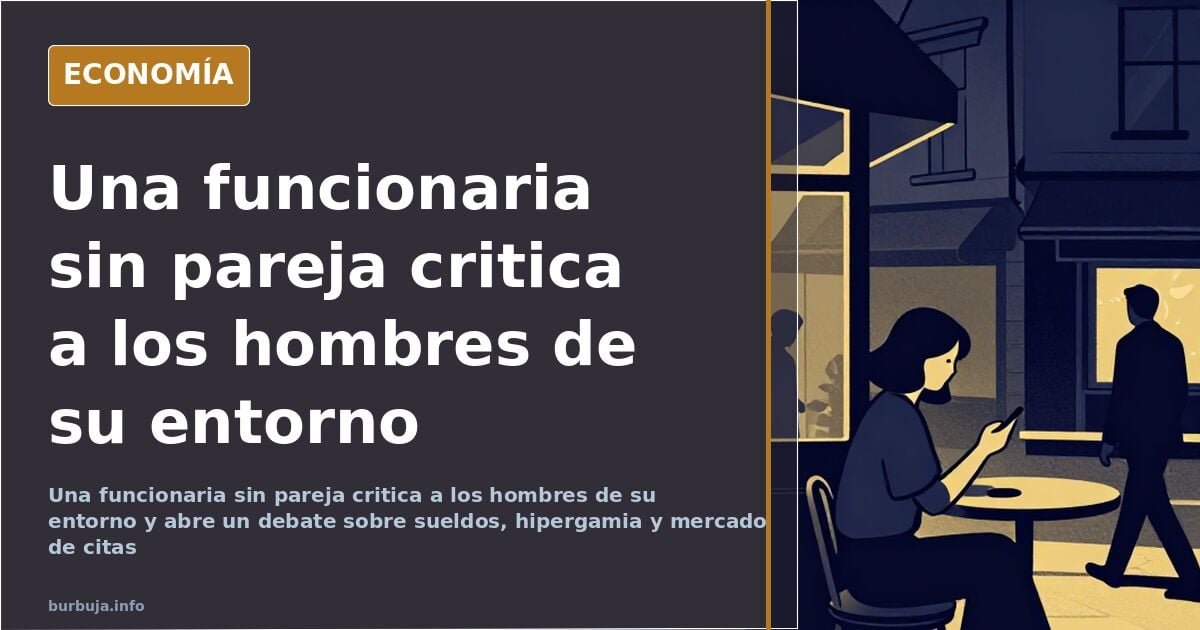
The single civil servant who blames men
A civil servant takes stock of her closest circle: of all her friends, only one has a partner, and that one is thinking of leaving him. The rest aren't doing much better. What starts as a personal venting ends up as a verdict: the men around her are, in her view, "idiots with no future." The charges she files are specific: profiles peine on Tinder in secret, contacts added on Instagram, hobbies reduced to video games and the gym, and weekend plans that involve a hotel by the hour going Dutch.
The post racked up numerous responses. And there it stops being a domestic anecdote to become an X-ray of a broader malaise, with money, public employment, and the dating market as a backdrop.
What the initial message raises: salaries, status, and expectations
The starting text is not an abstract manifesto. It is a claim with numbers. The author identifies herself as a civil servant and stresses that her group of friends are too, marking distance from those who don't work. When they respond by appealing to the wallet, she sets her own threshold: she asks for a man who earns as much as she does and sets the floor at 1,400 euros per month. In the conversation, a figure of 1,700 euros also appears, attributed by a commenter to the author's income and received on the other side with disdain instead of arguments.
That detail—salary as a selection criterion and, at the same time, as a weapon—orders much of the exchange. The sentimental complaint quickly translates into budgetary language: who contributes, who maintains, and who benefits.
The hypergamy hypothesis: looking above one's own level
One of the most repeated lines of analysis holds that the mismatch is not sarracena but market-based. The thesis: women are hypergamous by instinct and systematically aspire to a partner of higher status than themselves. The problem, according to this reasoning, comes when their educational and salary level equals that of men: if the bar remains high, the pool of candidates who exceed it narrows. The conclusion is uncomfortable for both sides, because it turns an emotional complaint into a matter of supply and demand.
Not everyone buys the framework. Some respond that the theory serves to justify anything and that, deep down, there are only people choosing badly and repeating the pattern. Others point to something simpler: that the description portrays a specific type of man and not all of them.
The counterattack: infrastructure and the tax bill
The majority response did not engage with the substance. It went on the attack. The infrastructure argument appears: that 98.76% of the world's infrastructure is built by men and that without that there would be no public employment to pay for. It is a figure without a source, launched as a verdict, and it works as a summary of a widespread idea: that the state acts as an imposed support and that those who live off it benefit from money they do not generate.
The fiscal reasoning has its elaborate version. If high-income taxpayers stopped financing public spending, some argue, the system's accounts would wobble and many of those orderly lives would break. It is another way of saying that the economic independence that is claimed rests, in part, on transfers. Debatable, but it dominates the second half of the exchange.
The dating market: apps, asymmetry, and supply
Dating apps appear both as setting and as evidence. For some, they are the mechanism that concentrates attention on a few profiles and leaves the rest out of the game. For others, they are the window where it is verified that the complainer doesn't find anyone either. The discussion drifts toward infidelity—with some defending that the proportion is 50-50 between sens—and toward comparison with couples from other countries, proposed as a less demanding alternative.
Here the exchange loses the economic thread and enters personal territory. Legitimate complaints mix with disqualifications, and the conversation becomes more noisy than informative. It is the point where it stops contributing data and starts repeating itself.
A closing without a single official figure
At the end of the exchange, the balance is striking. Not a single official figure on salaries, rental prices, or birth rates appears to support the diagnosis. Only two opposing incomes—1,400 and 1,700 euros—and a 98.76% without a source. Whether the problem is market, expectations, or simply bad mood, no one managed to close it.
A civil servant takes stock of her closest circle: of all her friends, only one has a partner, and that one is thinking of leaving him. The rest aren't doing much better. What starts as a personal venting ends up as a verdict: the men around her are, in her view, "idiots with no future." The charges she files are specific: profiles peine on Tinder in secret, contacts added on Instagram, hobbies reduced to video games and the gym, and weekend plans that involve a hotel by the hour going Dutch.
The post racked up numerous responses. And there it stops being a domestic anecdote to become an X-ray of a broader malaise, with money, public employment, and the dating market as a backdrop.
What the initial message raises: salaries, status, and expectations
The starting text is not an abstract manifesto. It is a claim with numbers. The author identifies herself as a civil servant and stresses that her group of friends are too, marking distance from those who don't work. When they respond by appealing to the wallet, she sets her own threshold: she asks for a man who earns as much as she does and sets the floor at 1,400 euros per month. In the conversation, a figure of 1,700 euros also appears, attributed by a commenter to the author's income and received on the other side with disdain instead of arguments.
That detail—salary as a selection criterion and, at the same time, as a weapon—orders much of the exchange. The sentimental complaint quickly translates into budgetary language: who contributes, who maintains, and who benefits.
The hypergamy hypothesis: looking above one's own level
One of the most repeated lines of analysis holds that the mismatch is not sarracena but market-based. The thesis: women are hypergamous by instinct and systematically aspire to a partner of higher status than themselves. The problem, according to this reasoning, comes when their educational and salary level equals that of men: if the bar remains high, the pool of candidates who exceed it narrows. The conclusion is uncomfortable for both sides, because it turns an emotional complaint into a matter of supply and demand.
Not everyone buys the framework. Some respond that the theory serves to justify anything and that, deep down, there are only people choosing badly and repeating the pattern. Others point to something simpler: that the description portrays a specific type of man and not all of them.
The counterattack: infrastructure and the tax bill
The majority response did not engage with the substance. It went on the attack. The infrastructure argument appears: that 98.76% of the world's infrastructure is built by men and that without that there would be no public employment to pay for. It is a figure without a source, launched as a verdict, and it works as a summary of a widespread idea: that the state acts as an imposed support and that those who live off it benefit from money they do not generate.
The fiscal reasoning has its elaborate version. If high-income taxpayers stopped financing public spending, some argue, the system's accounts would wobble and many of those orderly lives would break. It is another way of saying that the economic independence that is claimed rests, in part, on transfers. Debatable, but it dominates the second half of the exchange.
The dating market: apps, asymmetry, and supply
Dating apps appear both as setting and as evidence. For some, they are the mechanism that concentrates attention on a few profiles and leaves the rest out of the game. For others, they are the window where it is verified that the complainer doesn't find anyone either. The discussion drifts toward infidelity—with some defending that the proportion is 50-50 between sens—and toward comparison with couples from other countries, proposed as a less demanding alternative.
Here the exchange loses the economic thread and enters personal territory. Legitimate complaints mix with disqualifications, and the conversation becomes more noisy than informative. It is the point where it stops contributing data and starts repeating itself.
A closing without a single official figure
At the end of the exchange, the balance is striking. Not a single official figure on salaries, rental prices, or birth rates appears to support the diagnosis. Only two opposing incomes—1,400 and 1,700 euros—and a 98.76% without a source. Whether the problem is market, expectations, or simply bad mood, no one managed to close it.
Also available in: Deutsch
Summary of a discussion on Burbuja.info - Foro de economía, actualidad y política., translated from Spanish and reviewed before publication. Read the full discussion (437 replies).
More summaries
-
Women on Tinder: too many men, constant disappointment and ghosting
Economic analysis of the Tinder dating market: how male oversupply, ghosting and mismatched expectations fuel female frustration.
-
Bald men rejected: Spain's dating market row
A divorced woman in her 40s rejects bald men, sparking debate in Spain, the world's most bald country.
-
Teen arrested for killing plastic surgeon in Marbella
An 18-year-old suspect, allegedly a hitman, was arrested for shooting dead plastic surgeon Alexander Aslani at his Marbella clinic. The motive remains unconfirmed.
-
Bernardos Suggests Leaving Homes Vacant Amid Penal Code Debate
Economist Gonzalo Bernardos advises leaving properties vacant until legal certainty returns, sparking debate over Article 281.1 of the Spanish Penal Code.
-
Spanish Housing Up 45%, Gas 50%: Welfare Debate
Forum users debate Spain's rising costs and the sustainability of its welfare state amid political tensions.
-
Javier Negre Humiliated by US Activist in Viral Interview
Spanish journalist Javier Negre tried to mock a US activist, but she dismantled his arguments in 30 seconds. The video he posted went viral.