
A Mexican driving licence with no test required: one forum user's account
A forum user describes getting a permanent international licence in Mexico City in 2005 with just his voter ID and a fee. The thread turns into a debate about…
English · Original discussion in Spanish · Published
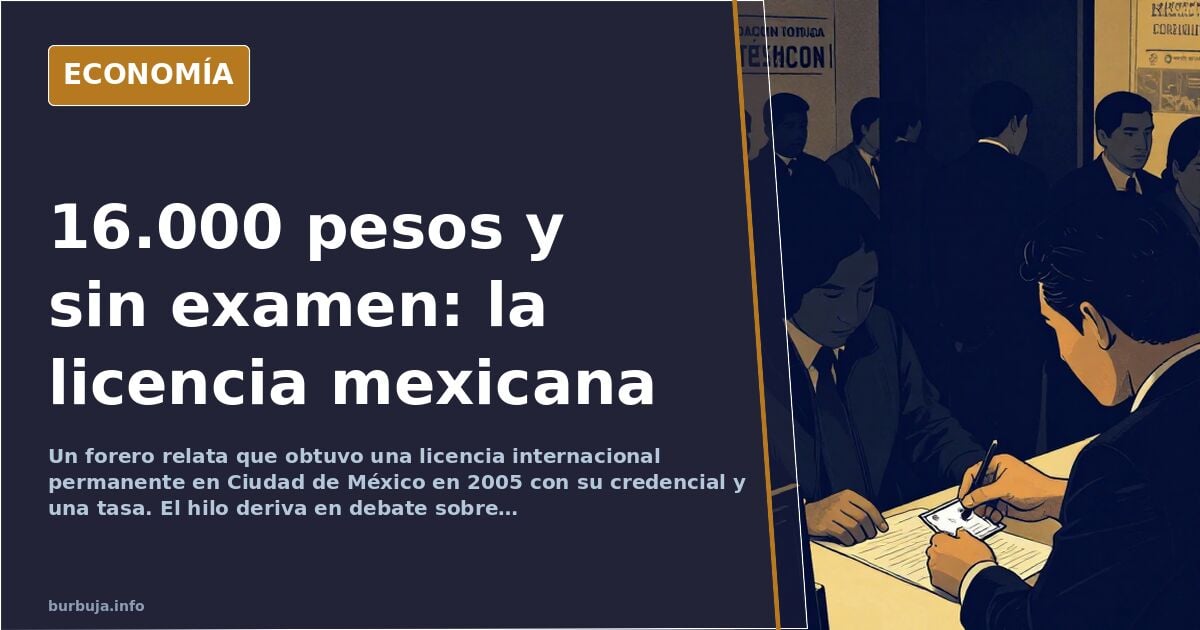
Forum user recounts that Mexico issues driving licences without any test in exchange for a fee
Can you get a licence to drive any vehicle, including tanker trucks and trailers carrying hazardous loads, without proving you know how to handle one? According to one forum user's account, in Mexico you can. Getting a permanent international licence at the traffic office in Agrícola Oriental, Mexico City, on 2 June 2005 was, by his account, settled with a voter ID card, a photograph and payment of a fee of 16,000 pesos —"16,000 and a bit more pesos", as the story goes. Not a single theory or practical test. The licence was issued in fifteen minutes.
The case is no anomaly, according to the same user. The discussion drifted towards an issue with economic and safety consequences: how easily driving licences can be obtained in several Latin American countries and the subsequent exchange of those documents in Spain. Another user summarises the procedure he went through in Veracruz: passport, proof of address —a utility bill that wasn't even in his name—, an eyesight test, a photo and "here you go, ma'am, here it is". Checking whether he could actually drive? "That's for another day."
How much does a permanent Mexican licence cost and what does it allow?
The cost mentioned in the account is 16,000 pesos, far above what another user remembers paying for a permanent licence in the past: around 670 pesos. The difference is attributed to the document's international status. That licence, according to the account, authorises driving "any wheeled vehicle" and carrying any cargo, including fuel tankers and trailers with radioactive waste.
The permanence of the licence comes with a caveat: it remains valid as long as it isn't lost or confiscated by a traffic officer, which would require paying for a new one. The document doesn't exempt drivers from carrying cash to pay fines on the spot, on pain of having the vehicle impounded.
Exchanging foreign licences in Spain
The most contentious point is what happens when those licences reach Spain. One user claims that the car licence and the theory test are exchanged even when the holder doesn't understand traffic signs, and that courses, driving lessons and exam fees such as the CAP (a professional driver's certificate) are then subsidised for migrants. He adds that Spain's traffic authority (DGT) examiners are under pressure to pass candidates, and yet many still drop out.
Another user takes it to the extreme: he claims that in Spain there are professional drivers going the wrong way because they don't understand a round red sign with a horizontal white bar. It's a claim not backed by data, but it illustrates the tone of the exchange.
Road accidents and the effect on transport
The economic argument appears when the ease of getting licences is linked to road accidents. One user claims that in Mexico the accident rate is "dreadful" and that driving there means "surviving anarchy". He argues that in the United States, until 2011, many drivers with Mexican licences worked in freight transport, driving down costs, until insurers began raising premiums for truckers without a US licence. The string of school bus accidents, according to this version, was the trigger for stop hiring them.
His conclusion is that the blame lies with local hauliers, who failed to defend their industry. If they had called an indefinite general strike when drivers with licences "not worth the plastic they're printed on" started joining the workforce, he argues, the situation would have changed.
The precedent of the nurse with a fraudulent licence
The comparison with the case of a nurse who practised in Florida using another person's licence number serves to draw a distinction. According to the account, the nurse had her university degree, failed her first state exam, fraudulently used another woman's licence number —someone with the same maiden name— and was arrested on seven counts of negligence. The distinction being stressed is that there it was forgery, whereas the Mexican licence is genuine: it is legally issued in exchange for a fee.
How you drive when the law of the jungle comes first
The account of driving in Mexico describes an informal hierarchy: truck and trailer ahead of the bus, the bus ahead of the van, then the car, the motorbike and the bicycle. The basic rule is "squeeze in wherever you can, as fast as you can", assuming everyone else will do the same. It's anarchy limited only by the survival instinct.
Some sum it up in one phrase: "Mexico, so far from God, so close to the United States." And others point out that the system doesn't test applicants because it never used to either —instead, you paid a bribe to skip the mandatory procedure; when it was eliminated, the fee was raised and the bribery ended, at the cost of anyone now being able to drive without knowing how.
In the end, the permanent licence lasts as long as the plastic does. Or as long as it takes an officer to ask for it so you have to pay for another one.
Also available in: Deutsch
Summary of a discussion on Burbuja.info - Foro de economía, actualidad y política., translated from Spanish and reviewed before publication. Read the full discussion (59 replies).
More summaries
-
Sánchez Courted 'Vulture Funds' in 2018, Now Calls for Solidarity
In 2018, Pedro Sánchez encouraged vulture funds to invest in Spain. Now, his government urges landlords to show solidarity and lower rents.
-
Riots in Milan's Duomo: looting and carabinieri van cornered
Riots broke out around Milan's Duomo: looting, a carabinieri van surrounded and beaten, and shops wrecked. The economic and political cost of a day of chaos.
-
When financial stress turns into suicidal thoughts
Suicidal ideation in financial communities: when cynicism and indifference deepen the crisis of someone reaching out for help.
-
Ceuta in crisis as 1,500 migrants swim in from Morocco
The arrival of 1,500 migrants by sea in just days exceeds the total for the previous seven months and reopens the debate on summary returns following a Spanish Supreme Court ruling.
-
Ceuta fires: first arrest is a local resident
More than three fires broke out in minutes in Ceuta, Spain, with the Tarajal area evacuated and 42 shacks burned down. The first person arrested is a local resident.
-
Signing for Saudi Arabia: erasing your girlfriend from Instagram
A Spanish footballer deletes photos with her girlfriend and daughter after joining Al-Qadsiah. The dilemma between Saudi money and personal identity.