
A €5.80 croissant and a coffee: the Madrid bill
A cream croissant at €5.80 and an afternoon snack for two costing over €16: the receipt that shows what it really costs to live in Madrid, Spain
English · Original discussion in Spanish · Published
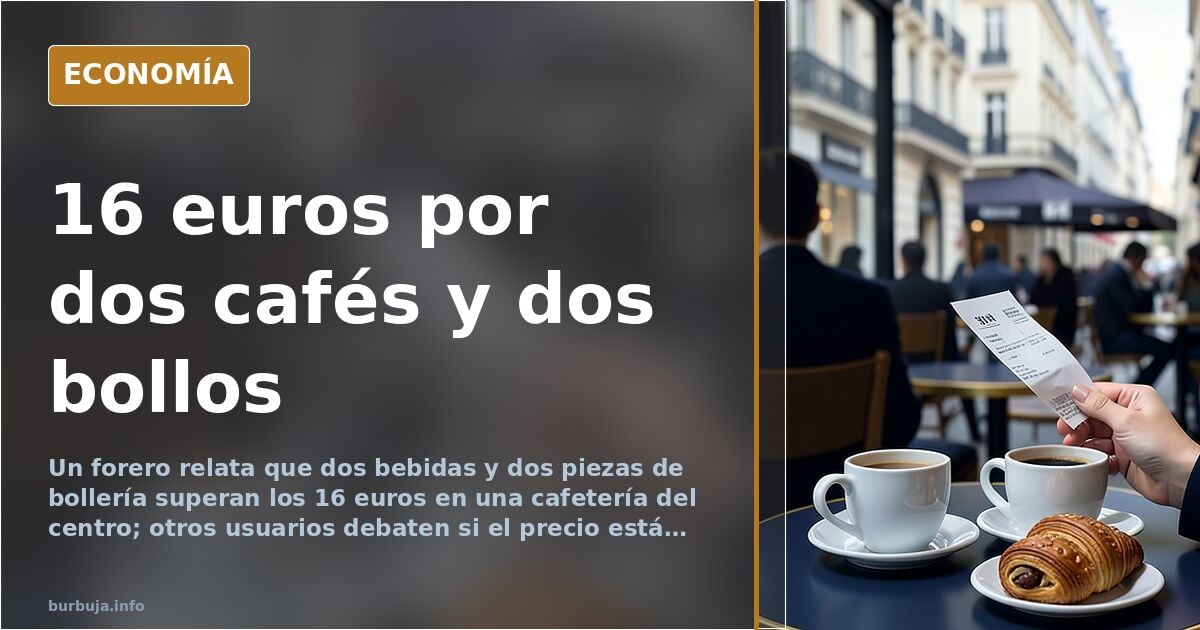
An afternoon snack for two costs over 16 euros in Madrid
A cream croissant at 5.80 euros and a coffee that in the city centre already costs two. Add them up and it doesn't add up to Madrid: it adds up to something else, because the price of a coffee stopped being measured in coffee. The bill for an afternoon snack for two topping 16 euros —two drinks and two pastries, no buffet, no eggs or bacon— works as the most honest thermometer of what it costs to live in the Spanish capital.
The establishment that a forum user identifies as La Duquesita, in Madrid, has, according to the thread, Oriol Balaguer as its owner: a disciple of Ferrán Adrià, seven years at El Bulli, Best Spanish Artisan Pastry Chef in 1993 at just 21, and Best Pastry Chef in Spain in 2008. With that résumé, the shop window isn't selling flour. It's selling a signature.
What a 16-euro afternoon snack in Madrid includes
The breakdown matters more than the total. No brunch with eggs or bacon: two drinks and two pastries, and the bill comes to over 16 euros. A cream croissant at 5.80 euros on its own explains the rest of the ticket. That's where the fine calculation lies, item by item, worth checking before considering a move to the area.
The distance between that bill and a neighbourhood bar isn't about the product: it's about the postal address.
Coffee as a thermometer: from 60 cents to 2 euros in the centre
Few indicators are as democratic as the price of a coffee: it's consumed daily, paid in cash and can't be mortgaged. According to a calculation circulating in the thread, in the year 2000 a coffee in the city centre cost 60 cents; today, two euros. Double in 26 years, right when wages, always according to that same forum user, haven't trinc the same path.
At the counter the figures drop. 1.40 euros on Calle Cerón, 1.60 in a bar in Jaén, with a churros breakfast for 3.10. Applying the rule of three with category and location, one forum user concludes that the prices of the place on the bill are normal for its segment, with the caveat that they lean towards the high side.
Paying for the scenery: the premium as a filter
Here comes the uncomfortable argument. The claim is that the premium doesn't buy better pastries, but a quiet table: a kind of filter that guarantees certain types of customer won't be sitting next to you. The reasoning works in reverse too —someone having breakfast at an eight-euro place ensures company capable of spending eight euros on breakfast, according to another forum user— and some add a consequence: lowering prices doesn't grow the business, it degrades it.
Location closes the loop. Trendy shops, shopping and a clientele that doesn't walk to a neighbourhood bar. What you're paying for isn't the coffee: it's not having to share the counter.
From the Ritz in Paris to the 25-peseta palmier
The comparison abroad offers no comfort either. Some would cross the Pyrenees head first for the Sunday brunch at the Ritz in Paris: 250 euros per person. Facing that, nostalgia measured in pesetas: a palmier bigger than a child's face cost 25 pesetas fresh from the oven; today, a thousand. And one more side complaint: in Spain, elegant cafés like those found north of the Pyrenees are scarce — or extremely rare.
Housing and wages: the maths that doesn't add up
The bill only completes the circle. It is argued that raising the SMI (Spain's statutory minimum wage) by 60% without moving higher salaries —up 10 or 15% in eight years— levels down and impoverishes those who don't earn it. And rent: where 500 or 600 euros used to be paid for a two- or three-bedroom flat, the benchmark has come unstuck. "In a free-market economy prices are free," another forum user sums up. So is getting up from the table.
One reasonable doubt remains: if the 16-euro bill is the sign that Madrid has become a club with an entry fee, how many of those planning to move there would still do it? The bill is on the table and nobody has asked for it yet.
Also available in: Deutsch
Summary of a discussion on Burbuja.info - Foro de economía, actualidad y política., translated from Spanish and reviewed before publication. Read the full discussion (48 replies).
More summaries
-
Spain's olive groves and the €68 daily wage: a forum debate
A forum thread debates why Spain's olive harvest cannot find seasonal workers at a daily wage of €68, amid criticism of mechanisation, the PER subsidy scheme and immigration.
-
School in Ceuta, Spain opens the year with a Thriller dance routine
A school in Ceuta, Spain welcomes students with a Thriller-inspired dance routine; the forum debates how much class time such celebrations take up.
-
Urda crash: 29 km without signals and an 'ordinary running' order
A technical analysis circulated on a forum points to 29 km without signals, an obsolete LZB and an 'ordinary running' order that regulations reserve for clear track.
-
Color screen over Monterrey: the test that debunks the Matrix
A color screen over Monterrey sparked simulation theories. The real explanation is a test pattern from an LED panel being tested.
-
LZB debate: "It fails half the days," says a forum user
A forum user claims the LZB fails half the days and another puts it at 170 outages a year; the minister reportedly called it routine, according to the thread. Staffing is at…
-
Spain appears in viral list of fatal train crashes since 2020
A list circulating on social media places Spain alongside Pakistan or Tanzania in fatal train accidents since 2020. The minister says the LZB system has failed 170…