
91-Year-Old Woman Faces 4 Years of Suspended Evictions Amid IMV Dispute
A 91-year-old Spanish woman supported squatters for four years while they received 1,309.25 euros monthly in Minimum Vital Income, exceeding her pension, according to THE OBJECTIVE.
English · Original discussion in Spanish · Published
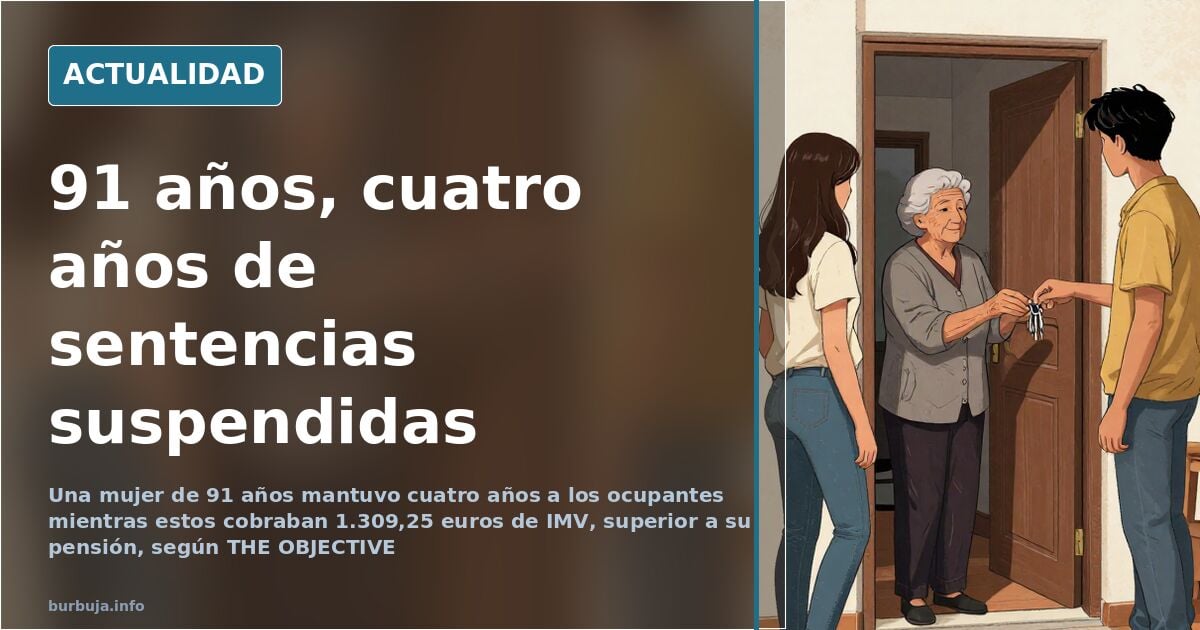
91-year-old woman, 4 years of suspended eviction orders, and 1,309 euros monthly IMV for squatters
A 91-year-old woman in Spain saw eviction orders against her property suspended for four years, as squatters received the Minimum Vital Income (IMV), according to documents published by THE OBJECTIVE. The occupants were paid 1,309.25 euros monthly via the IMV, verified by official Social Security certificates, which exceeded the owner's pension. Eviction rulings were repeatedly suspended citing alleged vulnerability. Four years. At 91. The owner supported the occupants, according to the case details.
IMV received by squatters exceeded owner's pension
The striking detail is not the occupation itself, but the economic asymmetry. The 91-year-old owner, in poor health, effectively supported those who took her home. They received 1,309.25 euros monthly from the IMV; she received a lower pension. The vulnerability claimed in court to halt evictions was backed by a public salary many retirees desire. Some argue the social protection system is captured by those who profit from it. This is a specific case, not a generalization, but the combination of declared vulnerability, public income, and suspended sentences erodes trust in the rule of law.
Four years of suspended sentences due to vulnerability
The timeline is key. There was no single favorable ruling, but successive eviction orders suspended one after another. The argument: the squatters' alleged vulnerability. The result: four years of legally tolerated occupation while the owner retained title. This mechanism prevents evictions for families with minors and no resources. Yet, when vulnerability is proven via public benefits and the property belongs to a nonagenarian, protection becomes inverted privilege. The question remains: how many such cases never reach court because owners lack the age or patience for four years of proceedings?
What happens when squatters earn more than the owner
The core debate concerns incentives. If occupying a home allows receiving the IMV while evictions are suspended, the system rewards occupation with public funds. This is not a conspiracy theory: it is arithmetic. 1,309.25 euros in benefits versus a retirement pension that, in this case, was lower. The consequence is that the weaker party—the elderly woman—bears all risk, while the stronger party—the squatters—receives protection. The case also exposes a design flaw in the IMV: benefits are not conditional on not committing crimes, as some analysts claim. Receiving the IMV and occupying another's home are not currently incompatible. This is the gap the case exposes.
The closure that never comes
The woman saw eviction orders suspended for four years. At 91. And with the unmeasurable feeling that the system meant to protect her treated her as an administrative obstacle. The unanswered question in the file is how many more times this script must repeat before someone decides to change it.
A 91-year-old woman in Spain saw eviction orders against her property suspended for four years, as squatters received the Minimum Vital Income (IMV), according to documents published by THE OBJECTIVE. The occupants were paid 1,309.25 euros monthly via the IMV, verified by official Social Security certificates, which exceeded the owner's pension. Eviction rulings were repeatedly suspended citing alleged vulnerability. Four years. At 91. The owner supported the occupants, according to the case details.
IMV received by squatters exceeded owner's pension
The striking detail is not the occupation itself, but the economic asymmetry. The 91-year-old owner, in poor health, effectively supported those who took her home. They received 1,309.25 euros monthly from the IMV; she received a lower pension. The vulnerability claimed in court to halt evictions was backed by a public salary many retirees desire. Some argue the social protection system is captured by those who profit from it. This is a specific case, not a generalization, but the combination of declared vulnerability, public income, and suspended sentences erodes trust in the rule of law.
Four years of suspended sentences due to vulnerability
The timeline is key. There was no single favorable ruling, but successive eviction orders suspended one after another. The argument: the squatters' alleged vulnerability. The result: four years of legally tolerated occupation while the owner retained title. This mechanism prevents evictions for families with minors and no resources. Yet, when vulnerability is proven via public benefits and the property belongs to a nonagenarian, protection becomes inverted privilege. The question remains: how many such cases never reach court because owners lack the age or patience for four years of proceedings?
What happens when squatters earn more than the owner
The core debate concerns incentives. If occupying a home allows receiving the IMV while evictions are suspended, the system rewards occupation with public funds. This is not a conspiracy theory: it is arithmetic. 1,309.25 euros in benefits versus a retirement pension that, in this case, was lower. The consequence is that the weaker party—the elderly woman—bears all risk, while the stronger party—the squatters—receives protection. The case also exposes a design flaw in the IMV: benefits are not conditional on not committing crimes, as some analysts claim. Receiving the IMV and occupying another's home are not currently incompatible. This is the gap the case exposes.
The closure that never comes
The woman saw eviction orders suspended for four years. At 91. And with the unmeasurable feeling that the system meant to protect her treated her as an administrative obstacle. The unanswered question in the file is how many more times this script must repeat before someone decides to change it.
Summary of a discussion on Burbuja.info - Foro de economía, actualidad y política., translated from Spanish and reviewed before publication. Read the full discussion (25 replies).
More summaries
-
Spain's 87-year-old eviction reopens the housing war
The eviction of an 87-year-old woman has reignited Spain's political battle over housing, exposing the clash between property rights and tenant protection.
-
Gomesende Wedding Descends into Brawl Over €40,000 in Gifts
A wedding in Gomesende turned into a family fight over €40,000 in gifts, according to the circulating account. The bride's origin became a focus of the dispute.
-
Ayuso: Madrid celebrates Hispanic Day with US as guest
Madrid's leader Isabel Díaz Ayuso marks Hispanic Day in Spain, highlighting the US as guest nation and asserting a shared cultural power.
-
The Ugliness Agenda: Architecture as a Control Tool
Analysis links Rockefeller network, MoMA and International Style to deliberate urban ugliness as a social control mechanism.
-
Omarchy creator condemns Swedish murder verdict
David Heinemeier Hansson calls the ruling in a Swedish immigrant's murder case 'insane' and warns of the perpetrator's release.
-
Peruvian candidate named Hitler Mussolini wins local election
Hitler Mussolini Simeon won the mayoral race in Peru's Queropalca district for the left-wing party Ahora Nación, sparking social media debate.