
86% of Spaniards Demand Stronger Climate Action
86% of surveyed Spaniards want stricter climate commitments, while only 16% in Russia support accelerating the energy transition.
English · Original discussion in Spanish · Published
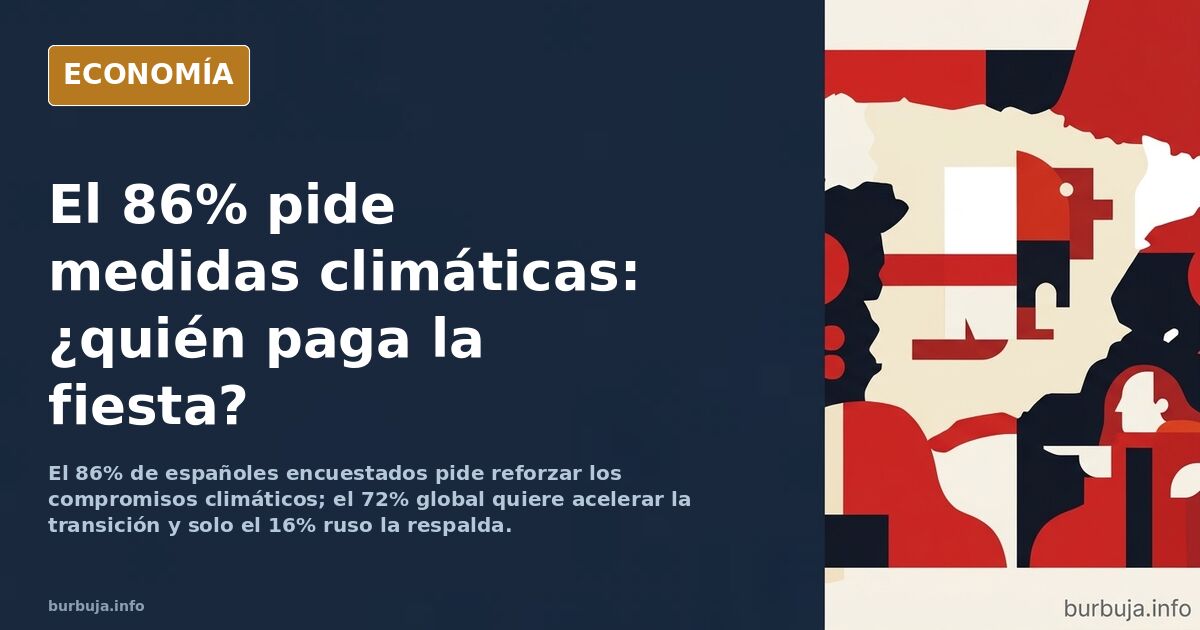
86% of Spaniards Call for Climate Measures
In Spain, 86 out of every 100 respondents demand tighter climate commitments. This figure rises to 88% in Mexico, drops to 83% in Argentina, and stands at 66% in the United States. A major survey by UNDP and Oxford University, involving 75,000 people across 77 countries, delivers a headline that sounds like a citizen mandate. Globally, 72% call for accelerating the shift from fossil fuels to renewables; only 7% believe no substitution is needed. In Spain, support for a rapid transition reaches 77%.
From Surveys to Tax Returns: Consensus Crumbles
The gap between what people declare in surveys and what they sign on tax returns is the real subject of study. Some argue that adding a voluntary box to the IRPF (Spanish income tax) would reveal how much of that 86% remains when commitment costs money. The proposal carries an ironic undertone: if support is so solid, revenue should skyrocket. No one has tested this yet.
The parallel with the pandemic lingers in the air. 86% of Spaniards accepted lockdowns and restrictions, recalls one message. That percentage measured antiestéticar, inertia, and social pressure, not ecological conviction. Applying the same logic to climate suggests that declared support in a phone survey does not predict concrete sacrifices.
Suspicion of the Method runs through nearly all rebuttals. The fact that UNDP and Oxford University conducted the survey does not immunize it: the same Oxford that proposes meat-free menus and car-free cities, mocks one message. Sample selection, fieldwork location, and question wording shape the results. If you ask "Should your country strengthen its commitments?", the socially acceptable answer is yes. If you ask "Are you willing to pay €200 more per year?", things change.
China, Russia, and the US: Those Who Ask for Nothing
The most uncomfortable data point concerns countries unwilling to move. In Russia, only 16% support a fast or very fast transition; in Iraq, it’s 43%. In the United States, 54%. These are the three largest fossil fuel producers setting the market’s real pace. That 75% of Saudis or 80% of Chinese want acceleration changes nothing: investment decisions in coal, oil, and gas happen in Moscow, Riyadh, and Houston, not in a survey.
Much analysis concludes that the Spanish 86% is not a mandate but a snapshot of desire. The same citizen demanding urgent measures gets angry when banned from driving a diesel car into central Madrid, complains about electricity prices, and books a flight to Tenerife in August. It isn’t hypocrisy: no one has put the full menu with prices on the table.
The Cost Missing from the Questionnaire
Banning oil paralyzes transport, spikes food prices, and makes medicines more expensive. This isn’t doomsday prediction: it’s the current supply chain. Proponents of rapid transition argue the cost of inaction is higher. Critics counter that those demanding measures will bear the cost of action, and the elite designing them won’t give up their Falcon jets or swimming pools.
The example of the embassy in Mauritania—pool filled daily, blamed on evaporation—circulates as proof that climate demands apply to everyone else. Not survey data, but it explains why the 86% sounds like wishful thinking to some and propaganda to others.
Ultimately, the unsettling figure isn’t Spain’s 86%. It’s Russia’s 16%. Until Moscow moves, the rest is just literature.
In Spain, 86 out of every 100 respondents demand tighter climate commitments. This figure rises to 88% in Mexico, drops to 83% in Argentina, and stands at 66% in the United States. A major survey by UNDP and Oxford University, involving 75,000 people across 77 countries, delivers a headline that sounds like a citizen mandate. Globally, 72% call for accelerating the shift from fossil fuels to renewables; only 7% believe no substitution is needed. In Spain, support for a rapid transition reaches 77%.
From Surveys to Tax Returns: Consensus Crumbles
The gap between what people declare in surveys and what they sign on tax returns is the real subject of study. Some argue that adding a voluntary box to the IRPF (Spanish income tax) would reveal how much of that 86% remains when commitment costs money. The proposal carries an ironic undertone: if support is so solid, revenue should skyrocket. No one has tested this yet.
The parallel with the pandemic lingers in the air. 86% of Spaniards accepted lockdowns and restrictions, recalls one message. That percentage measured antiestéticar, inertia, and social pressure, not ecological conviction. Applying the same logic to climate suggests that declared support in a phone survey does not predict concrete sacrifices.
Suspicion of the Method runs through nearly all rebuttals. The fact that UNDP and Oxford University conducted the survey does not immunize it: the same Oxford that proposes meat-free menus and car-free cities, mocks one message. Sample selection, fieldwork location, and question wording shape the results. If you ask "Should your country strengthen its commitments?", the socially acceptable answer is yes. If you ask "Are you willing to pay €200 more per year?", things change.
China, Russia, and the US: Those Who Ask for Nothing
The most uncomfortable data point concerns countries unwilling to move. In Russia, only 16% support a fast or very fast transition; in Iraq, it’s 43%. In the United States, 54%. These are the three largest fossil fuel producers setting the market’s real pace. That 75% of Saudis or 80% of Chinese want acceleration changes nothing: investment decisions in coal, oil, and gas happen in Moscow, Riyadh, and Houston, not in a survey.
Much analysis concludes that the Spanish 86% is not a mandate but a snapshot of desire. The same citizen demanding urgent measures gets angry when banned from driving a diesel car into central Madrid, complains about electricity prices, and books a flight to Tenerife in August. It isn’t hypocrisy: no one has put the full menu with prices on the table.
The Cost Missing from the Questionnaire
Banning oil paralyzes transport, spikes food prices, and makes medicines more expensive. This isn’t doomsday prediction: it’s the current supply chain. Proponents of rapid transition argue the cost of inaction is higher. Critics counter that those demanding measures will bear the cost of action, and the elite designing them won’t give up their Falcon jets or swimming pools.
The example of the embassy in Mauritania—pool filled daily, blamed on evaporation—circulates as proof that climate demands apply to everyone else. Not survey data, but it explains why the 86% sounds like wishful thinking to some and propaganda to others.
Ultimately, the unsettling figure isn’t Spain’s 86%. It’s Russia’s 16%. Until Moscow moves, the rest is just literature.
Also available in: Deutsch
Summary of a discussion on Burbuja.info - Foro de economía, actualidad y política., translated from Spanish and reviewed before publication. Read the full discussion (162 replies).
More summaries
-
China hikes tariffs to 125%, weaponizes yuan in trade war
China raises tariffs to 125% and devalues the yuan as a trade weapon. The debate: does it impoverish its population or shield its economy?
-
Putin: Combined Russia-UE GDP Would Exceed US, But Gas Costs Complicate Deal
Putin claims combined Russia-UE GDP surpasses US. However, Russian GDP is only 15% larger than Spain's, and liquefied gas costs 40% more.
-
Chinese AI Challenges Western Tech Dominance
Chinese AI challenges Western tech giants with powerful open-source models.
-
Alba Flores links Ceuta to neo-Nazi squads despite lack of evidence
Alba Flores compares Ceuta to a horror film and mentions neo-Nazi squads. Public records and figures do not support that narrative.
-
Germany announces mass deportations ahead of regional elections
Berlin touts stricter immigration measures, but details reveal mere procedural tweaks timed for the electoral calendar.
-
Louvre Evacuated in Paris Over Bomb Threat
A bomb threat forces the Louvre to evacuate, shifting debate toward false flags, social control, and the 2024 Games.