
60% of Spaniards Look Fit, but 80% Exercise Nothing
60% appear fit, yet 80% remain sedentary. Spain's fitness boom masks a widespread lack of physical activity.
English · Original discussion in Spanish · Published
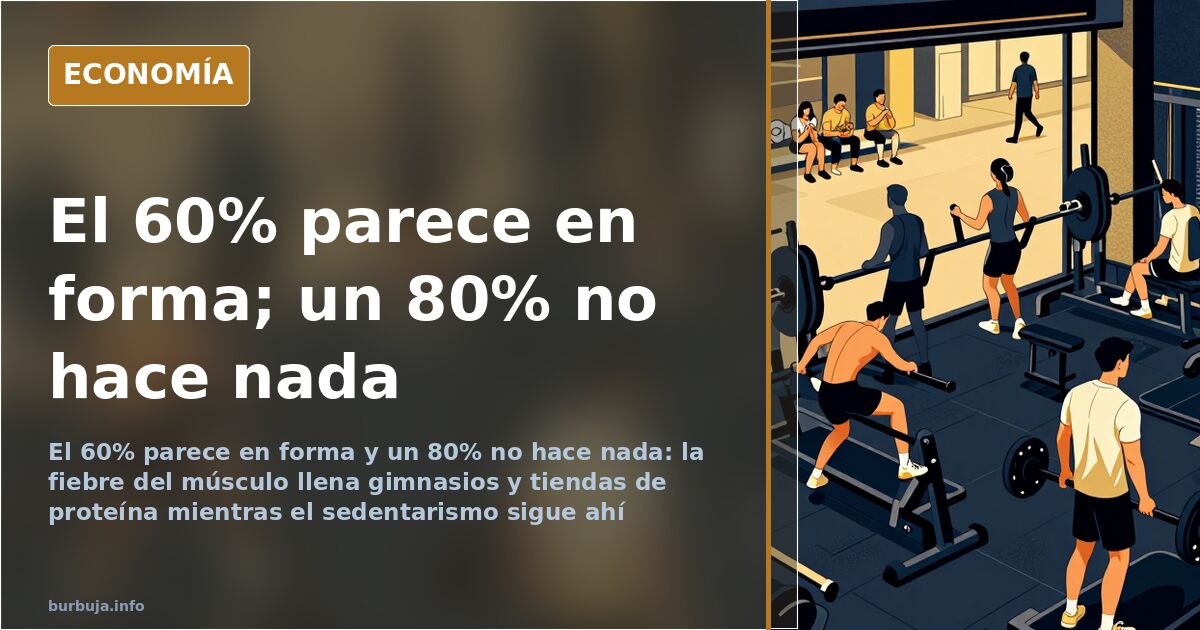
Spain Suspends Effort, Scores Excellent in Physical Education
Is people's fitness better than it was twenty years ago? This question has been circulating for over three years, with answers that do not match even in magnitude. The diagnosis opening the conversation is stark: 20 or 30 years ago, trained bodies were 5-10% of the population; now they seem to be 60%. And not just in the gym: sports clubs, 18-year-old kids, 40-year-old women with defined backs, people pushing themselves after ten hours of work.
What is striking, for the more sporty, is that the phenomenon no longer understands classes or ages. There are grandparents who go up the mountain with the same naturalness with which their peers smoked one cigarette after another. Running, rowing, lifting, or boxing has ceased to be the thing of four weirdos. Or at least, it has become very visible.
Why has the number of people training skyrocketed?
Because exercise has ceased to be a hobby and has become an aesthetic, health, and social obligation all at once. Three vectors are managed that feed back into each other.
The first is cultural: fifteen or twenty years of body worship, a gym in every neighborhood, and an industry that sells muscle with the same efficacy with which it used to sell tobacco. The second is medical. Increasingly, professionals prescribe sports for anxiety, insomnia, or depression, and this drags people without any athletic vocation to the gym: they train to not fall, not to show off.
The third is uncomfortable to say and is said anyway: that much of the most spectacular physiques are not explained only by weights and chicken breast. The reference to certain substances hovers over any conversation about big bodies, and not always as an accusation, but as an explanation.
The parallel economy of muscle
Muscle has become a market. Just stroll through any medium-sized city to come across places that are, in practice, supermarkets of protein tubs: oats, shakes, amino acids, pre-workouts. Twenty years ago, this trade was residual; today there are several per neighborhood.
The story sold by this business is that without supplements there are no results. The skeptical version is the opposite: tub protein builds nothing by itself, and what makes the difference is training and eating well for years. Between both positions floats a repeated warning: those who supplement seriously should get periodic blood tests, because nobody is measuring what happens inside.
There is even an isolated testimony of kidney problems after starting training and supplementing. A loose case proves nothing nor allows blaming a specific product, but it illustrates the noise surrounding a sector that bills with little control.
Is the gym enough to be fit?
No, if you heed the definition of the most demanding. The harshest criticism of the gym body maintains that visible hypertrophy does not equate to useful strength: they speak of inflated mass, abandoned mobility and proprioception, people who cannot withstand a real physical test. Their proof is that these bodies do not appear in elite units, in gymnastics, nor in tough exams.
At the opposite extreme, another stream defends that few sports are as rewarding as weights: two years of consistency turn an average forty-year-old into someone with visible muscle. The discrepancy is no less, because it defines what is considered a healthy body.
The flip side: bellies, abandonment, and the summer mirage
Half the conversation holds the opposite of what the headline suggests: that there are more and more people in bad shape. It points to bellies with extra kilos, scrawny arms, and that the trend is accentuated among the younger. The impression contradicts the photo of the full gym, and both can be true if activity is concentrated in one segment while the rest stays still.
There is the data that no one disputes: those who move are always the same. 80%, it is said, does absolutely nothing. And it is not just a matter of aesthetics: the circulating recommendation is two and a half hours of sports per week, even brisk walking, and there is still someone who does not meet it.
Running a marathon is no longer just for professionals
What has changed in a hardly fruta way is the type of challenge people set themselves. Half marathons, marathons, and Iron Man-type races, reserved four decades ago for specialized athletes, are today faced by anyone with an office job and a tight schedule. It is a level jump that confuses even those who observe it from outside: the average amateur's bar has moved up several notches.
The rise of contact sports
To the list of explanations is added the pull of combat disciplines —boxing, Muay Thai, MMA, kickboxing, jiu-jitsu—, which have gone from ghetto to trendy activity. The visible result is a pool of amateurs and a harvest of champions that did not exist two decades ago. Although not all is health: alongside enthusiasm appears criticism of a culture of appearance that, they say, stays on the surface.
With these handles, the honest conclusion is that there is no conclusion. Everything managed is impressions, not censuses: the 60% and the 80% coexist in the same conversation without anyone providing a serious measurement of how many people are truly fit. The only thing beyond doubt is that body appearance has become a calling card, and that generates as much admiration as suspicion. We do not know if we are healthier or just more showy.
Is people's fitness better than it was twenty years ago? This question has been circulating for over three years, with answers that do not match even in magnitude. The diagnosis opening the conversation is stark: 20 or 30 years ago, trained bodies were 5-10% of the population; now they seem to be 60%. And not just in the gym: sports clubs, 18-year-old kids, 40-year-old women with defined backs, people pushing themselves after ten hours of work.
What is striking, for the more sporty, is that the phenomenon no longer understands classes or ages. There are grandparents who go up the mountain with the same naturalness with which their peers smoked one cigarette after another. Running, rowing, lifting, or boxing has ceased to be the thing of four weirdos. Or at least, it has become very visible.
Why has the number of people training skyrocketed?
Because exercise has ceased to be a hobby and has become an aesthetic, health, and social obligation all at once. Three vectors are managed that feed back into each other.
The first is cultural: fifteen or twenty years of body worship, a gym in every neighborhood, and an industry that sells muscle with the same efficacy with which it used to sell tobacco. The second is medical. Increasingly, professionals prescribe sports for anxiety, insomnia, or depression, and this drags people without any athletic vocation to the gym: they train to not fall, not to show off.
The third is uncomfortable to say and is said anyway: that much of the most spectacular physiques are not explained only by weights and chicken breast. The reference to certain substances hovers over any conversation about big bodies, and not always as an accusation, but as an explanation.
The parallel economy of muscle
Muscle has become a market. Just stroll through any medium-sized city to come across places that are, in practice, supermarkets of protein tubs: oats, shakes, amino acids, pre-workouts. Twenty years ago, this trade was residual; today there are several per neighborhood.
The story sold by this business is that without supplements there are no results. The skeptical version is the opposite: tub protein builds nothing by itself, and what makes the difference is training and eating well for years. Between both positions floats a repeated warning: those who supplement seriously should get periodic blood tests, because nobody is measuring what happens inside.
There is even an isolated testimony of kidney problems after starting training and supplementing. A loose case proves nothing nor allows blaming a specific product, but it illustrates the noise surrounding a sector that bills with little control.
Is the gym enough to be fit?
No, if you heed the definition of the most demanding. The harshest criticism of the gym body maintains that visible hypertrophy does not equate to useful strength: they speak of inflated mass, abandoned mobility and proprioception, people who cannot withstand a real physical test. Their proof is that these bodies do not appear in elite units, in gymnastics, nor in tough exams.
At the opposite extreme, another stream defends that few sports are as rewarding as weights: two years of consistency turn an average forty-year-old into someone with visible muscle. The discrepancy is no less, because it defines what is considered a healthy body.
The flip side: bellies, abandonment, and the summer mirage
Half the conversation holds the opposite of what the headline suggests: that there are more and more people in bad shape. It points to bellies with extra kilos, scrawny arms, and that the trend is accentuated among the younger. The impression contradicts the photo of the full gym, and both can be true if activity is concentrated in one segment while the rest stays still.
There is the data that no one disputes: those who move are always the same. 80%, it is said, does absolutely nothing. And it is not just a matter of aesthetics: the circulating recommendation is two and a half hours of sports per week, even brisk walking, and there is still someone who does not meet it.
Running a marathon is no longer just for professionals
What has changed in a hardly fruta way is the type of challenge people set themselves. Half marathons, marathons, and Iron Man-type races, reserved four decades ago for specialized athletes, are today faced by anyone with an office job and a tight schedule. It is a level jump that confuses even those who observe it from outside: the average amateur's bar has moved up several notches.
The rise of contact sports
To the list of explanations is added the pull of combat disciplines —boxing, Muay Thai, MMA, kickboxing, jiu-jitsu—, which have gone from ghetto to trendy activity. The visible result is a pool of amateurs and a harvest of champions that did not exist two decades ago. Although not all is health: alongside enthusiasm appears criticism of a culture of appearance that, they say, stays on the surface.
With these handles, the honest conclusion is that there is no conclusion. Everything managed is impressions, not censuses: the 60% and the 80% coexist in the same conversation without anyone providing a serious measurement of how many people are truly fit. The only thing beyond doubt is that body appearance has become a calling card, and that generates as much admiration as suspicion. We do not know if we are healthier or just more showy.
Also available in: Deutsch
Summary of a discussion on Burbuja.info - Foro de economía, actualidad y política., translated from Spanish and reviewed before publication. Read the full discussion (387 replies).
More summaries
-
Pegasus: ABC's scoop and the missing Moroccan witness
ABC's scoop claims Morocco's ex-spy chief infected Sánchez's phone. The witness has yet to show any evidence.
-
Five officers fail to restrain one person in Spain, sparking police force debate
A viral video in Valencia shows five officers struggling with a single unarmed individual, reigniting the debate on police training, pay, and use of force.
-
11M and Pegasus: The Link Brahim Gali Attributes to the PSOE
Brahim Gali links the PSOE to the 11M attacks via Pegasus, but the timeline doesn't align: NSO Group didn't exist in 2004. An analysis of the detail that challenges the narrative.
-
Colau says she left her flat of 15 years because she couldn't afford it
Ada Colau says she is leaving the flat where she lived for 15 years because one salary wasn't enough; Newtral puts her salary as mayor at €96,000 gross
-
Spain's Parasite Debate: Cultural Shock or Marketing?
Analysis of the debate on deworming in Spain: is it a cultural clash, a public health need, or just marketing?
-
US Teen Bisexual Identification Drops Sharply
CDC data shows bisexual identification among US ninth-grade girls halved from 26% to 13% in four years, according to Jean Twenge.