
56-year-old brush cutter dies after wasp attack in Ourense, Spain
A 56-year-old worker died in Seadur (Ourense), Spain, after being attacked by wasps that got past his protective suit. Last year three men died in Galicia from Asian hornet stings.
English · Original discussion in Spanish · Published
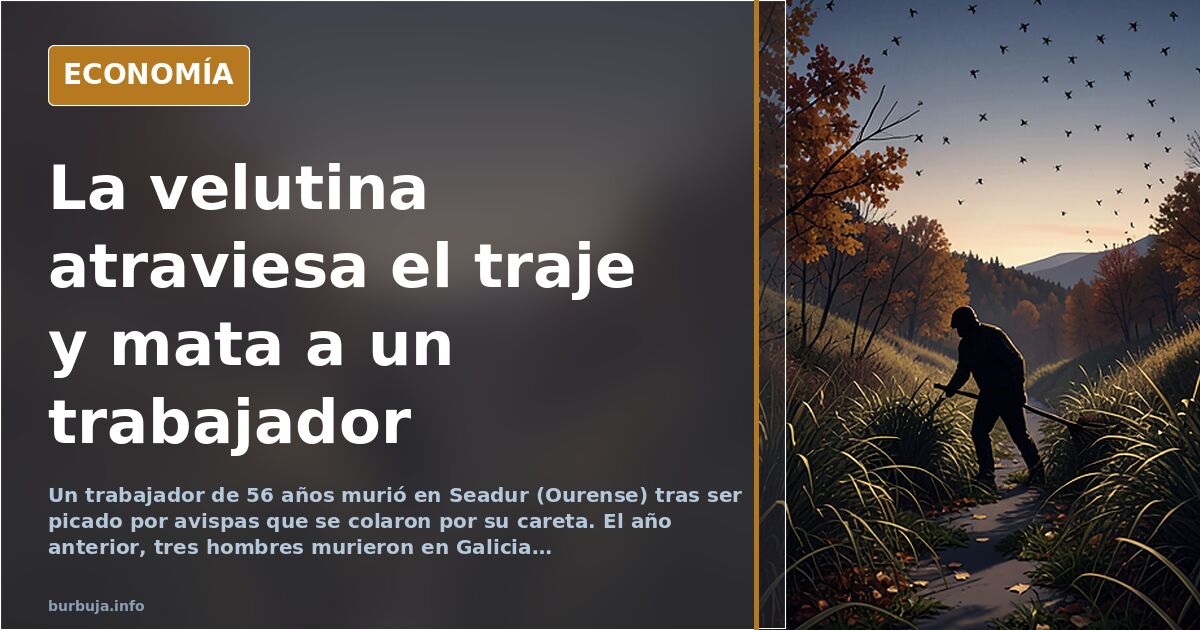
56-year-old brush cutter dies after wasp stings in Seadur
A 56-year-old man, originally from Pontevedra and living in Manzaneda, died this Wednesday, October 21, while clearing brush along a forest track in Seadur, in the Valdeorras region (Ourense). He was taking part in an employment training programme. The wasps got past his protective suit, entered through his face shield and attacked his face and neck. His colleagues called 061, the Spanish emergency number.
The incident, first reported by 20minutos, is not an isolated case. Autumn has become one of the most dangerous seasons for attacks by this invasive species: last year, in less than two weeks, three men died in Galicia from Asian hornet stings. Neither the season nor the concentration of deaths was considered normal, as the critical period used to run from June to September. The Xunta (the Galician regional government) admitted at the time to an "extraordinary increase" despite campaigns to combat the spread of nests.
Why Galicia is the region hit hardest by the Asian hornet
Galicia is the worst-affected autonomous community in Spain. The Asian hornet arrived in 2012 and adapted massively thanks to the humid, mild climate. Its presence is so disproportionate that in many Galician districts there are now more Asian hornets than native ones. The constant stream of news about the removal of thousands of nests creates the impression that this is a region unlike any other when it comes to wasp infestations.
The victim's profile adds a layer of misfortune: a trainee on an employment programme, retraining for manual work at 56, who went into the hills wearing borrowed equipment from his colleagues. The protection failed at the most vulnerable point, the face.
Do wasps sting or bite? The mistake that repeats every autumn
Confusion about the wasp's stinger is commonplace. Unlike bees, whose sting leaves the stinger embedded and kills them, wasps have a smooth stinger they can use several times. It is not a single-shot harpoon: they can strike again. And in a swarm attack, the risk multiplies because the venom accumulates.
The belief that wasps only bite and do not inject venom circulates frequently, but it is false. The real problem is not the toxicity of a single sting, but the allergic reaction and the combined effect of several. That is why the Asian hornet, larger and more aggressive than the native species, is a public health problem and not just a countryside nuisance.
The European honey buzzard, the natural predator that wipes out Asian hornets
Among the solutions being considered, one stands out for its biological elegance: the European honey buzzard. This bird of prey bases 90% of its diet on the larvae, pupae and adults of social insects, and is adapted to withstand attacks from bees and wasps. Not through chemical immunity, but through a natural physical armour that blocks stingers.
Some argue that its breeding should be encouraged as a control method, and individuals have been seen tearing half a nest apart and eating the larvae without flinching at the stings.
The losing battle: spraying, stomping and official inaction
The account of those who live alongside them is bleak. Spraying with conventional insecticide barely affects them; stomping on them requires real force, as many survive the first stomp. And nests appear where you least expect them: under the roof, in a mailbox, in a wall cavity. Anyone going to drill nearby or collect a letter finds the whole family pouring out in a swarm.
Complaints about the management cut across the board: town councils and civil protection wash their hands of it, and the feeling that the situation is getting worse every year has taken hold in the countryside. Some see political interests in not tackling the problem; others, sheer incompetence. What is certain is that the Asian hornet keeps gaining ground and that employment programmes, work brigades and private individuals are the front line.
Given all this, the question is not whether there will be another death, but when. The authorities have the data, the campaigns and the budget. What they do not have, for now, is a result.
Summary of a discussion on Burbuja.info - Foro de economía, actualidad y política., translated from Spanish and reviewed before publication. Read the full discussion (200 replies).
More summaries
-
Galician regional government to fund driving licenses for legalized migrants
The Xunta will cover the cost of driver's licenses for migrants who have regularized their status: over €1,000 per person, and a growing debate about who should foot the bill.
-
Cantabrian Coast: From €1M in Basque Country to €45k in Galicia
Basque coastal homes exceed €1 million, while Galicia offers apartments with garages from €45,000. Here is the price hierarchy along Spain's northern coast.
-
Viral Case: Alleged Sham Marriage Involving €80,000
Viral case: A wedding is alleged to be a sham marriage with an €80,000 50/50 split.
-
Call to prayer at 3 AM in Albacete: town still unidentified
A video without a specific town sparks alarm over a 3:00 AM call to prayer in Albacete. The timing doesn't add up and the controversy gets tangled between hoax, noise and…
-
Colau blames Barcelona riots on police and far right
Ada Colau blames the Barcelona looting on the police and the far right, while her housing record and the official narrative are being called into question.
-
Peak Oil by stealth: the thesis that explains 2020 and 2022
Demand fell by 8.5 million barrels per day in 2020 and prices collapsed. The managed Peak Oil hypothesis explains why.